Imaginary interview with Sor Juana Inés de la Cruz
by Charactorium · Sor Juana Inés de la Cruz (1651 — 1695) · Literature · 5 min read
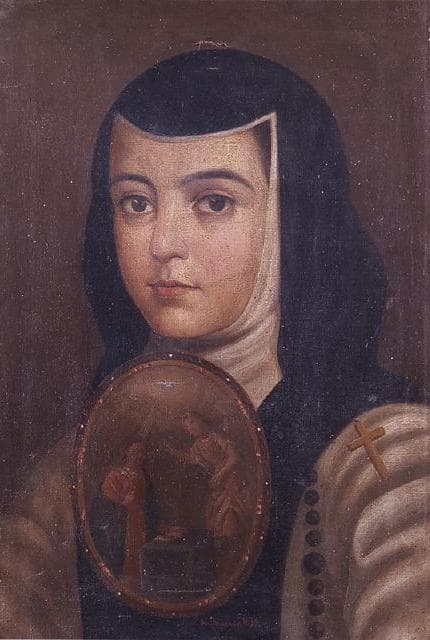
Mexico City, summer 1690. In a cell of the convent of San Jerónimo where four thousand volumes pile up, the air smells of ink, wax, and cold chocolate. A nun in a white veil sets down her quill to answer our questions, between two offices.
—How did a little girl from the village of Nepantla learn to read in an era that did not expect it of women?
At San Miguel Nepantla, I was not yet three when I followed my older sister to the ladies' school. But it was in my grandfather's library that everything happened: I would sneak down there, like stealing forbidden fruit, and devour the leather-bound volumes one by one. I learned Latin in about twenty lessons, then tackled Greek and the Nahuatl of our land. I would cut my hair to punish myself when I did not advance fast enough in my studies: it did not seem right to me that a head should be adorned with hair and empty of knowledge. The hunger to know came to me before hunger itself.
It did not seem right to me that a head should be adorned with hair and empty of knowledge.
—Why this need to learn in secret, rather than in the open?
Because the open was not meant for us. A girl in New Spain either married or took the veil; study did not fit either path. I had begged my mother to dress me as a boy so I could enter the University of Mexico — she laughed, and I understood that my only university would be the silence of a library. So I read by whatever light remained, I hid my parchments, I learned astronomy in the margins of theology books. I was often reproached for this curiosity as if it were a vice. Yet I never knew how to study except by loving, and one commands the mind no more than the heart.
My only university would be the silence of a library.
—It is said that at the viceroy's court, forty scholars subjected you to a public examination. Do you remember it?
How could I forget? The viceroy, having heard of this nun who was considered a prodigy, wanted to get to the bottom of it. He summoned to the Palace of the Viceroy some forty learned men — theologians, mathematicians, poets, jurists — to ply me with questions, each in his own discipline. I had only my habit and my memory. I was told afterward that I had responded like a royal galleon assailed by a few fishing boats: without sinking. I do not know if the comparison is fair, but I know that that day my name spread throughout New Spain. Glory is a strange currency: you receive it for what you are, and often pay for it with what you love.
You receive it for what you are, and often pay for it with what you love.
—What did this patronage from the viceregal court bring you, and cost you?
It gave me protectors, and a little breathing room. The viceroys liked verse, and I composed for their festivities: that Neptuno Alegórico of 1680, a triumphal arch full of allegories, erected to welcome the new viceroy upon his entry into the city. I was commissioned villancicos for the cathedral, comedies for the palace like Los Empeños de una casa. This earned me books, paper, ink — and a certain freedom that my cell alone could never have bought me. But the favor of the great is a thatched roof: as long as it rains gently, it shelters; when the storm of the Church comes, nothing remains on your head.
—Describe your cell at the convent of San Jerónimo. What are your writing days like?
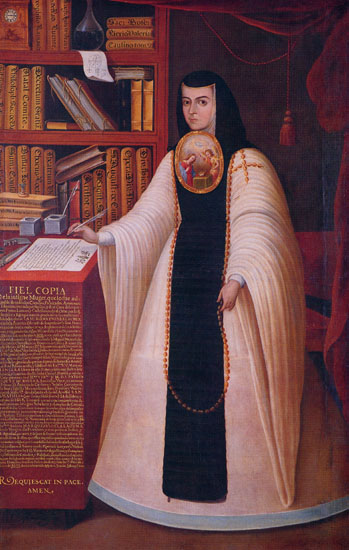
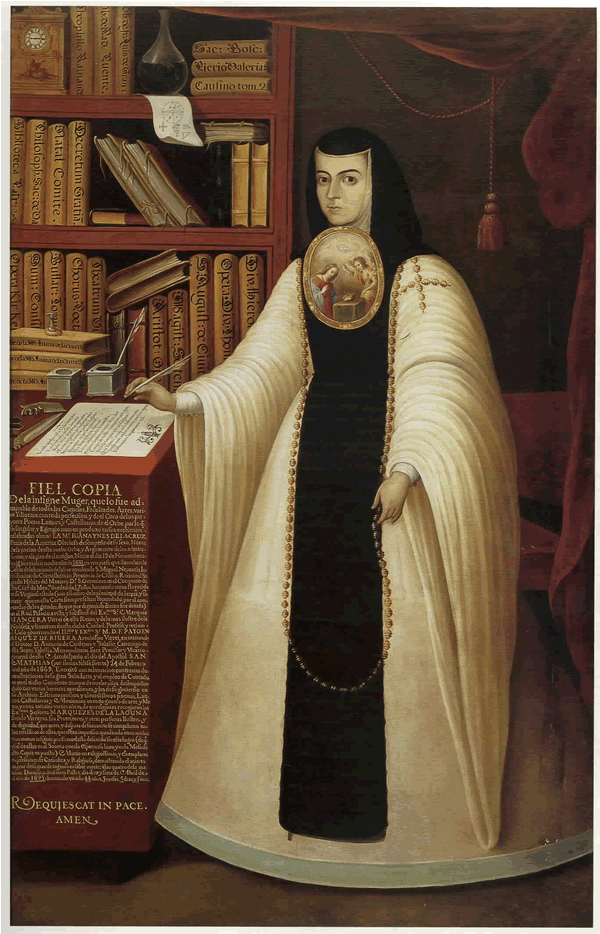
My cell is not a cell: it is a study room that prayer passes through. I have gathered there more than four thousand volumes, musical instruments, maps, some mathematical curiosities. Before dawn, the offices; a little bread and chocolate in the refectory; then the afternoon is mine. I dip my quill into the ceramic inkwell and write until vespers. That is how my Primero Sueño was born, more than nine hundred verses in which the soul, during the body's sleep, undertakes its flight through the spheres of knowledge to contemplate the order of creation. I wrote it for myself alone, without being commissioned — perhaps the only work I have done out of pure pleasure in understanding.
My cell is not a cell: it is a study room that prayer passes through.
—Why did you choose the convent, rather than marriage, to lead this life of the mind?
Because the convent was the least bad of prisons. I had, I admit, no inclination for marriage; and since I had to live somewhere, I judged that the cloister of the Jeronymites, in 1668, would at least leave me a cell, hours to myself, and the right to own books. I took the white habit and scapular knowing what I sacrificed and what I gained. The rule weighs, certainly: the offices break up the day, the community demands its due. But within the walls of a convent a woman could study without being forcibly married to a man or to ignorance. I preferred to obey a rule rather than a husband.
—Your quatrains against men caused a scandal. What did you want to say to them?
I wanted to hold up a mirror to them. In my redondillas, I wrote: 'Hombres necios que acusáis a la mujer sin razón, sin ver que sois la ocasión de lo mismo que culpáis' — foolish men who accuse women without reason, not seeing that you are the occasion of the very thing you blame. You want us virtuous and court us for our downfall; you despise us ignorant and forbid us knowledge. That accounting revolts me. I did not write these verses in cold anger, but as a logician: if you hold both ends of the chain, stop pretending that the woman alone forges it.
You want us virtuous and court us for our downfall.
—How do you justify, to churchmen, your right to study?
By the truth, uncomfortable as it may be. In my Respuesta a sor Filotea, I confessed without hesitation: 'I have fallen into the labyrinth of these worldly studies, and I cannot withdraw from it', even knowing that I must account for it to God. But I also reminded them that if Aristotle had cooked, he would have written much more — for one philosophizes even in the pot, and nature nowhere forbids a woman to think. How can one understand Saint Jerome without grammar, logic, history? Secular knowledge is the staircase to sacred knowledge. To forbid me the ascent is to wish me blind at the very foot of the altar.
Secular knowledge is the staircase to sacred knowledge.
—Tell us about that letter, the 'Carta Atenagórica', published without your consent. What happened?
I had written, at the urgent request of a prelate, a critique of an old sermon — an exercise in theology, nothing more. It was printed without my knowledge under the name Carta Atenagórica, then the bishop of Puebla, disguising himself as Sor Filotea, publicly reprimanded me: that a nun should meddle in arguing about Scripture smacked of pride. It was to that feigned sister that I replied, in 1691, to defend my entire life of study. But from then on I had the Church on my shoulders, and the inquisitorial censorship keeps a close watch on women who reason too loudly. They did not forgive me for being right; they forgave me even less for being a woman and being right.
—You gradually turned away from writing. Is it a renunciation, or something else?
It is a surrender, I will not disguise it. The pressure became too great; my own confessor, my superiors, everything pushed me back to silence as to a virtue. I began to dispose of my library, those four thousand volumes accumulated over a lifetime — sold, given away, distributed to the poor. I signed professions of faith in my own blood. Some will say I submitted; I say I chose peace of soul over pride of spirit, even if it meant letting the quill dry in the inkwell. If, by some chance, I am still read in a century, I would like them to remember not my silence, but the questions I dared to ask before it.
They did not forgive me for being right; they forgave me even less for being a woman and being right.
Read further
This imaginary interview was generated by artificial intelligence from sources documented in Sor Juana Inés de la Cruz's profile. It dramatises what the figure might have said based on what we know about them, but does not constitute attested historical testimony. For primary sources and factual documentation, refer to the full profile.