Imaginary dialogue between Sœur Philothée de la Croix (Sor Filotea de la Cruz, pseudonyme de l'évêque de Puebla Manuel Fernández de Santa Cruz) and Sor Juana Inés de la Cruz
by Charactorium · Sor Juana Inés de la Cruz (1651 — 1695) · Literature · 5 min read
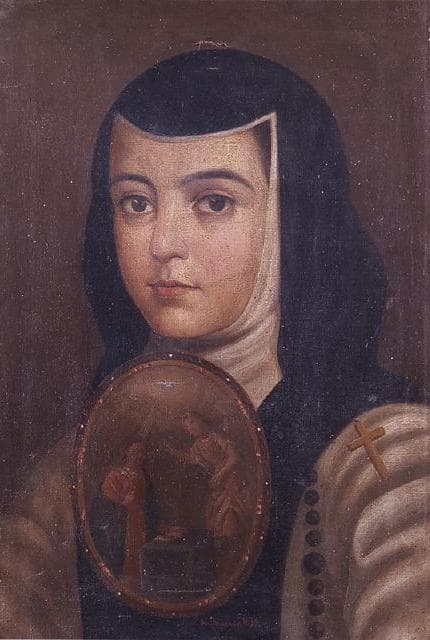
It is in the parlor of the convent of San Jerónimo, in Mexico, at the end of the year 1691, that Sister Philotea of the Cross comes to speak with Sor Juana. The light falls on a cell cluttered with bound volumes, and the smell of fresh ink still lingers near the writing desk. A few months earlier, the prelate had printed the Carta Atenagórica without her consent, then urged her to abandon secular letters. Sor Juana has just finished her Respuesta — and receives her correspondent with a deference through which firmness shows.
—My sister, in the letter you send me, you mention a studious childhood. How could such a little girl learn to read on her own?
You touch there, Sister Philotea, on my first sin of curiosity. I was barely three years old when I followed my older sister to school on a false pretext, and the teacher taught me without telling my mother. Later, I hid in my grandfather's library in Nepantla, among books that no one thought to forbid me — because no one imagined a girl would open them. I devoured Latin in a few lessons, depriving myself of cheese because it was said to harm the mind. You see: this hunger did not come from late pride, but from a nature I could never restrain.
This hunger did not come from late pride, but from a nature I could never restrain.
—Many are surprised that a woman of your intellect chose the veil. Why the cloister rather than the world, my child?
I will answer you plainly, since you yourself wear the habit. I had no appetite for marriage, and I knew few paths that allowed a woman the freedom to study. The convent of the Jerónimas was that refuge: here, in 1668, I was able to turn my cell into a library, and I gathered more than four thousand volumes. People think me secluded; I feel freer within these walls than I ever would have in any salon. The rule constrains me, certainly, but it also protects me from the thousand obstacles a household would have placed against my studies.
I feel freer within these walls than I ever would have in any salon.
—It is said that before the veil, at the viceroy's court, forty scholars questioned you. Did that examination weigh on you?
Ah, Sister Philotea, that day remains strange in my memory. The viceroy had gathered theologians, jurists, mathematicians, and poets to test me, as one tests a galleon in a storm. I answered each according to his science, not out of vanity, but because the questions came to me like water seeks its slope. Many felt admiration; others, I am sure, saw only an indecent prodigy in a young girl. It was from this patronage that my commissioned works were born, such as the Neptuno Alegórico for the viceroy's entry in 1680. The court gives much, but it watches the one who knows more than it loves her.
The questions came to me like water seeks its slope.
—Let us come to what presses me: I urged you, under my pen name, to more restraint. Why this long Respuesta in return?
Forgive my frankness, you who wrote to me with such apparent benevolence. You had my critique printed without my consent, then advised me to lower my eyes toward divine things. But how can I renounce understanding, when understanding is the very path God has opened for me? In my Respuesta a sor Filotea, I do not claim a privilege: I recall that so many holy women have taught, and that to deny knowledge to women is to deny them half their soul. I have said it elsewhere in verse against unreasonable men who accuse women without seeing that they themselves are the occasion of the evil they reproach. My defense is not rebellion: it is the avowal of a conscience.
How can I renounce understanding, when understanding is the very path God has opened for me?
—Do you not fear, my sister, that these bold writings will draw upon you the censorship of the Inquisition and the displeasure of the archbishop?
I fear it, Sister Philotea, and I do not hide it. You know better than anyone how much the Carta Atenagórica has already stirred up storms, and how much the archbishop of Mexico holds a woman's pen in suspicion. I am reproached for commenting on theology as if intelligence had a sex. Yet I have never written against the faith, only against the idea that study would betray it. If I am forced into silence, I will bow in obedience, for my profession demands it. But no one will take from me what I have already learned, nor this certainty that an intelligence stifled never falls entirely silent within.
I am reproached for commenting on theology as if intelligence had a sex.
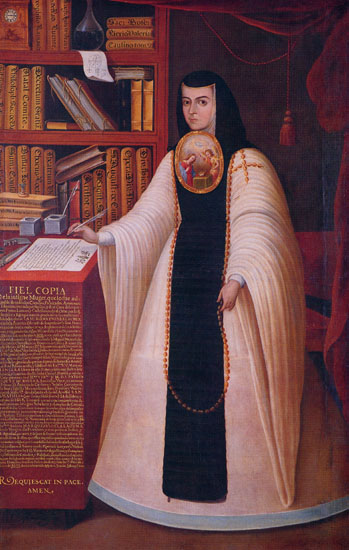
—Let us speak of your verses. In your great dream poem, the soul takes flight at night. What did you seek to say through this image?
You have read my Primero Sueño with attention, and I am touched. I wanted to depict the soul that, while the body sleeps, undertakes its nocturnal flight through the spheres of knowledge to contemplate the order of creation. It is the adventure of the understanding that rises, fails, begins again — because human knowledge grasps the universe only in fragments. I wrote this poem for myself alone, without commission or dedication, which I have done only once. The style is baroque, laden with allegories and conceptisms, but beneath the ornament there is a bare question: how high can the mind ascend before the light of day calls it back to its measure?
Beneath the ornament there is a bare question: how high can the mind ascend?
—Describe your days in this convent, my sister. How do you reconcile the rule with this ardor for study you confess?
My days follow the bell, Sister Philotea, as befits any nun. I rise before dawn for the offices, take a frugal meal of bread and chocolate, and listen to edifying readings in the refectory. But the afternoon belongs a little to me: in my cell, I compose, I answer letters from scholars who seek me out, I read among my volumes. In the evening, vespers bring me back to the community before the great silence. Believe me, I did not choose this discipline to flee study, but to save it from the distractions of the century. Even my duties as the convent's steward teach me: I have observed that a well-run kitchen contains more philosophy than one might think.
I did not choose this discipline to flee study, but to save it from the distractions of the century.
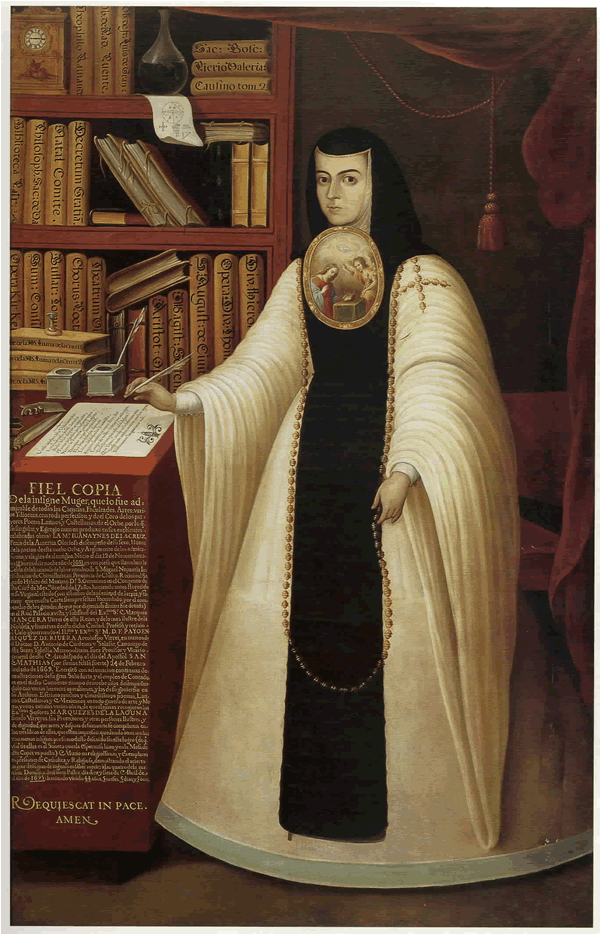
—As a child, you already spoke Nahuatl as much as Latin, they say. Do these languages of the New World still nourish your pen?
They nourish it more than my censors would wish. I grew up among the Indian voices of the fields, and Nahuatl is no more foreign to me than the Latin of my books. When I compose villancicos for the cathedral, I sometimes mix these languages and the rhythms of the Blacks and Indians of this land, for the praise of God rises as well from the humble as from the learned. This New Spain is not a pale copy of the mother country: it has its own language, its songs, its genius. I believe a mind is never impoverished by hearing many voices; it is impoverished by wanting to hear only one.
A mind is never impoverished by hearing many voices; it is impoverished by wanting to hear only one.
—Your art is called baroque, full of wordplay and surprising images. Does this style not lead the reader away from meaning?
That is a reproach I often hear, and I want to answer you. Conceptism and abundance are not, for me, gratuitous ornament: they are the very form of a thought that folds and unfolds. An idea said too quickly slips away without leaving a trace; an image that surprises forces the mind to stop, to dig. When I multiply contrasts, it is so that the reader feels the difficulty of understanding, which is the true subject of almost everything I write. The baroque is not a veil thrown over meaning: it is the honest admission that truth is never given all at once, and that to reach it, one must accept the labyrinth.
The baroque is not a veil thrown over meaning: it is the admission that truth is never given all at once.
—One last question, my sister. If you were ordered tomorrow to renounce all writing, would you submit willingly?
You press me where I am most tender, Sister Philotea. If obedience requires it, I will give up my books and my pen, for I did not take the veil to disobey. But do not think it costs me little: it is asking me to dry up a spring that gushes despite myself. I confess I have fallen into the labyrinth of these worldly studies, and I do not know if I would have the strength to withdraw entirely. Perhaps I will renounce profane verses; I will not renounce thinking, for no vow has ever been able to forbid that. And you, who wrote to me as a friend, know well that a lamp is not extinguished by hiding it under a bushel.
Perhaps I will renounce profane verses; I will not renounce thinking.
Read further
This imaginary interview was generated by artificial intelligence from sources documented in Sor Juana Inés de la Cruz's profile. It dramatises what the figure might have said based on what we know about them, but does not constitute attested historical testimony. For primary sources and factual documentation, refer to the full profile.