Kids interview Sor Juana Inés de la Cruz
by Charactorium · Sor Juana Inés de la Cruz (1651 — 1695) · Literature · 5 min read
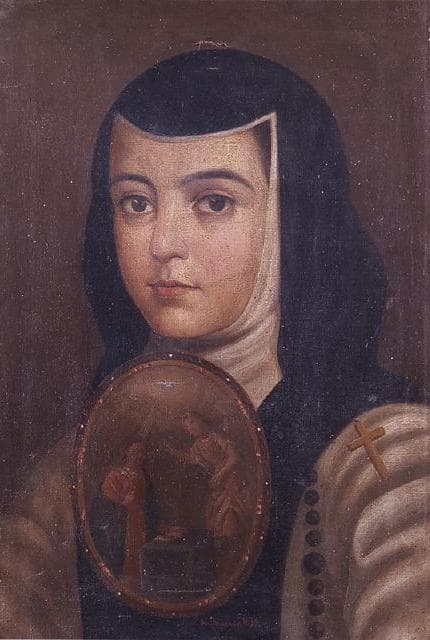
Two 12-year-old students visit an old convent in Mexico with their class. In a cell filled with books, a nun with a lively gaze awaits them. It's Sor Juana, and she loves being asked questions.
—Is it true you learned to read all by yourself, in secret?
Yes, my child! In my time, they didn't send little girls to school. But my older sister did have lessons. So I would hide to listen to the teacher, then sneak into my grandfather's library at San Miguel Nepantla. Imagine a dark room, smelling of leather and paper, with dozens of bound books. It was my secret treasure. I devoured everything. They told me cheese made you stupid, so I stopped eating it to learn better! You see, I was already stubborn. Reading was stronger than anything.
They told me cheese made you stupid: I stopped eating it to learn better.
—And is it true you spoke many languages before age ten?
Latin, especially. You know, in my time, all true scholars wrote in Latin, like a secret language of educated people. I wanted to be part of that. So I asked for lessons, and I promised to cut my hair if I didn't learn fast enough! When my hair grew back and my head was still empty of knowledge, I cut it again. A head full of curls but empty of learning didn't please me. I also learned some Nahuatl, the language spoken around me in Mexico. Learning was my greatest joy.
A head full of curls but empty of knowledge didn't please me.
—Why did you become a nun if you just wanted to study?
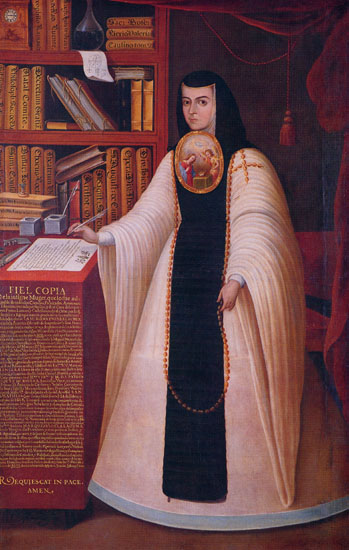
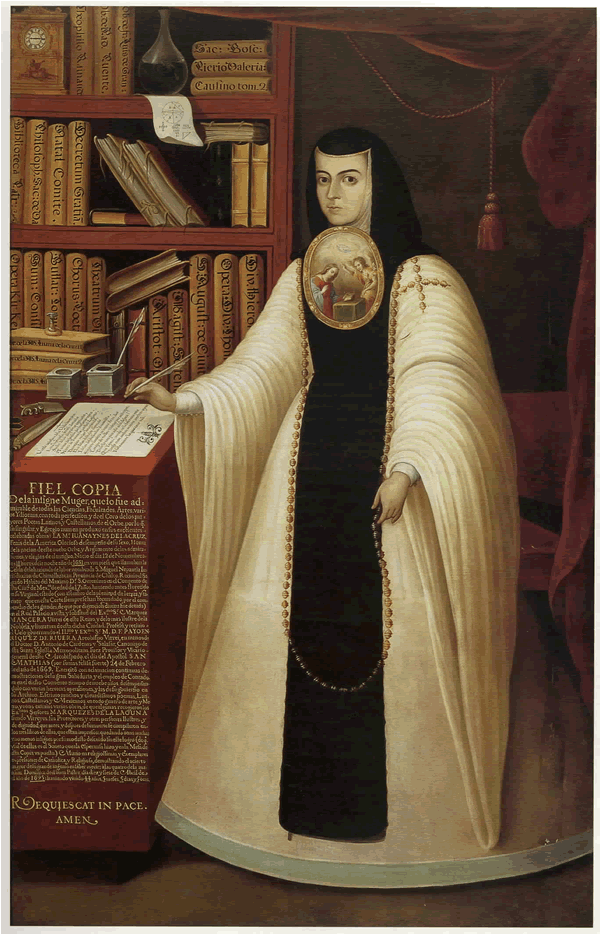
Good question, you've understood everything. I didn't really dream of prayers from morning till night. But look at my time: a woman had two paths. Marry and keep a house... or enter a convent. Marriage meant abandoning my books. So in 1668, I entered the Jerónimas sisters in Mexico City. It was one of the few places where a woman could read, write, think, without being prevented. I turned my cell into a library, with thousands of volumes. Imagine a small room lined with books up to the ceiling. It was my own kingdom.
The convent was not my vocation: it was the only door to my books.
—What was your daily life like at the convent?
It began before sunrise, my child. Bell, mass, prayers: the life of a nun is very regulated. In the early morning, I had a simple meal, bread, sometimes chocolate — a great luxury among us! I wore the white habit of the Hieronymites, with a veil over my hair. But the real happiness came in the afternoon: alone in my cell, I composed poems, plays, answered letters from learned people. In the evening, vespers, then a bit more reading by candlelight before the great silence. Writing between bells was my way of breathing.
Writing between bells was my way of breathing.
—It's said that forty scholars examined you. How did that happen?
Ah, that famous day! I was young, living then at the viceroy's palace of New Spain. The viceroy is the man who governed Mexico in the name of the King of Spain. To see if my reputation was deserved, he summoned about forty scholars: theologians, mathematicians, poets. Imagine a large hall, and each in turn asks me a difficult question. I stood and answered them all. They said I was like a great royal ship repelling the assault of little boats. My heart was pounding, believe me. But I held firm.
Forty scholars questioned me: I answered them all, heart pounding.
—Did you also write poems for important people?
Yes, that was part of my job as a court poet. When a new viceroy arrived, they would build a great triumphal arch, like a giant decorated gate. In 1680, I was asked to imagine that of Mexico City: it became my Neptuno Alegórico. I compared the viceroy to Neptune, the god of the sea in old legends. You see, in my time, showing you knew the ancient gods was proof of great learning. It was a commission, paid work. But even then, I slipped in my ideas. A poetess always finds a corner to say what she really thinks.
Even in commissioned work, a poetess slips in what she really thinks.
—Is it true you wrote a poem to defend women?
Yes, and that one is still recited! It begins: Hombres necios que acusáis a la mujer sin razón — "Foolish men who accuse women without reason." I told them a very simple thing, my child: men reproach women for their faults, but often they are the ones who push them to it. It's like someone who dirties a mirror, then complains the reflection is dirty. In my time, writing that was audacious. A woman was not supposed to teach men a lesson. I did it, in verse, so that it would be remembered.
They dirty the mirror, then complain the reflection is dirty.
—Why was it so serious for a woman to want to study in your time?
Because they thought knowledge was not meant for us. A woman had to obey, pray, keep her house, not ponder great questions. When I was reproached for my passion for study, I wrote a long letter, the Respuesta a sor Filotea, in 1691. I confessed that I had fallen into the labyrinth of these studies and could no longer get out. But above all I defended an idea: if God gave me a curious mind, why would it be a sin to use it? I wanted girls to be allowed to learn. That was my true battle.
If God gave me a curious mind, why would it be a sin to use it?
—Did you get into trouble because of your writings?
Yes, and it caused me great pain. One day, a text where I criticized a famous priest's sermon was published without my permission, under the title Carta Atenagórica. Then the archbishop of Mexico reprimanded me publicly: a nun should not discuss theology, he said. Theology is the study of things of God, a domain reserved for churchmen. Imagine being told, in front of everyone, that your greatest talent is actually a fault. It breaks the heart. I had to defend myself alone, with my pen as my only weapon.
I was told in public that my greatest talent was a fault.
—And in the end, did you really stop writing?
Yes, my child. Under pressure from the Church, toward the end of my life, I gradually set down my pen. I even sold part of my precious books to help the poor. Many believed I fell silent for good. In 1695, an epidemic struck my convent; I nursed my sick sisters, and the disease took me. But do you know? My poems kept traveling, to Spain and beyond. I am still read today. That is my little revenge. Words truly written cannot be silenced forever.
Words truly written cannot be silenced forever.
Read further
This imaginary interview was generated by artificial intelligence from sources documented in Sor Juana Inés de la Cruz's profile. It dramatises what the figure might have said based on what we know about them, but does not constitute attested historical testimony. For primary sources and factual documentation, refer to the full profile.