Imaginary interview with Stendhal
by Charactorium · Stendhal (1783 — 1842) · Literature · 6 min read
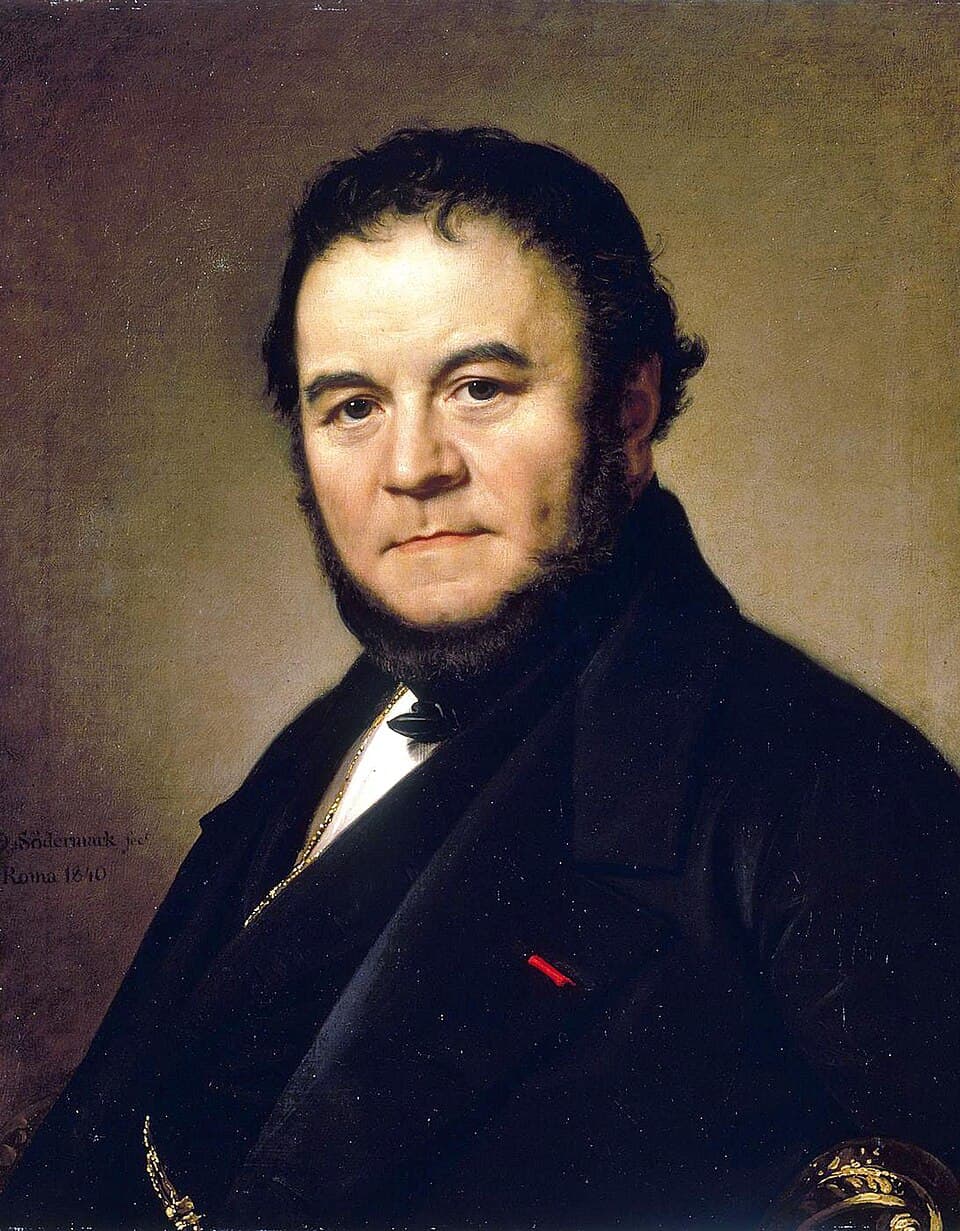
Civitavecchia, an evening in 1836. The French consul receives in an office cluttered with crossed-out manuscripts, the window open onto the port and the smell of salt. Henri Beyle, whom they call Stendhal ever since he liked the name of a German town, speaks quickly, his eye sharp behind his lorgnette, as if he were always afraid of being bored.
—You are called Stendhal, but that is not the name on your baptismal record. How do you explain this taste for masks?
In the registers of Grenoble, in 1783, they wrote Henri Beyle, son of magistrates I did not much care for. The rest I chose myself, and more than two hundred times! I signed letters, articles, drafts under assumed names until I lost myself in delight. Stendhal is a small German town whose sound pleased me one day, that's all — no genealogy, no coat of arms, just my whim. A man who changes his name like his coat escapes a little from the society that would pin him down. And besides, believe me, when you have spent your childhood fleeing a father, you acquire a taste for being nowhere the person they expect.
A man who changes his name like his coat escapes a little from the society that would pin him down.
—You kept a diary all your life and undertook the story of your youth. What were you seeking in it?
I have been scratching in my notebooks since the age when others play cards. In the evening, returning from salons, I note what I felt, not what I did — the nuance is my whole method. In the Vie de Henry Brulard, which I have shown to no one, I try to go back to the little Beyle of Grenoble, to find the exact moment when sensibility came to me. It is the work of an anatomist bent over himself. I believe one knows oneself only on condition of writing quickly, without beautifying, letting the pen outpace vanity. Most memoirs lie out of elegance; I prefer to show myself mediocre and true. If I am to be read one day, let it be for that frankness.
—For Le Rouge et le Noir, they say you started from a real news item. What had it taught you?
In 1829, the newspapers reported the trial of a young man from the Franche-Comté, Antoine Berthet, a tutor who rose too high and ended with his head on the scaffold for a pistol shot fired in a church. I read that as one reads a poem: everything was there — the ambition of a commoner, passion, the fall. Julien Sorel was born from that mud. I could not invent better than what provincial life served up raw. I like to paint a young man “whose physiognomy betokened subtlety and intelligence” — the energy of a being who wants to tear himself away from his condition, and whom society crushes for having dared. The novelist is but a mirror carried along a path; still, he must carry it where the blood flows.
I could not invent better than what provincial life served up raw.
—Why insist that the provinces, not Paris, be the stage for this ambition?
Because it is in the provinces that one suffocates best, and suffocation breeds great ambitions. Besançon, its seminary, its gray walls: that is the setting where a Julien learns to conceal his flame under the cassock. In Paris, ambition dissolves in the noise of salons; in the provinces, it concentrates like gunpowder. I have known those sleepy towns where the slightest passion is a scandal, where one watches one's neighbor through the slats of shutters. That is where the psychological novel finds its material: an immense heart enclosed in a tiny horizon. My Parisian readers find that provincial; they do not understand that it is precisely there that the drama of a whole era plays out.
—You lived several years in Milan. What were you seeking in that Italy?
I landed in Milan around 1814, and I thought I was reborn. France weighed on me with its proprieties; Italy, on the other hand, does not blush at its passions. In the evening, at La Scala, opera moved me to tears — an air by Cimarosa was worth all philosophies to me. There, people love without calculation, hate frankly, live. I spent seven years breathing that air, and it infused everything I have written since. When much later I composed La Chartreuse de Parme, it was that Italy of my youth that I painted, its little courts, its imprudent loves, its sky. They say I dictated it in fifty-three days; it is because I had only to remember.
France weighed on me with its proprieties; Italy, on the other hand, does not blush at its passions.
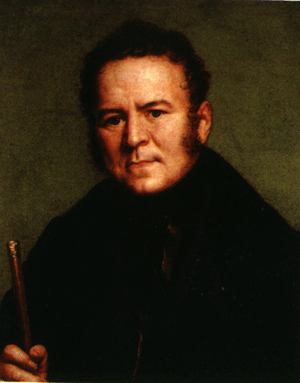
—And yet here you are consul in Civitavecchia, that modest port. How do you live this exile?
In 1831 they gave me this consulate as one throws a bone, after I had hoped for better. Civitavecchia is only a dusty port, without theater, without wit, where I die of boredom between two administrative dispatches. But you see, boredom is an excellent secretary: it sends me back to my manuscripts. I escape to Rome as soon as I can, I reread, I cross out, I dream. This Italy that disappoints me as a civil servant consoles me as a writer. A mediocre post has never prevented a thought from being lofty; I would even say that disgrace has its merits, it rids you of importunate people. I write here more freely than in Paris, where every salon demanded its tribute of pleasant words.
—In De l'Amour, you propose a singular theory, that of crystallization. What is it about?
Imagine throwing a stripped tree branch into the salt mines of Salzburg. You pull it out two months later covered in sparkling diamonds: the bare branch has disappeared under the crystal. That is what the mind does to the beloved. We adorn them with perfections they do not have, we cover them with our own light. In De l'Amour, in 1822, I wanted to be the anatomist of that secret operation, to describe step by step how a passion is born as one would describe the circulation of blood. For me, love is “the involuntary admiration that the sight of certain perfections in another forces upon us.” I have been reproached for dissecting what one prefers to feel; but understanding a feeling has never killed it — it has made it deeper.
The bare branch disappears under the crystal: that is what the mind does to the beloved.
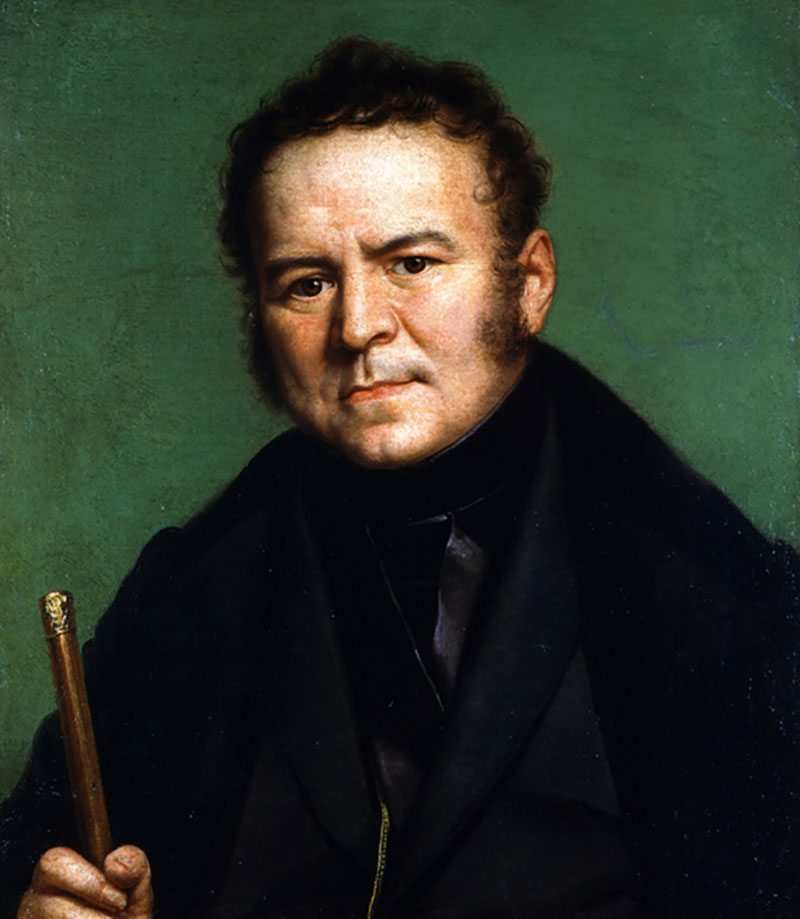
—You speak of dissecting passions. Is that not a strange ambition for a novelist?
It is the only one that matters to me. Other writers tell what people do; I want to grasp the precise moment when one decides to do it, that inner quiver where the soul leans. With my pen, bent over my notebooks, I track the movements of the heart as a naturalist pins an insect. The society of the 19th century thinks itself reasonable, calculating, bourgeois; under the black coat, I see the same passions boiling as among the ancients. My business is to lift the coat. I do not write for today's readers, who want to be flattered, but for those of 1880 or even further — that happy few who will love the truth of a heart more than a well-turned plot.
—You followed the armies of the Empire. What remains in you of those war years?
I wore the uniform, I served in the quartermaster corps, and in 1812 I saw what no one should see: the retreat from Russia, men frozen standing, the Grande Armée melting like dirty snow. In 1814, I was still in military affairs when everything collapsed and the Bourbons returned in their dusty carriages. People think war is made of grand phrases; I saw it made of mud, fatigue, and absurd courage. That cured me of theatrical heroism. When I paint a battle — Waterloo seen by a young man who understands nothing of it — I do not lie: one never sees the battle, one sees one's little corner of smoke. The epic exists only in bulletins; on the ground, there are only lost men.
One never sees the battle, one sees one's little corner of smoke.
—Did this experience change your view of ambition, that driving force of your characters?
Deeply. I was twenty, I believed that a man of talent rose straight to glory, like Bonaparte from the 18 Brumaire to the crown. Then I saw the star fall, and with it all our hopes as children nourished on battles. Ambition remains the great spring of my Juliens, my Fabricios — but I now paint it lucid, almost bitter, for I know where it leads. Under the Restoration, one no longer climbs with a drawn saber, but through hypocrisy and flattery; the red of the uniform has given way to the black of the cassock. My own fate is proof: so many efforts to end up consul in a forgotten port. The energy of a soul no longer finds its use in this century of shopkeepers; it wears itself out, or it rebels.
This imaginary interview was generated by artificial intelligence from sources documented in Stendhal's profile. It dramatises what the figure might have said based on what we know about them, but does not constitute attested historical testimony. For primary sources and factual documentation, refer to the full profile.