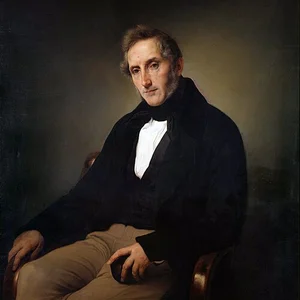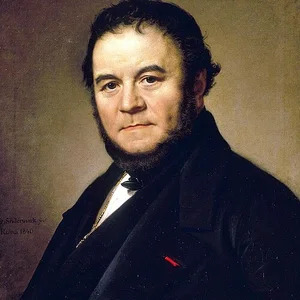

A French writer of the 19th century, Stendhal is the author of the psychological novel The Red and the Black (1830). Known for his sharp analysis of human passions and his direct style, he left a lasting mark on French literature by exploring themes of ambition, passion, and social criticism.
Stendhal(1783 — 1842)
Stendhal
France
8 min read
Frequently asked questions
Famous Quotes
« Beauty is a promise of happiness»
« One can only give love when one has plenty of it»
Key Facts
- 1783: Born in Grenoble on January 23 under the name Marie-Henri Beyle
- 1830: Publication of The Red and the Black, his masterpiece
- 1839: Publication of The Charterhouse of Parma, his second major novel
- 1842: Died in Paris on March 23 at the age of 58
- Parallel diplomatic career as a consul in several countries
Works & Achievements
A major psychological novel exploring the ambition and passion of a young man in post-Napoleonic society. A masterpiece of French realism that offers a sharp analysis of human motivation and social critique.
An adventure and love story set in Italy, blending romantic intrigue with deep psychological analysis. Considered one of the greatest literary achievements of the 19th century.
A theoretical essay on the psychological mechanisms of love, introducing the famous theory of crystallization. A foundational work in the psychology of human emotion.
Stendhal's first novel, exploring passion and family secrets within the French aristocracy. A precursor to his characteristic psychological style.
An unfinished novel depicting the life of a young man navigating politics, love, and career. An important work for understanding the development of Stendhal's thought.
A travel account through France combining realistic observations with philosophical reflections. A unique testimony to France during the Restoration period.
An intimate autobiography tracing Stendhal's childhood and youth. A key work for understanding the formation of his literary thought.
Anecdotes
Stendhal's real name was Henri Beyle, and he adopted over 200 pseudonyms throughout his life! The pen name 'Stendhal' comes from a small German town he was particularly fond of. This habit reflected his love of mystery and his desire for freedom from the society of his time.
In 1814, Stendhal took part in the military campaign against Napoleon as a supply officer. This firsthand experience of war and historical upheaval deeply influenced his writing and his vision of human ambition — themes he would later explore in The Red and the Black.
Stendhal spent several years in Italy, including Milan from 1814 to 1821, where he developed a passion for Italian culture and opera. This Italian period nourished his works and his reflections on sensitivity, art, and human passions, which he saw as essential to understanding the human soul.
To write The Red and the Black, Stendhal drew inspiration from a real-life case: the trial and execution of a young man from high society, Antoine Berthet, who was sentenced to death in 1829. This grounding in real events reveals his commitment to observing contemporary life rather than retreating into pure imagination.
Stendhal was appointed French consul in Civitavecchia, Italy, in 1831 — a less prestigious post than he had hoped for. Despite this professional disappointment, he continued to write and reflect on the human condition, proving that adversity could fuel his literary creativity.
Primary Sources
I propose to paint a young man of nineteen, of ordinary appearance, but whose expression suggested shrewdness and intelligence. His gaze was lively and penetrating; his conversation was brilliant, but full of affectation.
Fabrice saw life in a singular way. He was passionately preoccupied with the question of whether he should become a priest or not. This question was, for him, of capital importance.
Love is the involuntary admiration that we are compelled to feel at the sight of certain perfections in the person who pleases us. It is a state in which one finds pleasure in giving the greatest pleasure to another being.
I observed the customs of the inhabitants with particular attention. What struck me most was the contrast between the beauty of the landscapes and the mediocrity of the political institutions.
True passion is that which sacrifices everything to its object. Happy is the one who has known such a passion — he has truly lived.
Key Places
Stendhal's (Henri Beyle) birthplace in 1783. The Alpine region and life in Grenoble profoundly shaped his intellectual and emotional development, particularly through his childhood memories.
The heart of Parisian life where Stendhal spent most of his adult years, observing aristocratic and bourgeois society. The capital serves as the primary backdrop for his major novels.
The Italian city where Stendhal lived and worked as French consul (1830). Italy, and Milan in particular, captivated the writer and inspired his love of Latin passion and the Mediterranean world.
A city in the Franche-Comté region that served as the inspirational setting for The Red and the Black (1830). Its urban and provincial atmosphere influenced the creation of Stendhal's landmark psychological novel.
An Italian city beloved by Stendhal, where he spent time and drew material for several works. For him, Rome embodied the ideal of passion and beauty that he celebrated throughout his writing.
The Italian port where Stendhal served as French consul from 1831 to 1842. It was in this city that he died in 1842, far from France but in the Italy that had inspired him so deeply.
Liens externes & ressources
Références
Œuvres
Le Rouge et le Noir
1830
La Chartreuse de Parme
1839
Lucien Leuwen
1894 (publication posthume)
Mémoires d'un touriste
1838
Vie de Henry Brulard
1890 (publication posthume)