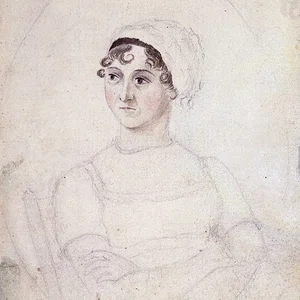

Jane Austen (1775-1817) was a major English novelist of the 19th century, author of romantic and social novels that subtly critique the social conventions of her time. Her work, most notably Pride and Prejudice, explores human relationships and the stakes of marriage with irony and psychological insight.
Jane Austen(1775 — 1817)
Jane Austen
royaume de Grande-Bretagne, Royaume-Uni de Grande-Bretagne et d'Irlande
8 min read
Frequently asked questions
Famous Quotes
« It is a truth universally acknowledged, that a single man in possession of a good fortune, must be in want of a wife.»
« There is nothing I would not do for those who are really my friends.»
« I declare after all there is no enjoyment like reading!»
Key Facts
- Born on 16 December 1775 in Steventon, Hampshire
- Anonymous publication of Pride and Prejudice in 1813, her most celebrated novel
- Author of six complete novels exploring romantic and social relationships
- Died on 18 July 1817 in Winchester, at the age of 41
- Posthumously recognised as a major figure of English literature
Works & Achievements
Jane Austen's first published novel, it contrasts two sisters with opposing temperaments: the sensible Elinor and the romantic Marianne. It examines the place of women in Georgian society and the choices imposed by the economic necessity of marriage.
Jane Austen's masterpiece, it follows Elizabeth Bennet and Mr Darcy through a relationship shaped by class prejudice and pride. It is one of the most widely read and adapted novels in world literature.
A darker novel, it explores moral questions through the heroine Fanny Price, a poor cousin raised in a wealthy family. Austen subtly addresses the issue of slavery and moral conscience.
A portrait of an imperfect and overconfident heroine, Emma Woodhouse learns humility through her errors of judgment. This novel is often considered Austen's most technically ambitious, featuring a highly controlled narrative point of view.
A parody of the Gothic novels then hugely popular, it follows the naive Catherine Morland as she discovers the realities of English society. Austen demonstrates her wit and her keen awareness of the literary fashions of her time.
Jane Austen's last completed novel, it tells the story of a second chance for Anne Elliot and Captain Wentworth, separated years earlier by social conventions. It is her most melancholic and most personal work.
Anecdotes
Jane Austen wrote her novels on small scraps of paper that she could quickly hide under a blotter whenever someone entered the room. She worked in the family sitting room and did not want her relatives to know she was writing, as writing was not considered a suitable activity for a young woman of her time.
Pride and Prejudice was first titled First Impressions and rejected by a publisher in 1797 without even being read. Jane Austen had to wait sixteen years before seeing it published, in 1813, under its final title. The novel was an immediate success and sold out within weeks.
Jane Austen published all her novels anonymously, under the byline "By a Lady". She never publicly revealed her identity as an author during her lifetime. It was her brother Henry who disclosed her name after her death in 1817.
At the age of twenty-five, Jane Austen accepted a marriage proposal from Harris Bigg-Wither, a wealthy landowner, only to withdraw her acceptance the very next morning. She chose to remain true to her convictions about love rather than marry for financial gain — a central theme of her novels.
The Prince Regent George, the future George IV, was a great admirer of Jane Austen and had his librarian convey to her that she was welcome to dedicate one of her novels to him. Little enthused by a prince she considered lacking in virtue, she nonetheless complied and dedicated Emma (1815) to her royal admirer.
Primary Sources
« I have got my own darling child from London... I must try to write of something else, and it shall be a complete change of subject – ordination. » She expresses her joy upon receiving the first copies of Pride and Prejudice.
« I am fully sensible that an Historical Romance, founded on the House of Saxe Cobourg, might be much more to the purpose of profit or popularity than such pictures of domestic life in country villages as I deal in. »
« It is a truth universally acknowledged, that a single man in possession of a good fortune, must be in want of a wife. » This ironic opening line is one of the most famous in English literature.
« What should I do with your strong, manly, spirited sketches, full of variety and glow? How could I possibly join them on to the little bit (two inches wide) of ivory on which I work with so fine a brush, as produces little effect after much labour? »
Key Places
Jane Austen's birthplace and childhood home, where she spent the first twenty-five years of her life and began writing her earliest novels. The rectory has been demolished, but the Church of St Nicholas still stands.
The house where Jane Austen lived from 1809 to 1817, the most productive period of her career. She revised and published her six major novels there; the house is today a museum, Jane Austen's House.
A fashionable spa town where Jane Austen lived from 1801 to 1806, which she enjoyed little despite its social bustle. Bath is the setting of Northanger Abbey and Persuasion, novels in which she portrayed her ambivalence towards urban life.
Jane Austen died in Winchester on 18 July 1817 and was buried in the cathedral. Her grave slab is still visible in the north aisle, and a commemorative stained-glass window is dedicated to her.
A manor house belonging to her brother Edward Austen Knight, where Jane stayed regularly. These visits allowed her to observe life in the great English country houses, the setting of several of her novels.
Typical Objects

Jane Austen wrote with a hand-cut goose quill on small sheets of paper. These modest tools were the instruments of all her literary creation, which she practised discreetly in the family drawing room.

Her small portable fold-top writing desk, now preserved at Jane Austen's House in Chawton, served as her workspace. It could be quickly closed to conceal her manuscripts from visitors.

Jane Austen played the pianoforte every morning, an instrument highly prized in middle-class English households of the time. Female musical practice was a mark of good breeding, a theme she explores throughout her novels.

Like all women of her social circle, Jane Austen regularly embroidered and sewed. These manual activities filled long family evenings and inspired her famous metaphor of 'two inches of ivory' to describe her art.

Local balls were major social events in Georgian England, and Jane Austen attended them regularly. These objects symbolise the social world she portrays with irony in her novels.

Letters were the primary means of communication between loved ones; Jane Austen wrote hundreds to her sister Cassandra. Correspondence is also a central narrative device in her novels, revealing characters and secrets.
School Curriculum
Vocabulary & Tags
Key Vocabulary
Tags
Mouvement
Daily Life
Morning
Jane Austen rose early and played the pianoforte before the rest of the family was awake, cherishing these moments of solitude. She then had breakfast with the family — tea, toast, butter — before quietly devoting herself to writing in the sitting room.
Afternoon
Afternoons were spent visiting neighbours, walking through the surrounding countryside, and attending to domestic tasks such as sewing or embroidery. Jane Austen also helped her mother manage the household and tend the kitchen garden.
Evening
Family evenings were enlivened by reading aloud, card games or backgammon, and sometimes music. When a ball was taking place nearby, the whole family would travel there by carriage; these events were the great social outings of the English countryside.
Food
The diet was that of the modest English gentry: roasted meats, vegetables from the garden, pies and puddings, local cheeses. Tea was an indispensable daily ritual, and Jane regularly mentioned in her letters the dishes served at family dinners.
Clothing
Jane Austen wore high-waisted Empire-style gowns, made of light muslin or printed cotton depending on the season. She wore bonnets outdoors, lace fichus over her shoulders, and white gloves for balls and formal visits.
Housing
Jane Austen lived in modest but comfortable homes: the rectory at Steventon, a house in Bath, then the cottage at Chawton provided by her brother. These multi-room country houses, with a drawing room, dining room, and gardens, matched the lifestyle of the minor English gentry.
Historical Timeline
Period Vocabulary
Visual Style
Le style visuel de l'univers d'Austen est celui de l'Angleterre georgienne et régence : intérieurs sobres et élégants, lumière douce, campagne verdoyante du Hampshire, costumes Empire en mousseline blanche et pastel.
Sound Ambience
L'ambiance sonore de Jane Austen mêle la douceur feutrée d'un intérieur géorgien — piano, feu de cheminée, plume sur papier — aux sons de la campagne anglaise et de la vie familiale quotidienne.
Liens externes & ressources
Références
Œuvres
Sense and Sensibility (Raison et Sentiments)
1811
Pride and Prejudice (Orgueil et Préjugés)
1813
Mansfield Park
1814
Northanger Abbey
1817 (posthume)
Persuasion
1817 (posthume)