Kids interview Stendhal
by Charactorium · Stendhal (1783 — 1842) · Literature · 5 min read
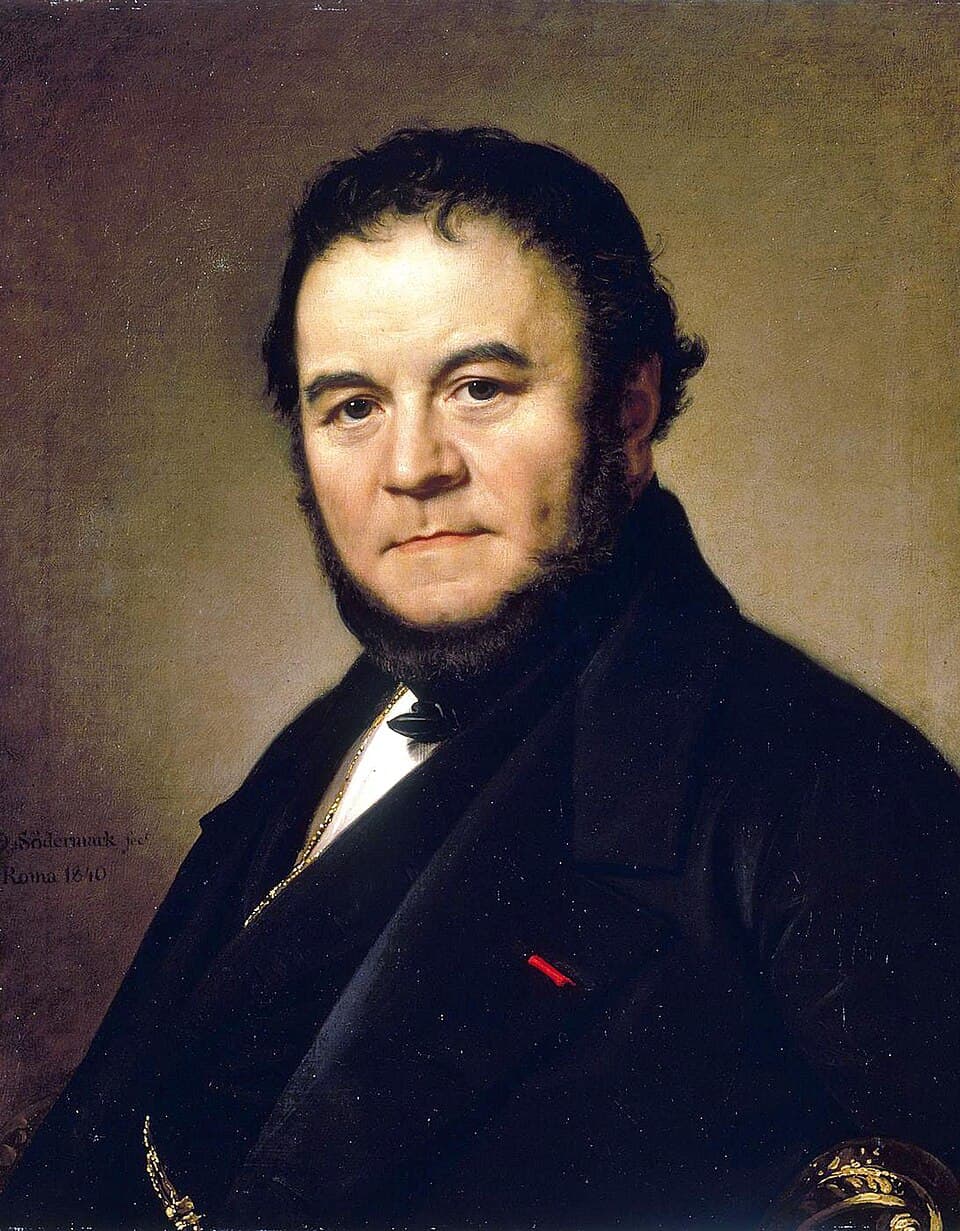
Two twelve-year-old visitors push open the door of an old Parisian apartment cluttered with manuscripts. A round gentleman with a mischievous eye sets down his pen. His name is Stendhal — well, one of his names. He beckons them closer.
—Is it true that Stendhal isn't your real name?
You've got a sharp eye, my child! My real name is Henri Beyle, born in Grenoble in 1783. But I've amused myself my whole life by changing names. Over two hundred, can you imagine? Stendhal I took from a small German town I liked. Imagine wearing a different mask every day: no one ever really knows who you are. That was my game. In my time, people were heavily watched for what they wrote. A borrowed name was like a cloak: it set you free.
A borrowed name is a cloak: it sets you free.
—Why did you write the story of your childhood?
Because as I grew older, I wanted to understand the little boy I had been. I wrote a book about it, Vie de Henry Brulard — yet another false name to talk about myself! I wondered: how did I become that man? In Grenoble, I wasn't a very happy child, you know. I already dreamed of leaving, of seeing the world. Writing my childhood was like reopening an old drawer full of dusty memories. Some made me smile, others tightened my heart. We never know ourselves as well as when we tell our own story.
We never know ourselves as well as when we tell our own story.
—Were you really a soldier before becoming a writer?
Yes! Before books, there were horses and mud. I wore the uniform of Napoleon's armies as a quartermaster officer — that is, responsible for feeding and equipping the troops. Not with a saber in hand, but with ledgers! Imagine endless roads, biting cold, thousands of men to supply. I saw up close how a great army operates, and especially how it collapses. In 1814, that entire empire I thought eternal crumbled. It taught me one thing: human glory is as fragile as glass.
Human glory is as fragile as glass.
—And after Napoleon's fall, what was France like?
Sad, my child. The kings had returned — we call it the Restauration. Suddenly, you had to bow, flatter the powerful, pretend. I, who had seen the energy of Napoleon's time, found this new society full of hypocrisy. People hid their true thoughts behind polite smiles. Imagine a grand ball where everyone dances, but no one says what they really think. That is the France I wanted to paint in my novels, without flattery. A writer must hold a mirror to his era, even when the image is not pretty.
A writer holds a mirror to his era.
—How did you come up with the idea for The Red and the Black?
Believe it or not, I found it in a newspaper! It reported the trial of a young man, Antoine Berthet, sentenced to death in 1829. A poor, ambitious boy who wanted to climb society and ruined everything. This true story seized me. I made it into Le Rouge et le Noir, published in 1830, with my hero, Julien Sorel. You see, I don't invent everything in my head: I look at life around me, the real dramas, the real passions. A well-observed news item can become a book that children will read two centuries later.
A well-observed news item can become an eternal book.
—Was Julien Sorel wicked, or just unhappy?
What a fine question! Neither, really. Julien is a poor, intelligent boy, devoured by the desire to succeed. He wants to escape his lowly condition, and to do so he learns to lie, to seduce, to hide his feelings. Is it his fault, or that of a society that closes all doors to the poor? I did not want to judge. I wanted to show his heart, with its impulses and its cowardices. Imagine someone climbing a cliff with bare hands: he could fall at any moment. Julien is the whole of human ambition, magnificent and dangerous.
—Did you write down all your feelings in a notebook?
Yes, I kept a diary almost all my life! In the evening, I noted what I had felt, observed, hoped. It was my secret laboratory. Because you see, what fascinated me above all was the human heart: why we love, why we fear, why we are jealous. I observed people like a scientist observes the stars. Then I stored it all in my notebooks. Later, these notes nourished my novels. Here, take this advice: write down what you feel, even three lines. Later, you will reread yourself and understand yourself better.
Write down what you feel: later, you will understand yourself better.
—And what is the “crystallization” you talk about in On Love?
Ah, my favorite idea! I explained it in an essay, De l'Amour, in 1822. Listen carefully. In salt mines, people sometimes toss in a simple branch. A few days later, they pull it out all covered with tiny sparkling crystals, like diamonds. Well, love does the same! When you love someone, your imagination covers them with magnificent qualities, sometimes more beautiful than reality. I called this crystallization. It's my own word. It's neither good nor bad — it's just how the human heart beats. And no era will ever change that.
Love covers the other with diamonds that imagination makes.
—Why did you love Italy so much?
Because there, my child, I felt I could finally breathe! I lived in Milan from 1814 to 1821. Imagine sun-drenched streets, people laughing loudly, singing, not hiding what they feel. And the opera, especially! I spent my evenings at the theater, heart pounding, eyes full of tears. In France, people always held back their emotions; in Italy, they let them burst forth. For me, who loved studying passions, it was paradise. I drew so many images from it that I never stopped writing about it.
—Did you write The Charterhouse of Parma there too?
That Italy never left me! Many years later, I wrote La Chartreuse de Parme, published in 1839. It's the story of a fiery young Italian, amid intrigues and loves. All my love for that country is in it. And do you know where I ended my days? In Civitavecchia, a small Italian port, where I was French consul — a civil servant representing his country abroad. I died there in 1842, far from Paris, but close to that land that had made me happy. One dies better where one has loved to live.
One dies better where one has loved to live.
—How does it feel that children read your books today?
You cannot imagine how much that moves me. In my lifetime, few people read me, you know. I used to say with a smile that I would be understood around 1880, long after my death. And look: here you are, two children, asking me questions! I never wrote for the glory of my own time, but for curious hearts like yours. My heroes, Julien Sorel or the lovers of The Charterhouse, still live because you read them. A book is a letter slipped into time, without knowing who will open it. Today, it's you. Thank you, my little ones.
A book is a letter slipped into time.
This imaginary interview was generated by artificial intelligence from sources documented in Stendhal's profile. It dramatises what the figure might have said based on what we know about them, but does not constitute attested historical testimony. For primary sources and factual documentation, refer to the full profile.