Kids interview Thales
by Charactorium · Thales (624 av. J.-C. — 545 av. J.-C.) · Sciences · 5 min read
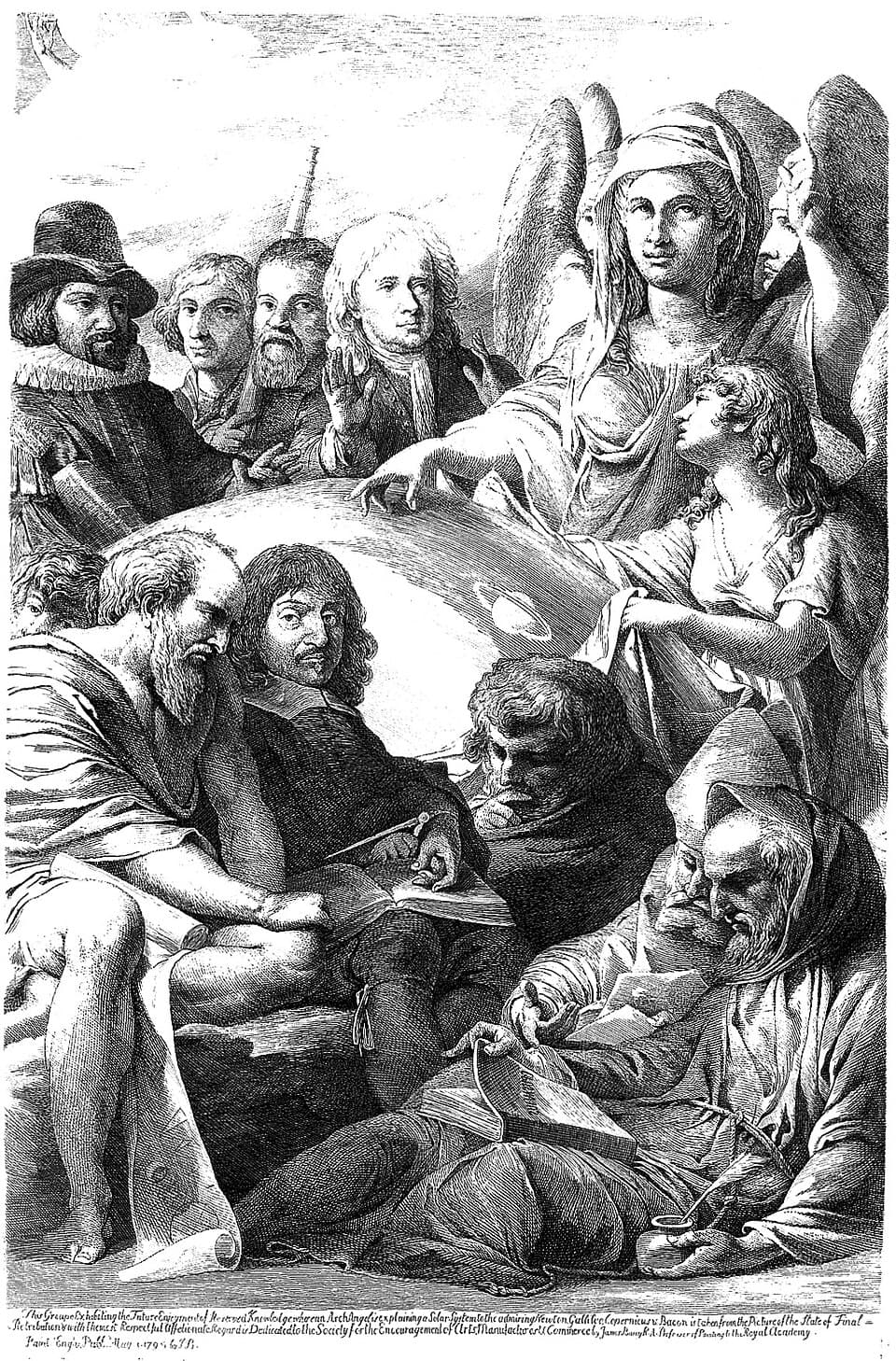
That morning, two 5th-grade students on a field trip stopped in front of an old scholar sitting in the shade in Miletus. He was drawing figures in the sand with a stick. He looked up, smiled, and invited them to sit beside him and ask all their questions.
—Where did you live when you were little? What was your city like?
I was born in Miletus, my child, a Greek city by the sea, where the sun beats down hard. Imagine a great port full of ships, with merchants shouting, amphorae filled with oil and wine. It smelled of salt, fresh fish, and the sweat of dockworkers. Miletus was a rich city, open to the world. And you know what? That wealth also nourished ideas. When your belly is full and ships travel, you start to ask questions about the world. It was there, in the midst of that joyful noise, that I felt the urge to understand how everything worked.
When ships travel, ideas travel too.
—What exactly was your school? What did you learn there?
It wasn't a school like you imagine, with walls and benches. It was more like a group of curious friends who met to think together. It was later called the Ionian school. Our rule was simple, but it changed everything: to explain the world, we no longer tell stories about gods. We look for natural causes. Why does the sea rise? Why does the sky turn? We observe, we discuss, we make mistakes, we start over. Imagine two people sitting in the sand, drawing triangles and debating until evening. That's how what we now call rational thought was born.
To understand the world, I looked for causes, not gods.
—They say you measured a pyramid with its shadow. Is that true?
Ah, that story! Yes, it happened during a trip to Egypt. The Egyptian priests showed me their great pyramids, immense, and no one knew how to tell their height. Too high to climb with a rope! So I had a very simple idea. I planted a stick straight into the sand, like a gnomon. At the hour when the shadow of the stick is as long as the stick itself, then the shadow of the pyramid is as long as the pyramid. I just had to measure the shadow on the ground! The Egyptians looked at me, astonished. You see, sometimes a shadow says more than a ladder.
Sometimes a shadow says more than a ladder.
—And your famous theorem, what's it good for in real life?
My child, my theorem is about proportions. A proportion is when two things grow together at the same rate. If my stick is twice your height, its shadow will be twice your shadow. Always. It's this rule that allowed me to measure the pyramid without moving a stone. But it's useful everywhere! You can measure the height of a tree, the width of a river you can't cross, the distance of a ship at sea. You keep your feet on the ground, yet you measure the unreachable. That's the magic of geometry: turning an impossible problem into a simple little calculation.
Keep your feet on the ground, and you'll measure the unreachable.
—Is it true you predicted an eclipse?
So they say, yes. An eclipse is when the Moon passes in front of the Sun and day turns into night in the middle of the afternoon. In my time, people were terribly afraid: they thought the gods were angry. By observing the sky for a long time and thanks to the knowledge of Eastern astronomers, I understood that it followed an order, a rhythm. They say I predicted the one in 585 BCE. On the day the shadow covered the sun, no one screamed in terror. Because it was expected. Understanding something, my child, is ceasing to fear it.
Understanding something is ceasing to fear it.
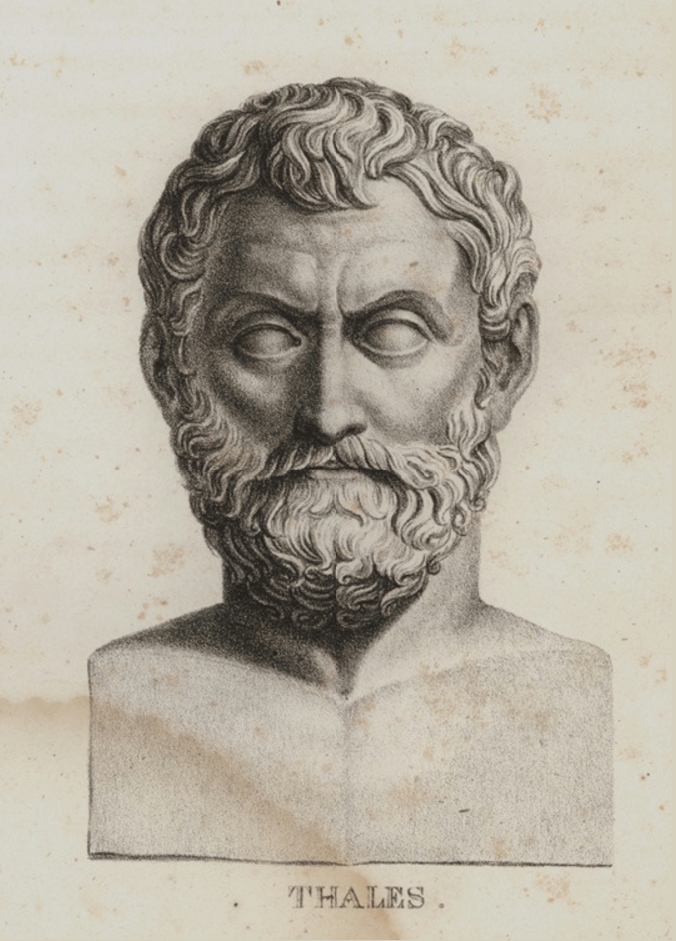
—What did you use to look at the stars? Were you afraid at night?
Afraid? Oh no, the night was my friend. I had no complicated instruments, just my eyes, a lot of patience, and sometimes a celestial sphere, a ball that represents the sky and the stars. Imagine a total night, with no light around, just thousands of stars above you. The silence, the cold, and that great sky slowly turning. I noted where the stars passed, I looked for regularities. Others saw gods up there; I saw an order, a giant clock. And the more I looked, the more I found the world beautiful because it was understandable.
The sky is not a frightening mystery; it's a giant clock.
—Did you think everything was made of water? Even stones?
Yes, and I know that makes you smile! I was looking for what I called the arkhé: the starting principle, the first ingredient from which everything is made. I answered: water. Why? Look around you. Without water, nothing grows, nothing lives. The seed needs moisture to germinate. Water becomes hard ice or light vapor; it changes form constantly. So I thought: what if everything came from it? I was wrong, of course. But the important thing wasn't my answer. The important thing was daring to ask the question: what is the world made of?
I was wrong about the answer, but I was right to ask the question.
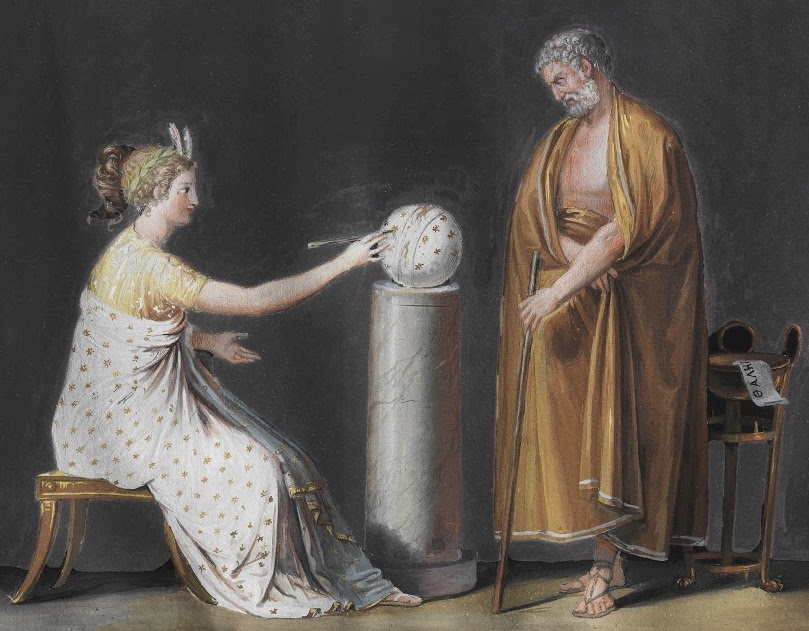
—They say you fell into a well. How did that happen?
Ha! You already know that story! One evening, I was walking with my nose in the air, contemplating the stars, lost in thought. I didn't look ahead... and splash, I fell into a well! A Thracian servant girl passing by made fun of me. She said I wanted to know the things of the sky while I couldn't even see what was at my feet. And you know what? She was right to laugh. A scholar is not a perfect man. You can search the stars and trip over a pebble. It keeps you humble.
You can search the stars and trip over a pebble.
—If you spent your time thinking, were you poor then?
I was often reproached for that! “What's the use of thinking if you don't have a penny?” So one day, I wanted to prove something. By observing the sky and the weather, I sensed that a big olive harvest was coming. I rented all the olive presses in Miletus in advance, while no one wanted them. When the harvest came, huge, everyone rushed to press their olives... and they had to go through me! I made a fortune. Not out of greed, but to show a very simple thing: a scholar could be rich if he wanted. Only, he prefers to seek the truth.
A scholar could be rich if he wanted; he prefers to seek the truth.
—Why is what you did still important today?
You know, I knew almost nothing compared to what you learn at school. But I left a habit, and that's my real treasure. Before me, when something happened, people said: “it's the will of the gods.” I asked: “why? how?” I looked for explanations through reason. That little question, “why?”, hundreds of Greek thinkers took it up after me, in Miletus and then everywhere. And it traveled through the centuries to you, on this school bench. So when you ask “why?” to your teacher, remember: you are doing exactly what I did in the sand.
When you ask “why?”, you are doing what I did in the sand.
Read further
This imaginary interview was generated by artificial intelligence from sources documented in Thales's profile. It dramatises what the figure might have said based on what we know about them, but does not constitute attested historical testimony. For primary sources and factual documentation, refer to the full profile.