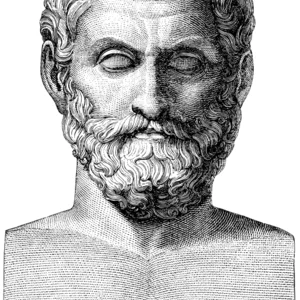

A Greek philosopher and scholar of the 6th century BCE, Thales of Miletus is considered the founder of Greek geometry. He is famous for his geometric theorems — particularly the theorem bearing his name on the proportionality of line segments — and for his pioneering work in mathematics and astronomy.
Thales(624 av. J.-C. — 545 av. J.-C.)
Thales
Milet
7 min read
Frequently asked questions
Key Facts
- c. 624–545 BCE: life and scientific activity in Miletus (Asia Minor)
- Development of geometric theorems, notably on the proportionality of segments created by parallel lines
- Practical application: measuring the height of the Great Pyramid of Giza using shadows and proportions
- Contributions to astronomy and prediction of a solar eclipse (c. 585 BCE)
- Founder of the Ionian school of philosophy and a major figure of Pre-Socratic thought
Works & Achievements
A fundamental theorem of geometry stating that if two lines are cut by parallel lines, the corresponding segments are proportional. It is one of the cornerstones of classical geometry taught in school curricula.
Thales is said to have measured the height of the Great Pyramid using its shadow and the principles of proportionality. This achievement illustrates the practical application of mathematics to real-world problems.
Thales contributed to the field of astronomy by predicting a solar eclipse and studying the movements of celestial bodies. He took a rational approach to explaining astronomical phenomena.
Thales founded one of the earliest schools of natural philosophy, marking the beginning of rational scientific thought in ancient Greece and shaping the transmission of knowledge for centuries to come.
Thales proposed that water was the fundamental principle underlying all matter, thereby launching the search for the basic constituents of the universe and laying the groundwork for natural philosophy.
Anecdotes
Thales is said to have predicted a solar eclipse in 585 BC, which greatly impressed his contemporaries. Although the exact details remain debated by historians, this prediction earned him widespread fame and demonstrated that celestial phenomena could be understood through human reasoning rather than attributed solely to the gods.
According to the legend recorded by Plato, Thales once fell into a well while gazing at the stars, so absorbed was he in his astronomical observations. A young serving woman mocked him, laughing that he sought to understand the mysteries of the heavens while failing to see what lay right at his feet.
Thales used his knowledge of geometry to measure the height of the Great Pyramid of Egypt by comparing its shadow to his own. This ingenious method demonstrated the practical usefulness of geometry and fascinated the Egyptians who watched him work.
Thales argued that water was the fundamental principle underlying all things, and that even the soul contained moisture. Although scientifically inaccurate, this theory marked the beginning of Greek natural philosophy by seeking rational explanations for natural phenomena rather than mythological ones.
It is said that Thales once made a fortune by using his weather predictions to anticipate a bumper olive harvest, then renting out all the olive presses in Miletus before the season began. This showed that scientific knowledge could also have practical and economic applications.
Primary Sources
Thales said that the principle (arkhē) of all things was water; for this reason he declared that the seed of all things was moist, and that heat itself was born from moisture and lived by it.
It is also reported that Thales, while gazing at the stars and looking up at the sky, fell into a well; a Thracian servant mocked him, saying that he was eager to know the things of the heavens while he could not see what lay at his very feet.
Thales of Miletus... was the first to introduce the study of geometry to the Greeks, having learned it in Egypt. He discovered how to calculate the height of the pyramids and demonstrated theorems on triangles and angles.
Thales held that water was the fundamental principle of all things, and that everything came from water and was ultimately resolved back into water.
Key Places
A city in Ionia (present-day Turkey) where Thales was born and founded the Milesian school, the first movement in Greek philosophy. It was here that he developed his pioneering work in geometry and natural sciences.
Thales is said to have traveled to Egypt, where he studied geometry and astronomy under Egyptian priests. These journeys greatly enriched his scientific knowledge.
Capital of ancient Greece, where Thales is said to have traveled and shared his knowledge. His theorems and methods influenced the development of Greek mathematics.
An ancient region of the Middle East (present-day Iraq) where Thales is said to have acquired knowledge in astronomy and mathematics. Babylonian learning complemented his scientific education.
According to legend, Thales predicted a solar eclipse in 585 BC that was visible from this region, demonstrating his ability to apply astronomical knowledge in practice.
Typical Objects
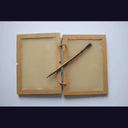
A flat surface coated with wax used by Greek scholars to jot down calculations and proofs. Thales is said to have used this medium to record his mathematical observations and geometric theorems.
📷 CC BY-SA 3.0 · Wikimedia Commons ↗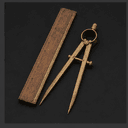
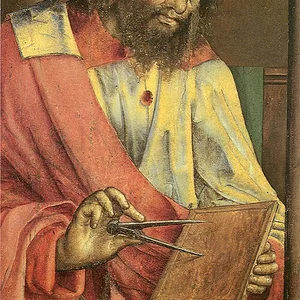
Essential tools of Greek geometry used to draw straight lines and circles. These instruments symbolize Thales' foundational work in geometry and his demonstrations on proportionality.

A vertical rod planted in the ground used to measure shadows and determine the time of day. Thales is said to have used it for his astronomical observations and to calculate the height of the Egyptian pyramids.
📷 CC BY 3.0 · Wikimedia Commons ↗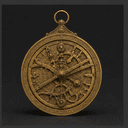
An observation and navigation instrument used in ancient astronomy to measure the positions of celestial bodies. Representative of Thales' pioneering work in astronomy and his fascination with celestial phenomena.
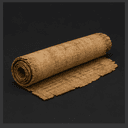
A Greek writing medium used to record scientific treatises and observations. It symbolizes the transmission of Thales' mathematical and philosophical knowledge to his successors.
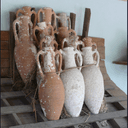
A ceramic vessel typical of ancient Greece, used for trade and transport. It symbolizes the cultural and commercial world of Miletus, the prosperous trading city where Thales was born.
📷 CC BY-SA 3.0 · Wikimedia Commons ↗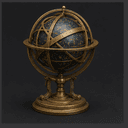
A three-dimensional representation of the vault of the heavens. It embodies Thales' contributions to astronomy and his vision of a universe governed by mathematical principles.
School Curriculum
Vocabulary & Tags
Key Vocabulary
Daily Life
Morning
Thales rises at dawn, like most Greeks of his time. He has a light meal of bread, olives, and diluted wine, then heads to the agora or his school to meet his students and debate philosophical and mathematical questions.
Afternoon
In the afternoon, Thales devotes himself to observation and study: he examines geometric figures drawn in sand or on tablets, and discusses mathematical and astronomical principles with his pupils. He may also visit the port of Miletus to watch the ships and talk trade with merchants.
Evening
In the evening, Thales shares a meal with his family or companions. After dinner, he may attend a symposium — an intellectual gathering where philosophy is debated over wine mixed with water — or spend time in personal reflection and recording his observations.
Food
Thales' diet consists mainly of barley or wheat bread, olives, cheese, and fresh fish, thanks to his proximity to the Aegean Sea. He drinks wine diluted with water, following Greek custom, and occasionally eats meat during religious sacrifices or festive meals.
Clothing
Thales wears the chiton, a woolen or linen tunic typical of the Greeks, usually draped simply. He pairs it with a himation, a large rectangular cloak thrown over the shoulders. As a respected scholar, his appearance is understated and dignified, with no excessive ornamentation.
Housing
Thales lives in Miletus, an important Ionian city on the coast of Asia Minor, in a typical Greek house built around a central courtyard (aula). His home is modest but functional, with rooms for living, cooking, and receiving students. As a man of both science and commerce, he enjoys a comfortable social and material standing.
Historical Timeline
Period Vocabulary
Visual Style
Un style inspiré de l'art grec antique classique, combinant la géométrie des vases ioniques avec l'atmosphère contemplative du port de Milet. Les illustrations évoquent les fresques et poteries grecques du VIe siècle av. J.-C., avec une lumière méditerranéenne dorée illuminant des figures en profil et des diagrammes géométriques.
Sound Ambience
Ambiance sonore évoquant le refuge de travail d'un sage grec antique au bord de la Méditerranée : le murmure contemplatif d'un philosophe mathématicien mêlé aux sons authentiques d'un port portuaire du VIe siècle av. J.-C., où géométrie et nature s'entrelacent.
Liens externes & ressources
Références
Œuvres
Théorème de Thalès
VIe siècle av. J.-C.
Démonstration de la hauteur de la Grande Pyramide
VIe siècle av. J.-C.
Travaux en astronomie
VIe siècle av. J.-C.
Fondation de l'école de Milet
VIe siècle av. J.-C.
Théories sur la matière
VIe siècle av. J.-C.