Imaginary interview with Thales
by Charactorium · Thales (624 av. J.-C. — 545 av. J.-C.) · Sciences · 6 min read
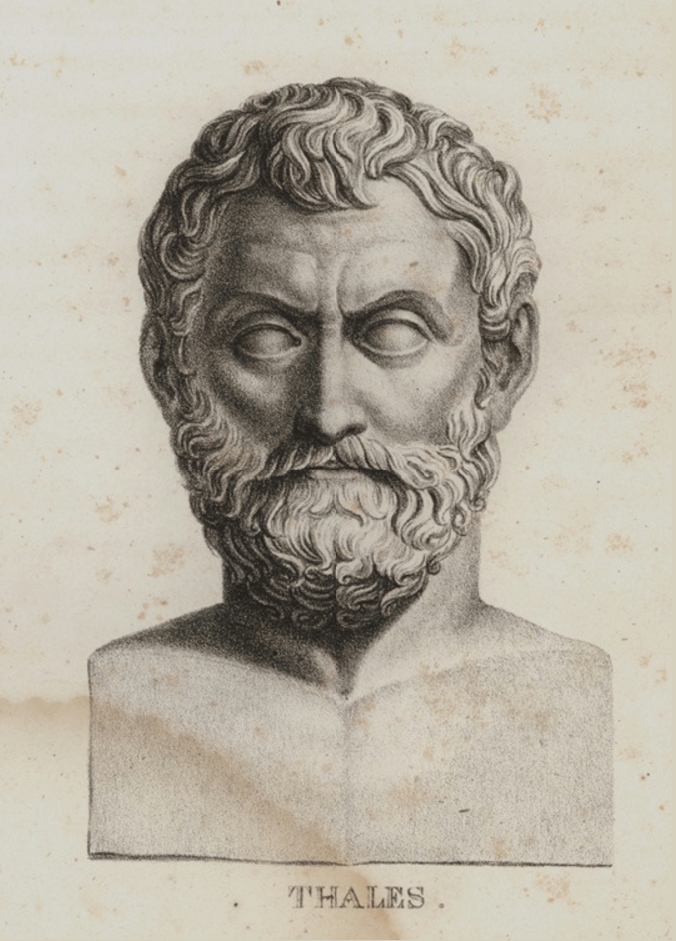
The port of Miletus smells of salt and the wood of merchant ships. Under a portico of light stone, an old man in a gray himation traces figures in the dust with his finger, without lifting his eyes to the sea that has nonetheless nourished him so much. He agrees to speak — not about himself, he says, but about what shadow, water, and sky have taught him.
—How would you describe the city where you grew up and worked?
Miletus is a city that never quite sleeps. Ships enter and leave the harbor like the breath of a sleeper, laden with wool, oil, and tales from Egypt or the shores of Asia. When I walk to the docks in the afternoon, I listen to the merchants haggling, and I believe it is there, in that hubbub, that my desire to understand was born. For a city that counts its amphorae quickly learns to count the stars. I gathered around me a few curious young men; we trace figures in the sand and discuss until evening. They say we form an Ionian school — I simply say we refuse to be satisfied with the stories told to children to explain thunder.
A city that counts its amphorae quickly learns to count the stars.
—They say you made a fortune with olive presses. What happened?
I was reproached for wasting my time observing the sky instead of filling my purse, as if wisdom condemned one to poverty. One year, I read in the signs of the sky and earth that the olive harvest would be abundant. Before the season, I rented all the presses in Miletus and the surrounding area, at low prices, since no one wanted them yet. When the olive trees bent under the fruit, everyone rushed, and I set my price. I earned what I needed, then I stopped. I did not do it for gold — gold bores me — but to show those who mocked that a scholar can be rich if he chooses, and that he chooses something else.
A scholar can be rich if he chooses; he simply chooses something else.
—Do you remember your journey to Egypt and what you learned there?
Egypt humbled me, and that is the finest gift a country can give. The priests there preserved ancient knowledge of angles and surfaces, inherited from their surveyors who redraw the fields each year after the Nile flood. I listened, I measured, I started over. Before the Great Pyramid, I was challenged to find its height, that stone monster no rope could climb. I planted my stick — my gnomon — straight in the sand and waited for the hour when a man's shadow equals his height. At that precise moment, the pyramid's shadow betrayed its height. The Egyptians, who had possessed this knowledge for centuries, had never thought to turn it against their own monument.
—Why do you hold so strongly to this idea of proportion between things?
Because proportion is the only thing the gods cannot take back from me. The shadow of a stick and the shadow of a pyramid resemble each other not at all — one fits in my hand, the other covers a field. And yet they obey the same ratio, exactly, without cheating. Two straight lines cut by parallels intersect segments that correspond: that is what my students now call my theorem. What amazes me is not the figure traced in the sand, but that a truth holds in the small as in the great. If I can measure the inaccessible with the accessible, then nothing in this world is entirely beyond the reach of the human mind.
A truth holds in the small as in the great.
—What would you say about that eclipse you supposedly predicted?
People talk about it more than I would like. The Babylonians, long before me, had noticed that eclipses recur in a rhythm, like the seasons return. I did not invent the sky; I merely counted its returns. When the day went dark in the midst of battle and the warriors dropped their weapons in terror, many believed the gods were angry. I had said it would come. Understand me well: I do not rejoice in having frightened men. I rejoice that something as terrible as a devoured sun could be awaited, foreseen, tamed by reasoning alone. That day, the sky ceased to be a tribunal and became a clock.
That day, the sky ceased to be a tribunal and became a clock.
—How do you observe the stars, with what means?
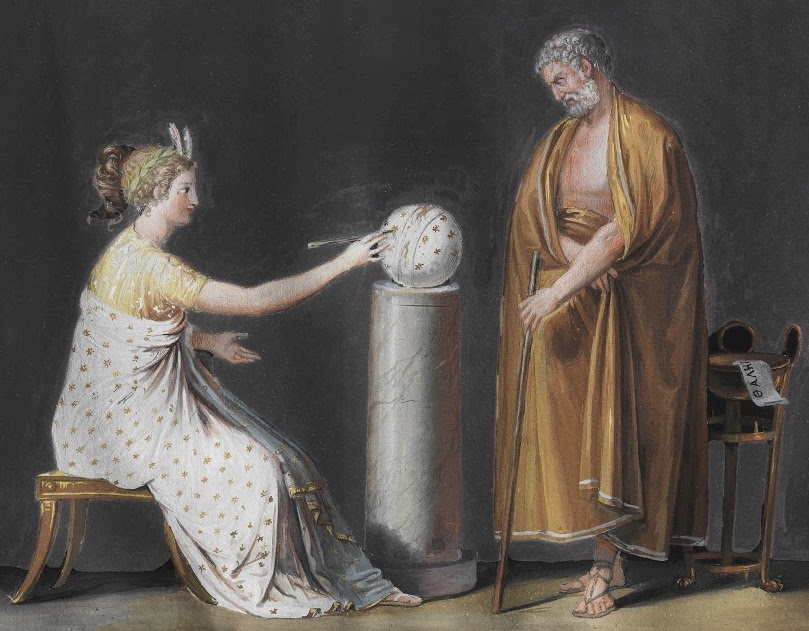
My tools are poor and my nights are long. I have my gnomon, that simple stick whose shadow tells me the hour and the season, and which I plant in the ground as others plant a vine. I follow the positions of the stars with my eyes, I note their returns on a wax tablet that I scrape and re-engrave endlessly. The sailors of Miletus ask me which star to follow so as not to get lost, and I tell them to trust the Little Bear, more reliable than the Great. Understanding the sky is not a dreamer's luxury: it is what brings a man back to port. I believe the stars are not divine whims but regulated bodies, and that a patient mind can read their law.
—You claim that water is the principle of all things. Where does this conviction come from?
Look around you, here, by the sea. Seed is moist, blood is moist, dry earth dies and watered earth gives birth. I have seen the Nile withdraw its waters and leave behind a silt so alive that it feeds an entire people. I came to think that water is the arkhè, the principle from which everything is born and to which everything returns; that even heat lives on moisture and feeds on it. I do not claim to be right for eternity — my students will contradict me, that is their right and my wish. But I will at least have asked the right question: what is the world made of? That question is worth more than all the fables about the loves of the gods.
I will at least have asked the right question: what is the world made of?
—Why seek a single principle rather than accept the stories of the gods?
Because the stories of the gods explain everything and predict nothing. If lightning is the wrath of Zeus, I will never know when it will strike. But if the world rests on a primary matter that transforms, then I can hope to follow its transformations, as one follows the course of a river. I do not fight the gods — I leave them to the poets. I only say that nature seems to obey causes that the mind can grasp. My neighbors find this impious or useless; they prefer Homer's tales. Yet the day one seeks a principle instead of a culprit, something changes forever in the way men look at the world.
The stories of the gods explain everything and predict nothing.
—It is reported that you fell into a well while observing the sky. How do you live with this story?
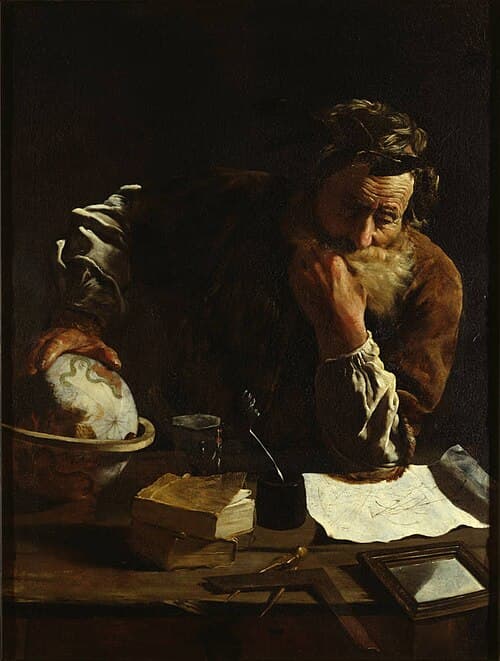
Ah, the maid of Thrace! She laughed heartily, and she was right to laugh. I had my eyes raised to the stars and did not see the hole at my feet — there I was at the bottom of the well, soaked, now contemplating the water more closely than I would have wished. They say she mocked this scholar who wants to know things in the sky and ignores what is under his nose. I do not hold it against her. A man who seeks the distant sometimes stumbles on the near: that is the price of looking. But tell me, who will remember her if not through my fall? Ridicule sometimes preserves better than a statue.
A man who seeks the distant sometimes stumbles on the near: that is the price of looking.
—Does this image of the absent-minded scholar seem unfair to you?
It is both fair and false, like everything told about the living. Yes, I get absorbed, I forget the meal my household has prepared for me, I trace figures in the sand until nightfall. But whoever thinks me incapable of worldly affairs has not heard of my olive presses! I wanted to prove one thing: one does not contemplate the sky because one is unable to walk on the earth. One contemplates it because one has decided that earth alone is not enough. If I fall into a well, it is an accident; if I measure a pyramid by its shadow, it is a choice. Judge me on my choices, not on my falls.
—What do you wish to pass on to those who come after you?
Not answers — they will grow old like me — but a habit. The habit of asking why and how, of planting a stick in the sand rather than shrugging one's shoulders. I hear that a young man from Samos, a certain Pythagoras, is already gathering these seeds and founding his own community in Italy. So much the better. Let my mistakes serve as a springboard for him. If anything of me survives, I would like it to be this stubborn idea: the world lets itself be understood, provided one looks at it without fear. Geometry, the stars, water — these are only paths. The true legacy is the conviction that a human mind, even mine, is worth questioning the entire universe.
The world lets itself be understood, provided one looks at it without fear.
Read further
This imaginary interview was generated by artificial intelligence from sources documented in Thales's profile. It dramatises what the figure might have said based on what we know about them, but does not constitute attested historical testimony. For primary sources and factual documentation, refer to the full profile.