Imaginary interview with Vercingetorix
by Charactorium · Vercingetorix (79 av. J.-C. — 45 av. J.-C.) · Military · 5 min read
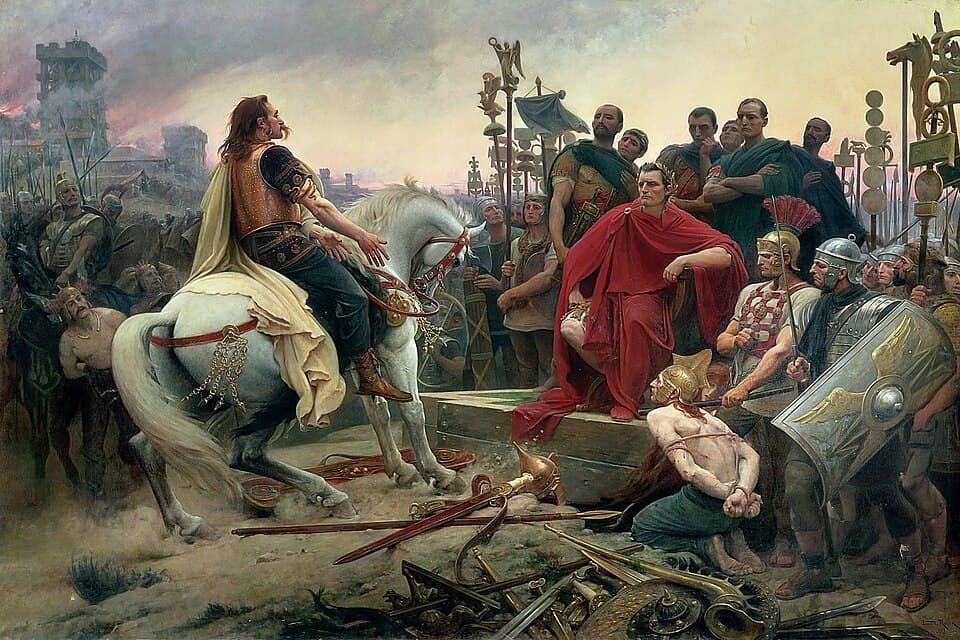
On the oppidum of Alesia, as the Roman fires encircle the hill with a second wall, the Arverni chieftain agrees to speak. He has laid his sword on a boar skin, his golden torc catches the last light. His voice is low, like that of a man who has already counted his days.
—How did you convince peoples who had always hated each other to march behind a single man?
I was twenty-seven years old, and they looked at me like a child asking for his father's shield. But the fear of Caesar silences old hatreds better than any druid. I spoke to the Arverni, my brothers, then to the Aedui who despised us, to the Helvetii, the Senones—more than sixty peoples who, just yesterday, stole each other's herds. I told them a simple thing: a wolf does not devour a pack that sticks together, it devours the isolated beast. The coalition held only by a thread of fear and honor, I knew it. But that thread, no Gallic chieftain had tied before me.
A wolf does not devour a pack that sticks together, it devours the isolated beast.
—Before Alesia, there was Gergovia. What does that battle mean to you?
Gergovia is the hill of my childhood, the Arverni oppidum where I learned to ride a horse before I knew how to speak. When Caesar launched his legions against its slopes, I let them exhaust themselves climbing, then my Gallic cavalry fell upon them like hail on wheat. That day, the master of Rome retreated. Retreated! My warriors understood that a Roman bleeds like a man. That victory weighed nothing on the map, but it weighed heavily in their chests. After Gergovia, no one whispered anymore that my name was too young to command.
My warriors understood that a Roman bleeds like a man.
—You chose to burn the lands of your own allies. How does one bear such a decision?
One does not bear it, one endures it like a wound one inflicts on oneself. I ordered the villages burned, the crops and barns destroyed along the path of the legions, so that Caesar and his men would advance only through ash and hunger. A chieftain who loves his land should never see the roofs of those who follow him ablaze. But starving Rome was better than feeding it. The Bituriges begged me to spare their beautiful city of Avaricum; I yielded, and Caesar took it, and all died there. Mercy, in this war, killed more surely than fire.
A chieftain who loves his land should never see the roofs of those who follow him ablaze.
—How did the trap of Alesia close around you?
I thought I held the height; it was the height that held me. Caesar had the entire oppidum of the Mandubii encircled with a double rampart of stakes, ditches, and towers—one facing me, the other facing the reinforcements I awaited. A siege in reverse: the besieger himself entrenched. I sent out my best cavalry by night, ordering them to gallop to every Gallic people and bring back the relief army. They slipped between the Roman fires. But the sky counted our rations faster than our friends came. Each morning, from the top of the wall, I scanned the empty horizon.
I thought I held the height; it was the height that held me.
—What did you see from the ramparts during those days of waiting?
I saw two Roman walls, one behind the other, and between them patient death. On the plain, the ditches Caesar had filled with water from the Oze, the iron traps hidden in the grass, the towers from which his archers looked down on us. Behind me, in the oppidum, the children of the Mandubii who had been driven out and wept between the two camps, belonging to no one. Hunger gnaws at a siege better than any spear. I had eighty thousand men and not enough to feed a third. When the relief army finally appeared on the horizon and was repelled, I knew the Gallic gods had fallen silent.
Hunger gnaws at a siege better than any spear.
—Once hope was gone, why did you surrender rather than die sword in hand?
Because a chieftain does not belong to himself. Dying in a charge would have been sweet for me, but cowardly toward them. My warriors still lived, the women, the elders of the oppidum. I called the council and said: take my life, hand me over, so that at least yours may be spared. The next day, I donned my finest arms, mounted my horse, and rode around Caesar's tribunal before laying at his feet my sword, my torc, my helmet. The Romans will write that I laid down my arms. So be it. But I laid them down as one places an offering, not as one casts off a burden.
I laid them down as one places an offering, not as one casts off a burden.
—You know what awaits you in Rome. How do you view this end?
They tell me Caesar will keep me alive, chained in the shadow of a dungeon, to drag me one day in his triumph through Rome, like a fairground beast displayed before being slaughtered. Six winters, perhaps, waiting for a consul to have the leisure to celebrate his glory upon my neck. An Arverni warrior is not made for the chain; he is made for the wind of the Massif Central plateaus and the smell of horses. But if my slow death must buy the lives of a few thousand of my people, then I accept it as one accepts winter: without loving it, without cursing it.
An Arverni warrior is not made for the chain, he is made for the wind of the plateaus.
—You who united Gaul for a moment, do you believe this union could have lasted?
No, and I knew it when I tied it. Gaul is not a people, it is a crowd of jealous peoples, each proud of its oppidum, its herds, its gods. The Aedui followed me, then betrayed me, then returned. The federation of peoples I raised held by fear of Caesar, not by love of Gaul—for that Gaul, no one had yet dreamed of before me. Perhaps I sowed the idea of a common soil in minds that thought only of their wooden steeple. If I am remembered in a hundred years, let it be for this: having, one summer, made brothers of enemies.
I made, one summer, brothers of enemies.
—Do you ever doubt that you led your people to the right fight?
Every night, since the walls of Alesia imprison me. I burned the barns of my allies, I let Avaricum perish, I threw eighty thousand men against the Roman machine. Were they doomed to follow me? Perhaps by bending the knee earlier, my people would have kept their sons and their harvests. But a free man who lies down before Rome never quite stands up straight again. I preferred that the Arverni fall standing. The druids say the soul passes from one body to another; if that is true, I will return, and I will begin again, and I will again burn my own fields so as not to see Rome sow its wheat there.
A free man who lies down before Rome never quite stands up straight again.
—When you think back on your warriors, what image will you keep of them?
I see them again at Gergovia, charging down the slope with their oval shields painted with spirals, their long swords raised, the torc around the neck for the nobles, the spear in hand for the others. Men who laughed before battle and sang their dead afterward. My Gallic cavalry did not have the cold discipline of the legions, but it had fire—and fire, sometimes, overturns order. I saw them die between the two walls of Alesia without bowing their necks. Let the Romans engrave what they will on their columns: I keep the image of free horsemen charging the eagle, one last time, under an Auvergne sky.
Men who laughed before battle and sang their dead afterward.
This imaginary interview was generated by artificial intelligence from sources documented in Vercingetorix's profile. It dramatises what the figure might have said based on what we know about them, but does not constitute attested historical testimony. For primary sources and factual documentation, refer to the full profile.