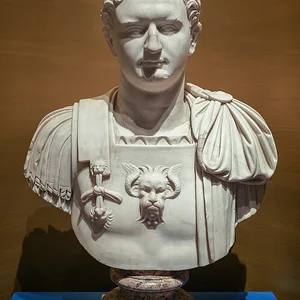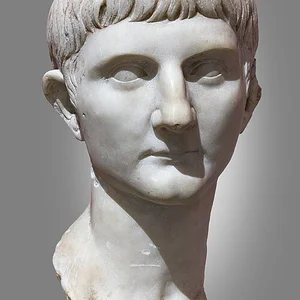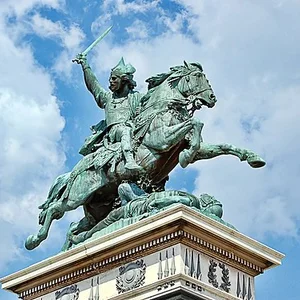

Arverni chieftain (79–46 BC), Vercingetorix united the Gallic peoples against Julius Caesar's Roman invasion. Defeated at the Battle of Alesia in 52 BC, he stands as a symbol of Gallic resistance to Roman conquest.
Vercingetorix(79 av. J.-C. — 45 av. J.-C.)
Vercingetorix
Arvernes
7 min read
Frequently asked questions
Key Facts
- 52 BC: Battle of Alesia, where Vercingetorix is besieged and defeated by Julius Caesar
- 52 BC: Unification of numerous Gallic tribes against the Roman invasion
- 46 BC: Execution in Rome after six years of captivity
- 72–52 BC: The Gallic Wars, a major phase of the Roman conquest of Gaul
Works & Achievements
Vercingetorix succeeded in uniting the various Gallic tribes (Arverni, Aedui, Helvetii, etc.) under a single command to resist Julius Caesar's invasion. This coalition represents the first major effort at political unification of Gaul in the face of the Roman threat.
The final great battle in which Vercingetorix faced Caesar with a Gallic army estimated at 80,000 men. Though tactically remarkable, the battle ended in defeat and the encirclement of the Gauls, marking the decisive turning point in the Roman conquest of Gaul.
Vercingetorix secured a victory against the Roman legions by defending the Arvernian oppidum of Gergovia. This temporary victory boosted Gallic morale and demonstrated the young leader's military capabilities against the Romans.
Vercingetorix employed a strategy of weakening the Roman armies by destroying the lands and resources the enemy could use. This innovative approach to prolonged resistance was designed to exhaust Caesar's forces.
As a young Arvernian chieftain, Vercingetorix became the political symbol of Gallic resistance, organizing the first truly coordinated uprising against Roman rule and establishing a centralized military government.
Vercingetorix organized the recruitment and training of a disciplined Gallic cavalry army, transforming tribal warriors into organized military forces capable of competing with the Roman legions.
Anecdotes
In 52 BC, at just 27 years old, Vercingetorix managed to unite more than 60 different Gaulish peoples under his command — an unprecedented political feat in Gaul. This fragile alliance brought together traditional rivals who agreed to set aside their quarrels and face Julius Caesar's army together.
During the siege of Alesia, Vercingetorix found himself trapped inside the oppidum (hilltop fortress) as Roman legions constructed massive fortifications around the town. He sent his best cavalry to seek reinforcements from the Gaulish peoples, but help arrived too late to break through the Roman blockade.
After his defeat at Alesia, Vercingetorix surrendered to Caesar to spare his soldiers and the civilian population from massacre. This desperate act, though noble, sealed his fate: he was imprisoned in Rome for six years before being executed in 46 BC.
Vercingetorix adopted a scorched-earth strategy against Caesar, burning crops and villages in the path of the Roman legions to cut off the enemy army's supply lines. This tactic slowed the Roman advance but also showed the Gaulish peoples the brutal reality of war.
His name literally means 'supreme chief' in Gaulish, and he came from the Arverni tribe in the Auvergne region. Although his revolt ultimately failed, Vercingetorix became a legendary figure symbolizing Gaulish freedom in the face of Roman domination.
Primary Sources
Vercingetorix, son of Celtillus the Arvernian, whose father had once held the sovereignty of all Gaul and had been put to death by the Arverni because he aimed at making himself king, assembled his dependents and soon gathered a following.
Vercingetorix, seeing that his hopes were dashed and that no relief was coming, laid down his arms and surrendered the leaders of the revolt along with the most senior officers to the Romans.
Vercingetorix was put to death in Rome after being paraded in Caesar's triumph — the final expiation of Gallic resistance against Roman domination.
Roman archaeological and monumental sources attest to the capture of Vercingetorix and his role in the Gallic Wars under the command of Julius Caesar.
Key Places
An Arvernian oppidum located in the Auvergne region, where Vercingetorix won a decisive victory against Caesar's legions in 52 BC. This success strengthened his prestige and authority among the allied Gaulish peoples.
An oppidum of the Mandubii in Burgundy, site of the decisive battle of 52 BC where Vercingetorix was besieged and defeated by Caesar, marking the end of organized Gaulish resistance.
The homeland of Vercingetorix, a powerful people of the Massif Central. It was from this territory that the Arvernian chieftain united the various Gaulish tribes to organize resistance against the Roman conquest.
Capital of the Roman Empire, where Vercingetorix was brought as a captive after his defeat. He was executed there in 46 BC, symbolizing Caesar's triumph and the end of Gaulish independence.
Gaulish coins issued in the name of Vercingetorix, bearing witness to his political authority and his power to unite the Gaulish peoples. They reflect his recognition as supreme chieftain.
Typical Objects

A characteristic combat weapon of Gallic warriors, long with a broad blade. Vercingetorix and his warriors wielded these swords in their clashes against the Roman legions.

An oval or hexagonal shield decorated with Celtic motifs and reinforced with a central boss (umbo). An essential defensive piece for Gallic fighters during the Gallic Wars.

A Gallic warrior's helmet, often adorned with horns or a metal crest. A symbol of warrior status and Gallic identity in the 1st century BC.

A two-horse war vehicle used by Gallic nobles and chieftains such as Vercingetorix to command troops and fight in battle. A hallmark military tactic of ancient Gaul.

A rigid, twisted collar worn as a mark of power and prestige by Gallic chieftains. Vercingetorix, as leader of the Arverni, would have worn this symbol of his authority.

A throwing and thrusting weapon used by Gallic warriors in formation. Deployed in large numbers by Vercingetorix's troops during the siege of Alesia.

An oppidum (hillfort) located in Burgundy, site of the decisive battle of 52 BC where Vercingetorix was defeated by Caesar — marking the end of organized Gallic resistance.

A gold or silver coin minted by Gallic peoples, sometimes bearing the likeness of their chieftains. Evidence of the political and economic organization of Gaul before the Roman conquest.
School Curriculum
Vocabulary & Tags
Key Vocabulary
Daily Life
Morning
Vercingetorix begins his day in his oppidum (Gallic hill fort) by inspecting his warriors and receiving reports on Roman troop movements. He consults his advisors and druids on military strategies and matters of governance among the allied Gallic peoples.
Afternoon
The afternoon is devoted to martial training, horsemanship, and overseeing war preparations. As military commander, he takes part in drills alongside his warriors and organizes the defenses of his territories against Caesar's advance.
Evening
In the evening, Vercingetorix shares meals with his warriors and noble allies, where important decisions are debated around the fire. These gatherings strengthen the political and military bonds essential for maintaining the unity of the revolting Gallic peoples.
Food
His diet consists mainly of meat (pork, wild boar, beef) and grains, the staples of Gallic eating. As a noble Arvernian chief, he also eats cheese, honey, and legumes, and drinks beer and imported wine — markers of his high status.
Clothing
Vercingetorix wears wool and linen garments: a tunic, trousers (bracae), and a cloak fastened with a fibula. His rank as chief is displayed through gold and silver ornaments, a decorated sword, a torc (a Gallic neck ring), and a helmet worn in battle.
Housing
He resides in the oppidum of Alesia or in Arvernian strongholds — defensive structures that include dwellings, workshops, and storehouses. These Gallic noble residences combine wood, stone, and earth, organized around a central courtyard where military and administrative activities take place.
Historical Timeline
Period Vocabulary
Visual Style
Un style historique épique mêlant traditions pictorales du XIXe siècle avec l'esthétique celte de l'Antiquité. L'ambiance dramatique valorise le courage et la détermination du chef arverne face à l'oppression romaine, avec un éclairage chaud et des détails guerriers richement ornementés.
Sound Ambience
Une ambiance guerrière immersive mêlant les sons du campement gaulois, les instruments de guerre celtiques, et la tension dramatique de la résistance contre l'invasion romaine sous le commandement de Vercingétorix.
Liens externes & ressources
Références
Œuvres
Unification des peuples gaulois
52 av. J.-C.
Bataille d'Alésia
52 av. J.-C.
Siège de Gergovie
52 av. J.-C.
Stratégie de terre brûlée
52 av. J.-C.
Révolte arverne et leadership politique
52 av. J.-C.
Campagne de mobilisation militaire
52 av. J.-C.