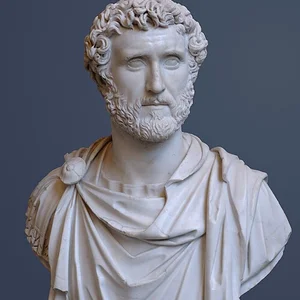

Antoninus Pius was Roman emperor from 138 to 161, the third of the “good emperors” of the Antonine dynasty. His exceptionally long and peaceful reign remained a symbol of stability and prosperity for the Empire.
Antoninus Pius(86 — 161)
Antoninus Pius
Rome antique
6 min read
Frequently asked questions
Key Facts
- Adopted by Emperor Hadrian and succeeded him in 138
- Received from the Senate the honorific title of “Pious” (Pius)
- Had the Antonine Wall built in Britain (Scotland) around 142
- A peaceful 23-year reign, with no major war and without ever leaving Italy
- Died in 161, leaving power to his adoptive sons Marcus Aurelius and Lucius Verus
Works & Achievements
By forcing the hostile Senate to consecrate his adoptive father, Antoninus ensured a peaceful transition of power and earned his nickname “Pius.”
Advance of the Roman frontier in Britain through a new rampart, the principal military achievement of his reign.
A charitable institution created in honor of Faustina the Elder to aid the poor girls of Rome, extending the imperial *alimenta*.
A monument dedicated to his deified wife, one of the best-preserved temples of the Roman Forum and a testament to Antoninus's piety.
Antoninus developed a humane body of law (protection of slaves against cruelty, the principle of favorable presumption), later taken up by the great Roman jurists.
Grand games and coin issues marking the nine centuries since the legendary founding of the City, asserting the greatness of the Empire.
Prudent management of the treasury, allowing help for cities struck by earthquakes and fires (Asia, Rhodes), while leaving an abundant treasury at his death.
Anecdotes
Antoninus received the surname "Pious" (Pius) probably because he insisted that the Senate deify his adoptive father Hadrian, even though many senators detested the late emperor. Out of filial loyalty, Antoninus managed to ease tensions and obtain this honour.
During his 23-year reign, Antoninus never left Italy: he governed the vast Roman Empire from Rome and his villas, through letters and messengers. It was one of the most peaceful reigns in Roman history, in stark contrast to his adoptive grandfather Trajan, the tireless conqueror.
Under his reign, his generals pushed the frontier forward in Britain (present-day Scotland) and built a new rampart of turf and timber, the "Antonine Wall," north of the famous Hadrian's Wall. This was his main military undertaking.
Antoninus deeply loved his wife Faustina the Elder. Upon her death, he had her deified and created a charitable foundation, the "Girls of Faustina" (puellae Faustinianae), which helped the poor girls of Rome.
On his deathbed in 161, the watchword he gave to the officer on guard was "aequanimitas" (equanimity, serenity). Then he turned over as if to sleep and died peacefully, true to his reputation for calm to the very end.
Primary Sources
He was a man remarkable for his physique, distinguished by his moral qualities, full of kindness, noble of countenance, of exceptional intellect, eloquent, highly learned, and temperate.
From my father, gentleness, but also unshakable firmness in decisions carefully thought through; the absence of vain glory in so-called honours; the love of work and perseverance.
The emperor Antoninus, the first of that name, granted many benefits to all his subjects: he had aqueducts and baths built, and came to the aid of cities struck by misfortune.
The whole inhabited earth has been adorned like a garden... the cities shine with brilliance and grace, and the entire earth is in festival, under a universal peace.
Key Places
A town in Latium, near which Antoninus was born into his senatorial family. His family was of Gaulish origin, settled in Italy.
Capital of the Empire from which Antoninus governed without ever leaving Italy. The Forum is home to the Temple of Antoninus and Faustina, raised after their deaths.
An imperial villa on the Via Aurelia where Antoninus spent much of his childhood and his reign, and where he died in 161.
A turf-and-timber rampart built around 142 between the estuaries of the Clyde and the Forth, marking the advance of the Roman frontier in Britain.
A wealthy province of which Antoninus was proconsul before his accession, which forged his reputation as a fair administrator.
Typical Objects

A crown of oak leaves, a symbol of honor rewarding whoever saves fellow citizens. Associated with the emperor as protector of civil peace.

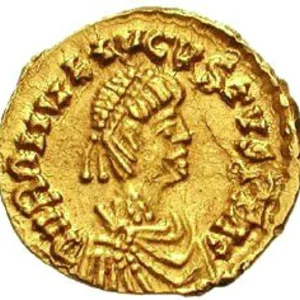
A gold coin struck with the emperor's likeness, spreading his image and political messages throughout the Empire. The reverses celebrated peace and prosperity.

The ceremonial garment of high Roman magistrates, edged with a purple band. The emperor wore it during official acts.

A bundle of rods surrounding an axe, carried by the lictors who walked before the emperor. It symbolized the power to command and to punish.

The legionaries' short sword, the main weapon of the army that guarded the Empire's frontiers under Antoninus. A symbol of Rome's military might.

The medium for laws, rescripts, and imperial correspondence. Antoninus governed the Empire in writing from Rome, answering the requests of the provinces.
School Curriculum
Vocabulary & Tags
Key Vocabulary
Daily Life
Morning
Like every Roman aristocrat, the emperor rose early and received the *salutatio* at dawn: clients, senators, and petitioners came to greet him in his home. He then devoted the morning to affairs of state, reading and dictating replies to requests that came from all over the Empire.
Afternoon
The afternoon could be taken up by judicial hearings, councils with his friends and legal experts, or the management of the imperial estate. **Antoninus** also enjoyed the simple life in the countryside, in his villas in **Latium**.
Evening
Evening brought the main meal, the *cena*, sometimes shared with close companions in a moderate atmosphere. **Antoninus** was known for being temperate and avoiding the excessive lavishness of banquets.
Food
The Roman diet was based on bread, olive oil, wine diluted with water, vegetables, fruit, cheese, and fish. **Antoninus** had a reputation for eating simply, without the gluttony of other emperors.
Clothing
For official acts, he wore the toga edged with purple; in everyday life, a tunic of wool or linen. The imperial insignia and the civic crown marked his rank during ceremonies.
Housing
**Antoninus** resided at the imperial palace on the **Palatine** in Rome, but preferred his country villas, notably the one at **Lorium** on the *via Aurelia*, where he had grown up and where he died.
Historical Timeline
Period Vocabulary
Liens externes & ressources
Références
Œuvres
Divinisation d'Hadrien
138
Mur d'Antonin
vers 142
Fondation des puellae Faustinianae
vers 141
Temple de Faustine au Forum (puis d'Antonin et Faustine)
à partir de 141
Politique juridique et rescrits
138-161
Célébration du 900e anniversaire de Rome
148
Stabilisation des finances et aide aux provinces
138-161