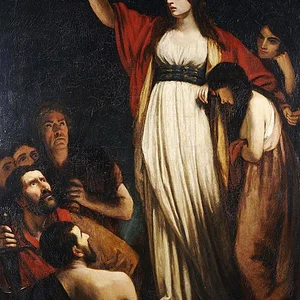

Queen of the Iceni, a Celtic people of Britain, she led a major revolt against Roman occupation around 60–61 AD. At the head of a coalition of British tribes, she destroyed Camulodunum, Londinium, and Verulamium before being defeated by the governor Paulinus.
Boudicca(30 — 61)
Boudica
7 min read
Frequently asked questions
Key Facts
- Around 60–61 AD: general uprising of the Iceni and their allies against Rome
- Destruction of Camulodunum (Colchester), Londinium (London), and Verulamium (St Albans)
- According to Tacitus, her army numbered several tens of thousands of warriors
- Final defeat at the hands of governor Gaius Suetonius Paulinus
- Died shortly after the defeat, according to ancient sources (by suicide or illness)
Works & Achievements
A military coalition of unprecedented scale in Roman Britain, uniting several tribes against the occupying power. This event forced Rome to fundamentally rethink its policy of exploiting the province.
Three major Roman cities razed and burned within a few months, demonstrating remarkable military and logistical capability. These destructions durably set back Roman urban development in Britain.
A work by sculptor Thomas Thornycroft, erected opposite the British Parliament, depicting Boadicea standing on her chariot. Since the 19th century it has symbolised national resistance and freedom in British culture.
A rhetorical reconstruction of Boadicea's address to her troops before the final battle, a classic literary genre of the time. This text is one of the rare ancient portrayals of a female war leader speaking in her own voice.
Anecdotes
According to the Roman historian Cassius Dio, Boudica was a woman of imposing stature, with long red hair and a powerful voice. Before each battle, she would consult omens by releasing a hare hidden in her garments, interpreting the direction of its run as a divine sign of victory.
After the death of her husband King Prasutagus, the Roman authorities refused to honor his will, which had divided the kingdom between Rome and his daughters. Boudica was publicly flogged and her two daughters were raped. This humiliation triggered the revolt of 60–61 AD, one of the most serious crises the Roman Empire faced in Britain.
The destruction of Londinium (present-day London) by Boudica's forces is archaeologically confirmed: a layer of reddish ash dating to the 1st century was uncovered during excavations beneath the City of London. The destruction was so complete that the governor Paulinus had chosen to evacuate the city rather than defend it.
Tacitus reports that Boudica's army numbered as many as 230,000 warriors — a figure modern historians consider greatly exaggerated, but one that reflects the scale of the coalition formed by the Iceni, the Trinovantes, and other British tribes. The final defeat, in a battle whose exact location remains debated, was nonetheless devastating.
Primary Sources
Tacitus describes the revolt of Boudicca with precision: "Prasutagus, king of the Iceni, famous for his long prosperity, had made the emperor and his two daughters his heirs, believing that this act of deference would protect his kingdom and household from any injury. Things turned out differently."
Cassius Dio describes Boudicca in these terms: "She was very tall, with a terrifying aspect, a fierce gaze, and a harsh voice. She had a great mass of red hair that fell to her hips."
Tacitus evokes, in the biography of his father-in-law Agricola, the aftermath of the revolt: "Britain had nearly been lost; there were great massacres in the colonies, the municipalities, and in the countryside."
Key Places
The first Roman capital of Britain, home to a grand temple dedicated to Claudius. Its destruction by Boudica around AD 60 is archaeologically confirmed by a thick layer of ash.
An important Roman commercial hub razed by Boudica's forces, its inhabitants having fled or been massacred. Archaeological traces of the fire have been discovered beneath what is now the City of London.
The third city destroyed during the revolt, a former Celtic oppidum that had become a Roman municipium. The Verulamium Museum today houses numerous artefacts from this period.
A region in south-east Roman Britain where Boudica's tribe held sway. Many gold Iceni treasures have been unearthed here, bearing witness to the wealth of this people before the Roman confiscations.
The sacred island of the druids, attacked by Governor Paulinus at the very moment Boudica's revolt broke out. Its distance from eastern Britain helps explain how swiftly the Roman towns were destroyed.
Typical Objects

A rigid twisted metal necklace worn by Celtic warriors and chieftains as a symbol of status and power. Boudica likely wore one when rallying her troops, as described by Cassius Dio.

A two-wheeled horse-drawn vehicle used by the British Celtic nobility in battle. Boudica is said to have driven her own chariot during the revolt, addressing her soldiers before each engagement.

Characteristic weapons of the Iceni warriors, the shield typically oblong and decorated with metal fittings. These arms are representative of the weaponry carried by the British coalition that faced the Roman legions.

The Iceni minted their own gold and silver coins featuring stylized horses and human figures. These coins bear witness to the level of civilization and political autonomy enjoyed by Boudica's people before the Roman conquest.

A decorative enamelled metal clasp used to fasten clothing, characteristic of Celtic craftsmanship in Britain during the 1st century. Several examples have been found at Iceni archaeological sites in what is now Norfolk.

Cassius Dio records that British women desecrated Roman female captives in rituals dedicated to the goddess Andraste. Though violent, these practices reflect the strong religious dimension that shaped the conduct of the revolt.
School Curriculum
Vocabulary & Tags
Key Vocabulary
Tags
Lieu
Daily Life
Morning
Boudicca rises at dawn in her large round house of wood and wattle-and-daub, heated by a central hearth. As queen, she is attended by servants who help her dress and style her long red hair. She begins the day with offerings to Andraste, goddess of victory venerated by the Iceni.
Afternoon
The afternoon is devoted to the affairs of the kingdom: audiences with clan chiefs, settling disputes according to druidic customs, and overseeing grain reserves and livestock. Since the revolt, she personally inspects warrior training and war preparations, riding through the camp in her chariot.
Evening
In the evening, the feast gathers noble warriors, druids, and bards around the hearth. Barley beer, roasted pork or venison, and spelt bread are served. Bards sing of ancestral exploits, reinforcing tribal identity and the courage of the fighters before the next battle.
Food
The Iceni diet is based on cereals (barley, spelt), legumes, pork, mutton, and game, supplemented by dairy products and honey used to ferment mead. The nobility consumes more meat, a symbol of social status, and has access to Mediterranean imports through Roman trade networks.
Clothing
Boudicca wears a colored wool tunic with checkered patterns characteristic of Brittonic Celts, fastened with enameled bronze fibulae. Over it, she wears a large cloak (sagum) in bright colors. She bears a gold torque around her neck, the royal insignia essential to her authority.
Housing
The Iceni royal dwelling is a large roundhouse approximately 15 to 20 meters in diameter, built with wooden posts and wattle-and-daub walls, topped by a conical thatched roof. The interior is organized around a central hearth; partitions divide the living, storage, and reception spaces for nobles.
Historical Timeline
Period Vocabulary
Visual Style
Direction artistique évoquant la Bretagne brumeuse du Ier siècle, entre réalisme archéologique celte et héroïsme romantique victorien, avec une palette de tons terreux, verts profonds et rouges sombres.
Sound Ambience
Ambiance du camp des Iceni avant la grande bataille : bruits guerriers celtes, invocations druidiques, hennissements de chevaux de combat et grondement sourd de l'armée romaine au loin.
Liens externes & ressources
Références
Œuvres
Grande révolte des Iceni et des Trinovantes
60-61 apr. J.-C.
Destruction de Camulodunum, Londinium et Verulamium
60-61 apr. J.-C.
Statue de Boadicée sur le Victoria Embankment, Londres
1902
Discours de Boadicée rapporté par Tacite (Annales XIV)
vers 117 apr. J.-C.