Imaginary dialogue between Jules César and Vercingetorix
by Charactorium · Vercingetorix (79 av. J.-C. — 45 av. J.-C.) · Military · 5 min read
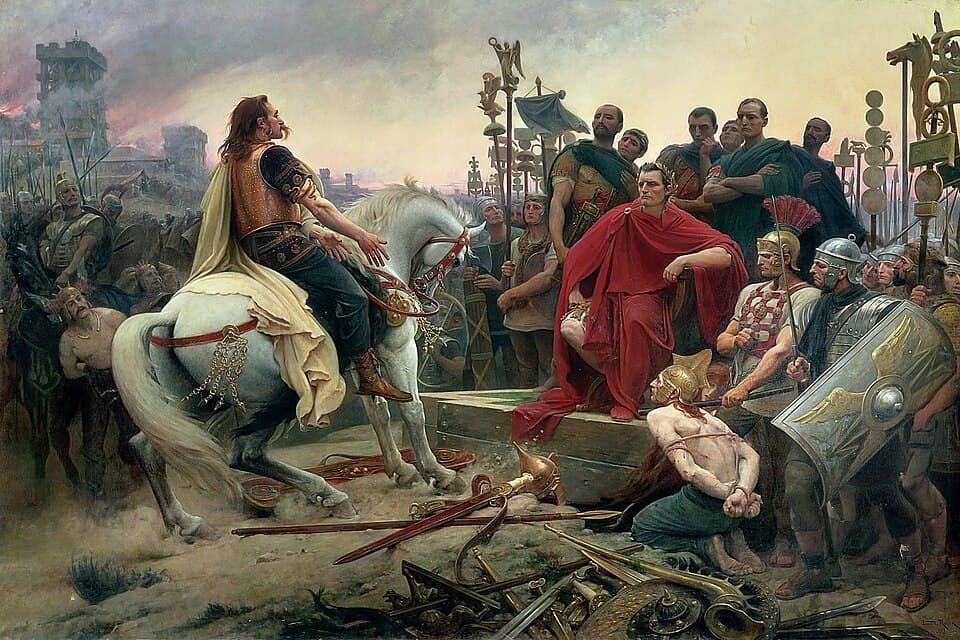
It is in a leather tent pitched on the heights near Alesia, in the autumn of 52 BC, that Julius Caesar has the Arvernian chief he has just defeated brought before him. An oil lamp makes the shadows tremble on the weapons laid on the ground; outside, the noise of the legions dismantling the siege fortifications can still be heard. The two men have known each other through war for months — one has pursued the other from Gergovia to here. Caesar, who records every day the facts of this campaign, wants to hear from the mouth of the vanquished what his chronicles cannot say.
—Vercingetorix, before I crossed the Province, your peoples had never submitted to a single chief. How did you bind rivals I thought irreconcilable?
You saw rightly, Caesar, what no Roman had seen before you: we were divided, and it is that division which opened Gaul to you. When I understood that, I spoke to the Arverni, then to the Aedui my enemies of yesterday, to the Helvetii, to all. I told them that your march would stop at no tribal border, that your army ate our quarrels like bread. At twenty-seven, I united more than sixty peoples under a single hand — men who, the day before, were still burning each other's villages. I demanded hostages, fixed the number of warriors each had to provide, harshly punished the lukewarm. That coalition was fragile, I knew it. But it was, and you had to fight it as a single nation.
Your army ate our quarrels like bread.
—You remember, no doubt, those plains I found empty and blackened as my legions approached. Why did you burn the lands of your own people?
Because I knew you, Caesar. Your legions are invincible with a full belly; hungry, they are only a troop of men far from home. I ordered the destruction of the crops, the barns, the villages that could feed you — more than twenty cities of the Bituriges in a single day. Believe me, nothing cost me more. I saw my allies weep for their houses reduced to ashes by their own torches, and I had to argue before the council that this fire saved us. The war you forced upon me was not one of pitched battles: it was one of hunger and time. To defeat a Roman, the Gaul had to accept suffering in his flesh before suffering under your sword.
Your legions are invincible with a full belly; hungry, they are only a troop of men far from home.
—And yet, at Gergovia, you did not flee: you defeated me beneath the walls of the oppidum. What did that victory against me teach you?
Gergovia taught me that you were not a god, Caesar, and my warriors learned it at the same time as I did. You had launched the assault on the height, your men climbed too far, too fast, and we hurled them down the slopes. That day, thousands of yours remained on Arvernian soil. For the first time since your arrival, the wavering peoples saw that a Gallic chief could make you retreat. The Aedui, who still served you, swung to my side after this news. I knew it was only a victory, not the war; but a victory sometimes suffices to rekindle the courage of an entire nation. You learned that day no longer to despise me.
A victory sometimes suffices to rekindle the courage of an entire nation.
—Here, at Alesia, my lines trapped you between two walls. When you saw the relief army retreat, what did you feel, you who awaited them?
The coldest despair I have ever known, Caesar. I had sent my cavalry to break through your lines before you closed the trap, to summon all Gaul to my aid. And they came — tens of thousands of men behind your back, while I held the hill. For three days, I hurled my warriors against your fortifications from the inside, believing I heard theirs striking from without. Then I saw your double rampart hold, and the relief army scatter into the night. At that moment, I knew it was all over: we were thousands, and we were dying of hunger between your stakes, unable to touch you. No wall of men had ever embraced a people as yours embraced me.
We were thousands, and we were dying of hunger between your stakes, unable to touch you.
—You could have died weapon in hand rather than come to lay down your arms at my feet. Why did you surrender alive, Vercingetorix?
Because a chief does not belong to himself, Caesar. When I convened the council in the oppidum, some wanted to fight to the last, others begged me to hand them over to spare the families from famine. I had accepted this command from their hands; I told them they could dispose of me as they wished, send me to you dead or alive. I chose to surrender so that the useless deaths of those who had followed me might cease. I came to you, I laid down my arms — you were there, seated, you know better than anyone what you saw. It was not death I feared, but the idea of letting a people who had trusted my word starve to death.
A chief does not belong to himself: they could dispose of me as they wished.
—I am told that your father, Celtillos, was put to death by your own people for wanting to rule Gaul. Did that memory weigh on you?
It weighed, Caesar, and your informants did not lie to you. My father Celtillos had held the first rank among the Arverni, and our own nobles killed him because they accused him of aspiring to kingship. I grew up with that suspicion attached to my name like a shadow. When I raised the peoples against you, many whispered that I wanted my father's crown, and that is why the elders of Auvergne first drove me from the city. I had to conquer my authority in the countryside, among the poor and the young, before returning to impose myself. Ruling did not interest me: I wanted a free Gaul, not a throne. But my father's blood had taught me what it costs to unite men who prefer their divisions.
I grew up with that suspicion attached to my name like a shadow.
—Before this war, what were your days like in the Arvernian oppidum, when you did not yet have my legions at your heels?
They had the slowness of peacetime, Caesar, which you took from us. In the morning, I inspected my warriors, received those who came to complain or seek justice, and consulted the druids on what was to be done. The afternoon was spent on horseback, at weapons training, among the young nobles I was training for combat. In the evening, we ate together around the fire — boar, pork, bread, and the wine your merchants already sold us at a high price. It was there, in those meals, that loyalties were forged. I wore the golden torque of my rank, and coins were struck in my name. All that seems barbaric to you, I know; but we had our laws, our assemblies, and an order that your chronicles only half tell.
It was there, in those meals around the fire, that loyalties were forged.
—My officers marvel that so young a chief could command grizzled warriors. How did you impose your authority on men older than you?
By harshness as much as by speech, Caesar — you know that price. I had neither gray hair nor years to command obedience, so I demanded hostages from each people, a pledge of their loyalty. Those who deserted or betrayed, I punished without flinching: fire, iron, sometimes severed ears for cowards, so that fear might stand in for respect among the lukewarm. But fear alone unites nothing. I went before the warriors, I shared their hunger and their marches, I paid in person in the front ranks. A chief whom one sees suffer like his men, one follows him even old and defiant. Thus a young Arvernian was able to raise against you the largest army Gaul had ever assembled.
A chief whom one sees suffer like his men, one follows him even old and defiant.
—Do you know, Vercingetorix, what your name means in your language? Did those who chose it for you foresee the destiny you would take?
My name says what I was before I even became it, Caesar: 'supreme chief of warriors.' I do not know if my father saw it as an omen or merely a wish. Among us, a name is a burden more than an ornament; I had to earn it in mud and blood, not inherit it. When the peoples recognized me as their sole leader, I felt that name become true — and heavy. Today, defeated before you, I wonder if it was a promise or a curse. You will take me to Rome, I know, as the vanquished are taken. But the name I bear will always say that one man, once, united all Gaul against you. That, your chains do not undo.
The name I bear will always say that one man, once, united all Gaul against you.
This imaginary interview was generated by artificial intelligence from sources documented in Vercingetorix's profile. It dramatises what the figure might have said based on what we know about them, but does not constitute attested historical testimony. For primary sources and factual documentation, refer to the full profile.