Imaginary interview with Vincent van Gogh
by Charactorium · Vincent van Gogh (1853 — 1890) · Visual Arts · 6 min read
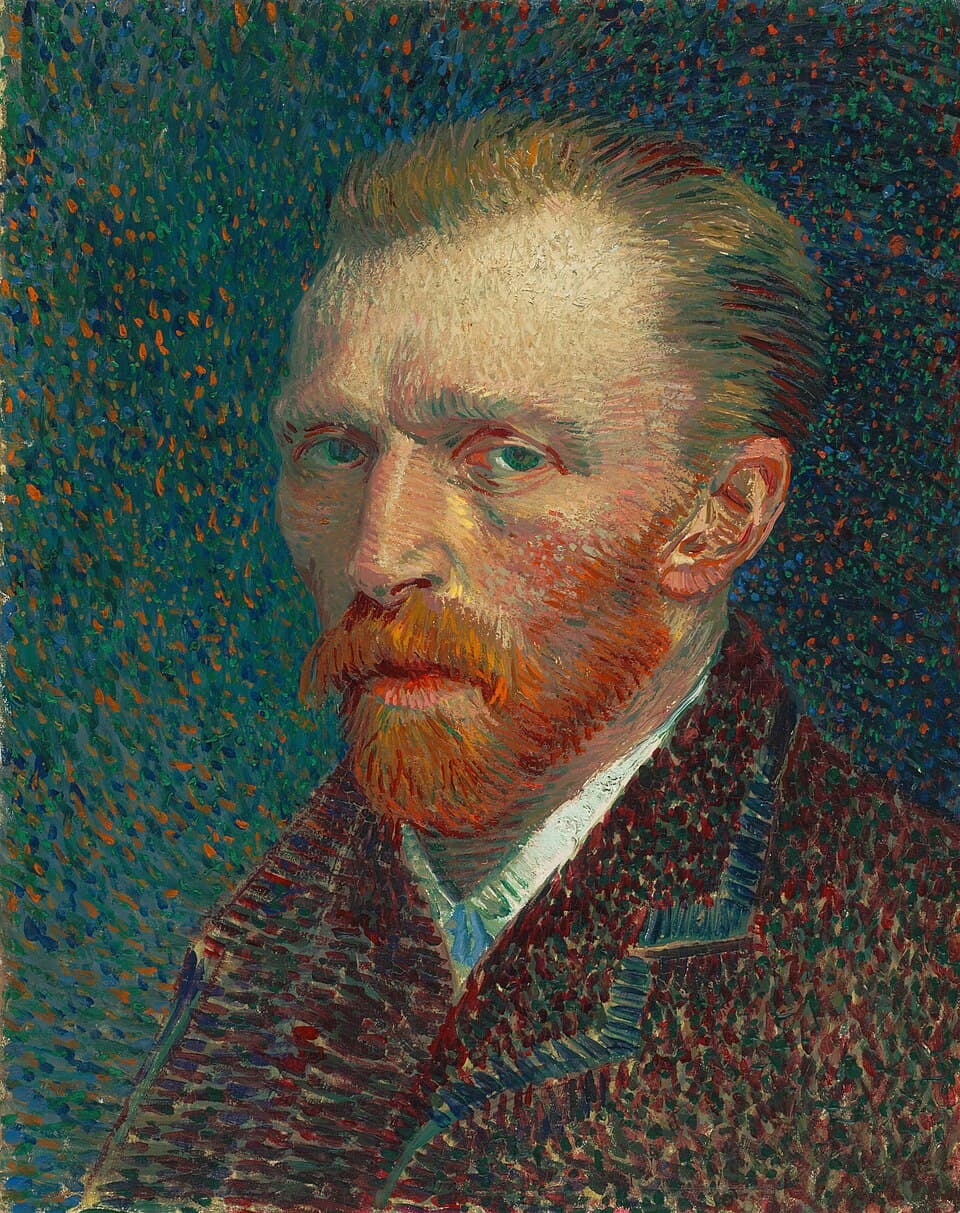
Arles, autumn 1888. The yellow house smells of linseed oil and turpentine; barely dry canvases line the walls, yellow upon yellow. Vincent van Gogh, his gaze feverish under a straw hat, agrees to set down his brushes for the duration of a conversation.
—Before the easel, you were a dealer, a preacher, a miner. How does one come to painting so late, at twenty-seven?
Before color, I wore many clothes. First I sold other people's paintings for the Goupil house, where my uncle reigned, then I wanted to save souls—preacher among the miners of the Borinage in Belgium, eating the same black bread as they did at the bottom of the pit. I was dismissed: too much zeal, it seems. It was there, in that mud, around 1880, that I understood that my hands could not bless but could draw. I was twenty-seven, the age when others settle down. Theo wrote me a single word: paint. I took up the pencil as one takes a decision that should have been taken ten years earlier, and I never let it go.
—They say your entire oeuvre spans ten years. How did you keep up such a pace?
They say I did everything in ten years, and it's true—between 1880 and today, barely a decade. But those ten years, I lived them like ten lives. In The Hague, around 1882, I was still learning to pose a figure, to dig into perspective with a frame of threads stretched before the eye. I worked from morning until night, until I made myself ill. 'Work absorbs me completely. I paint all day and in the evening I am so tired that I fall asleep almost while eating.' That is my method, if it is one: relentless persistence. You cannot make up for lost time, but you can burn it at both ends.
—Why this obsession with yellow, which bursts forth in your Sunflowers?
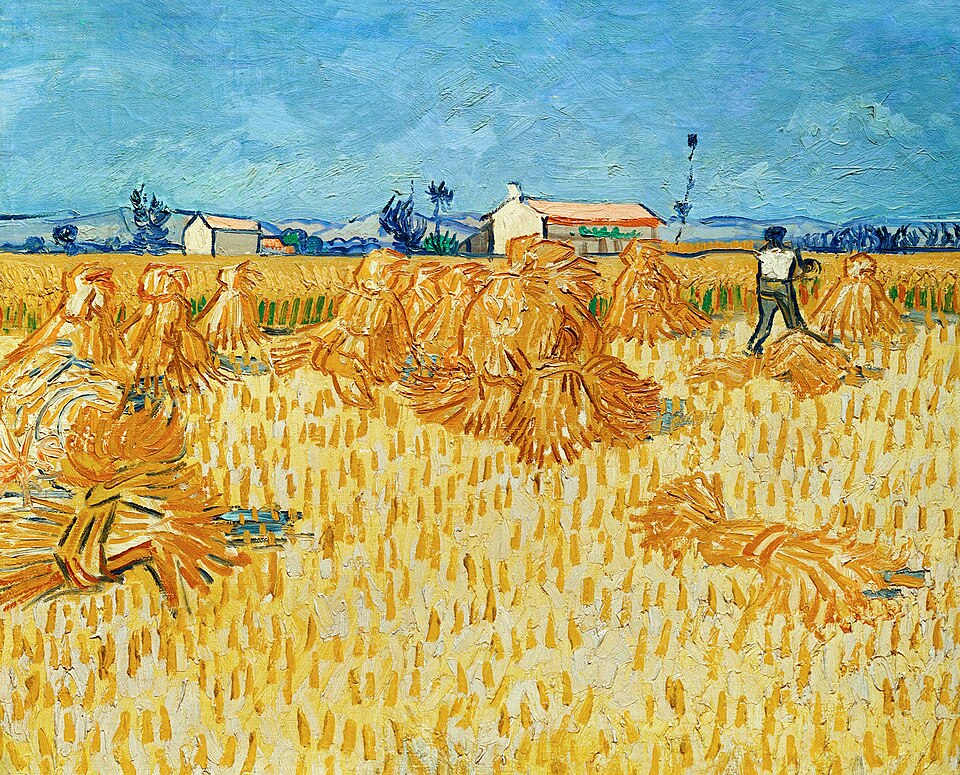
The South taught me yellow. In Arles, the light is not that of the North—it hits, it gilds the wheat until it blinds. I wanted to trap that sun in a vase. My Sunflowers, I painted them like singing a hymn: from the palest lemon to the most burnt ochre, nothing but yellows laid on yellows. I wrote to Gauguin: 'I am always seeking the true color. My paintings have a life of their own, they breathe through the matter I place on the canvas with frenzy.' It was not a painter's coquetry. I wanted the flower to breathe long after the model had withered.
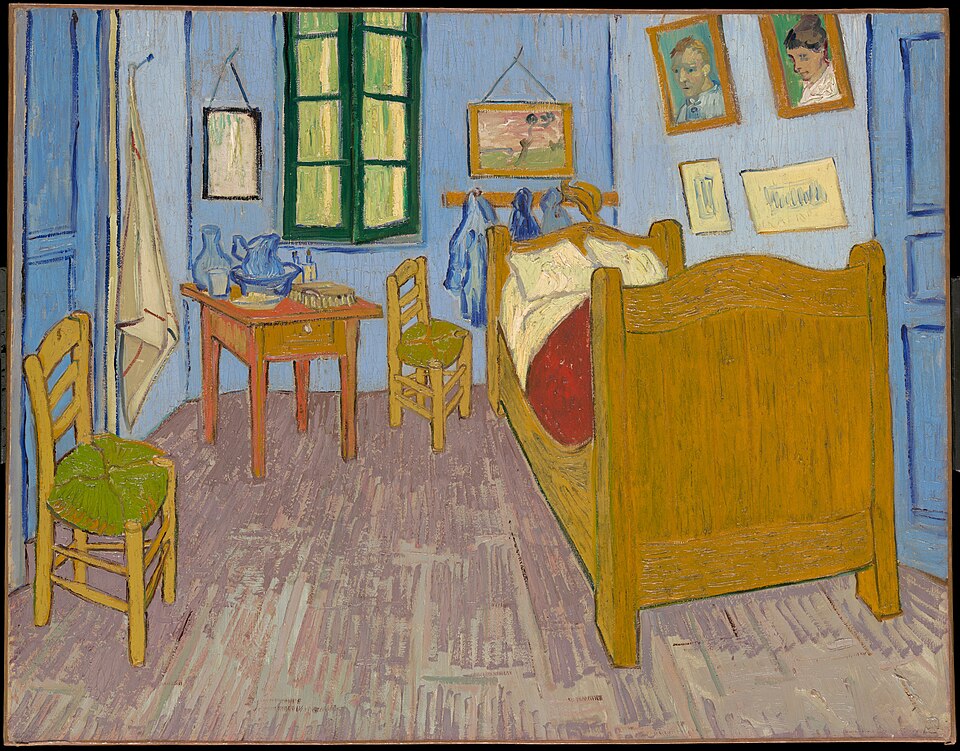
—You painted your own room. What was there to say about a bed and two chairs?
My room in Arles, I painted it because it was mine—the first, perhaps, that I could ever call so. The wooden bed, the straw chairs, the pale mauve walls, the floor that slopes askew: everything is a bit crooked, I know. I was criticized for that lopsided perspective. But I was not seeking the geometer's rule, I was seeking rest. I wanted whoever looked at The Bedroom in Arles to feel sleep, the peace of a man finally laying down his hat. The warm colors were to do the work of silence. A room, you see, is already a self-portrait—without the face.
—What happened that winter night between Gauguin and you?
It was winter 1888, in the yellow house. Gauguin and I lived side by side like two wild beasts in the same cage—he so sure of himself, I so feverish. Our quarrels about painting turned into storms. One evening, something in me gave way; I took a razor and cut off part of my left ear. Why? I cannot say exactly, and the doctors themselves are at a loss. I remember the cold, the blood, the terrified look of the neighbors. Gauguin left the next day and never returned. I had dreamed of a studio in the South, a brotherhood of painters; what remained was a scar and a great silence.
—How did you come to ask for confinement yourself?
After that night, the crises came like tides whose hour I did not know. The people of Arles took fright—a petition was circulated to have me removed, and I understand their fear, for I frightened myself. So, in the spring of 1889, I asked to be locked up. Of my own free will, I entered Saint-Paul-de-Mausole, that old cloister turned asylum near Saint-Rémy. They probably think I am broken for good. But between two attacks, I had weeks of perfect lucidity, and in those weeks I never stopped painting. The illness, if it is one, took my peace—it did not take my hand.
—That Starry Night the world knows, did you paint it with the sky before your eyes?
From my barred window at Saint-Paul-de-Mausole, I saw the day rise over the hills, and at night, stars bigger than elsewhere. The Starry Night, however, I did not paint on the spot—I composed it from memory, in the morning, in my cell, the sky still beating behind my eyelids. That swirl of stars, that black cypress rising like a flame, is not the sky I saw: it is the sky I felt. They tell me it is strange. But what is a star that one would have copied faithfully? I wanted a night that moves, where the infinite is not cold but alive.
It is not the sky I saw, it is the sky I felt.
—How could a man said to be ill produce so much in so little time?
In a single year of confinement, nearly one hundred and fifty canvases came from this hand. They marvel that a man declared ill painted so much; I painted so as not to sink. The Irises in the garden, for example—I bent over those violet flowers for hours, each one bent in its own way, and forgot all the rest of the world. The asylum had its enclosed garden, its olive trees, its cypresses: it was my entire universe. Work was my only dyke against the void. When the hand holds the brush, the head stays upright—that is what Saint-Rémy taught me better than any doctor.
—You sold only one canvas in your lifetime. How did you survive that?
In my lifetime, I will have sold only one canvas—The Red Vineyard. Just one, you hear me, after hundreds. All the rest piles up against the walls of my rooms in Arles, in Auvers. Without Theo, my brother, a dealer at Goupil, I would have starved long before my time: he sends me his money, my colors, his courage in whole letters. I live on bread, cheese, and black coffee, often skipping a meal for a tube of blue. They will say this is the life of a failure. I prefer to believe that I paint for eyes not yet born.
I paint for eyes not yet born.
—You wrote hundreds of letters to your brother. What were you seeking in that paper?
More than eight hundred letters, yes, and most to Theo. In the evening, after painting, when fatigue pins me down, I still write—it is my way of thinking aloud, of holding onto another across the distance. I tell him my doubts, my colors, my debts. I wrote to him one day: 'I dream my painting and I paint my dream. I want to paint men and women with something of the eternal, whose halo was once symbolized by the aureole.' Those pages were not meant to be kept. But if I am read one day, in a hundred years, I would like them to hear not a madman, but a man who was searching.
—Ultimately, beyond color, what were you trying to grasp?
Always the same thing: to understand. 'One only paints well what one understands,' I wrote from Saint-Rémy, and I believe it more than ever. Color is not an ornament, it is a language—yellow for the tenderness of the sun, blue for the infinite, green for the hope or despair of men. I did not paint things, I painted what they made me feel. A wheat field under a stormy sky in Auvers will say more about my life than my face in the mirror. If my canvases still breathe when I am no longer here, then I will not have lived in vain.
I did not paint things, I painted what they made me feel.
This imaginary interview was generated by artificial intelligence from sources documented in Vincent van Gogh's profile. It dramatises what the figure might have said based on what we know about them, but does not constitute attested historical testimony. For primary sources and factual documentation, refer to the full profile.