Kids interview Wolfgang Amadeus Mozart
by Charactorium · Wolfgang Amadeus Mozart (1756 — 1791) · Music · 5 min read
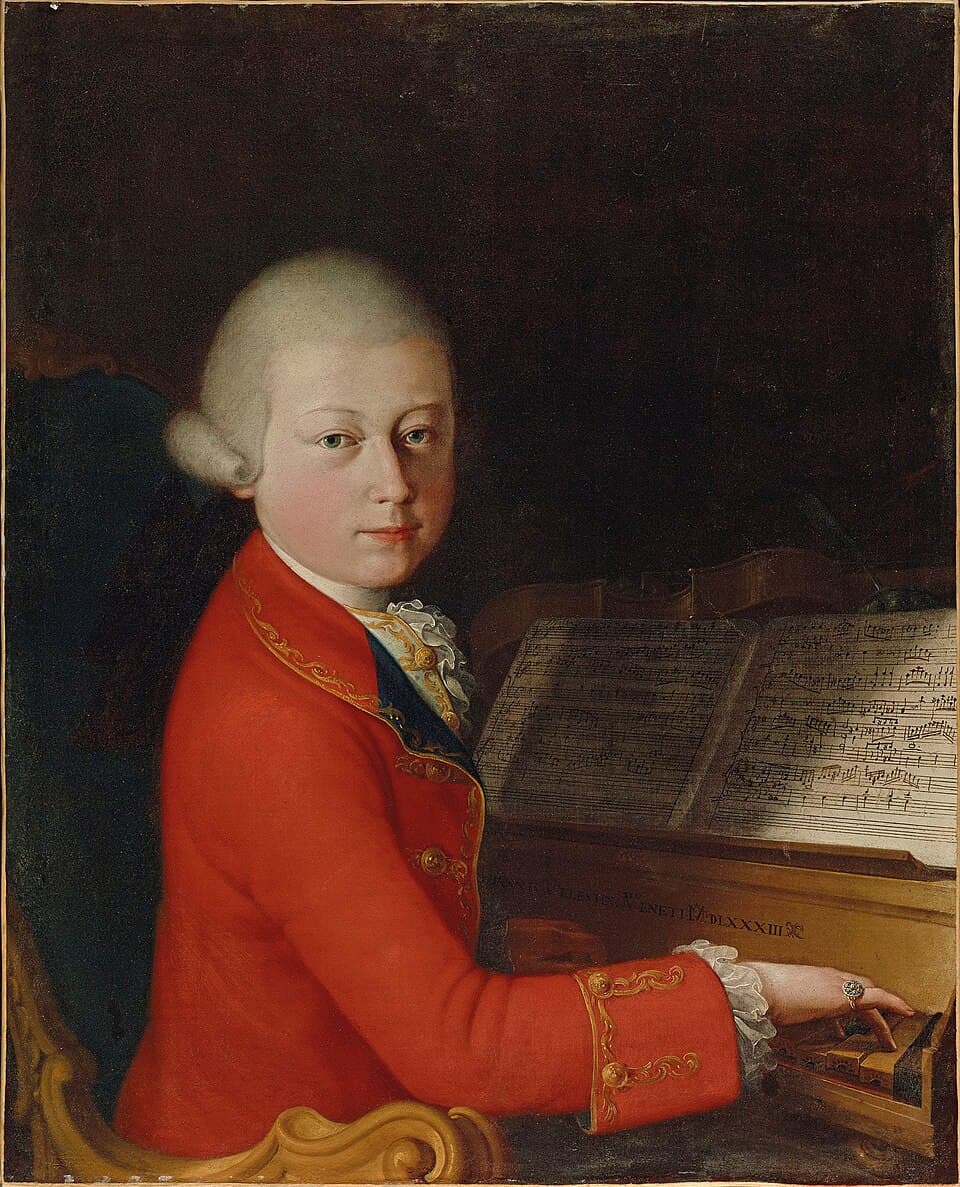
Two twelve-year-old visitors push open the door of a grand room where a pianoforte stands. That morning, their school trip meets a composer in an embroidered coat. He looks at them, smiles, and invites them to sit near him.
—How old were you when you wrote your very first piece of music?
You know, my child, I was barely five years old when I composed my first little minuet. A minuet is a dance in triple time, slow and elegant, danced at court. Imagine a tiny boy, standing on a stool, placing his fingers on the harpsichord and already finding melodies. My father Leopold couldn't believe his ears. Very soon, he took me on the road with my sister Maria Anna. We traveled by carriage for weeks, jostled on the roads, to go play before kings.
At five, I was already finding melodies on the harpsichord.
—What was it like to play before a real king when you were little?
Oh, it was impressive! In 1765, I played at Versailles before King Louis XV. Imagine a huge hall, candles everywhere, ladies in big gowns smelling of powder and perfume. And me, that little boy, having to play without a mistake. My heart was pounding, I admit. But as soon as my fingers touched the keys, fear flew away. The sovereigns were amazed: a child playing harpsichord and violin like an adult! They would make me play blindfolded, just to see if it was real.
As soon as my fingers touched the keys, fear flew away.
—Is it true that you wrote an opera when you were still a child?
It's true, and I'm proud of it! At fourteen, I composed Mitridate, re di Ponto, a grand opera in Italian. An opera is a play entirely sung, with an orchestra. It's enormous work: hours of music, dozens of singers. Many people didn't believe a boy my age could do it. Some thought my father wrote it for me! So they would lock me in a room, alone with my pen and inkwell, to prove the music came from me.
They locked me in alone to prove the music came from me.
—What did you eat in the morning before starting to write your music?
Ah, you ask a real gourmand's question! I rose early, around six or seven o'clock. A very simple breakfast: a little bread, and above all coffee or a nice hot chocolate. Imagine the steam rising from the cup in the morning, when the city of Vienna is still silent. No machine noise, just the hooves of horses in the street. And there, with a clear mind, I would sit at my table. I dipped my pen in the inkwell and wrote the notes on paper. That was my favorite moment.
In the morning, with a clear mind, I wrote the notes one by one.
—How did you manage to write over 600 pieces of music in such a short time?
You know, I lived only thirty-five years, and yet I wrote over 600 works: symphonies, concertos, operas. How? Because music turned constantly in my head, even while walking, even while eating. Often a melody was already complete in my mind before I wrote it down. My hand only had to copy it onto paper. Imagine a garden where flowers grow by themselves: I only had to pick them. But don't think it was magic: I had to work, again and again, every day.
Music grew in my head like flowers in a garden.
—Were you happy when your opera Don Giovanni was a success?
Very happy, yes! It was in Prague, in 1787. The Praguers adored me, much more than the Viennese sometimes. A theater director, Guardasoni, had commissioned an opera from me: Don Giovanni, the story of a seducer punished for his misdeeds. I had already triumphed there with The Marriage of Figaro. Imagine an entire hall standing, applauding, shouting your name. On the opening night, they say I finished writing the overture just in time, almost at the last moment! It was in those distant cities that I felt most loved.
It was in Prague, far from home, that I felt most loved.
—Why did you travel so much to have your operas performed?
Because a composer, my child, had to go where he was wanted. I had no king who kept me for himself all my life. So I climbed into my traveling carriage and left: Munich, Mannheim, Paris, Prague. Long, dusty, tiring roads. But in each city, a new audience, a new chance to have my music heard. An opera is commissioned, performed, paid for. I lived by my art, and I constantly had to find who would listen. That was the life of a free musician.
I lived by my art, and my art carried me on the roads.
—What's this story about hidden symbols in The Magic Flute?
Ah, you have a sharp eye! In 1785, I joined the Freemasons in Vienna. It was a society of men who met to talk about liberty, brotherhood, tolerance — the great ideas of my time, called the Enlightenment. In my final opera, The Magic Flute, from 1791, I slipped in symbols of that brotherhood: trials, numbers, the passage from night to light. Imagine a fairy tale with a hidden message underneath. Children see the magic; adults hear an ideal that was close to my heart.
A fairy tale on top, and an ideal of liberty hidden beneath.
—Why were these ideas of liberty and tolerance important to you?
Because I grew up in an age when people were beginning to think differently, my child. They said all men deserved respect, regardless of birth. I was a musician's son, not a prince's, and I often had to bow before nobles. So those ideas of brotherhood, I felt them in my heart. Freemasonry brought together very different men who treated each other as equals. Imagine a big table where the rich and the less rich sit side by side. That idea, I put it into music, softly, in my last works.
A big table where everyone sits as an equal: that was my dream.
—Is it true that you never finished your last piece of music?
It's true, and it still weighs on my heart. At the very end of my life, I was working on a Requiem, a sung prayer for the dead. The score opens with terrible Latin words: Dies irae, the "day of wrath." But illness took me before the end. I died in Vienna, on December 5, 1791, at only thirty-five. Imagine a painter falling asleep, brush in hand, before an almost finished painting. My pupil Süssmayr completed the work in my place, following what I had explained to him.
I fell asleep with the brush in my hand, before the almost finished work.
—Weren't you afraid to write music for the dead?
You touch something deep, my child. No, fear was not the right word. It was more a great emotion. Writing a Requiem is reaching out to those who leave, and accompanying them with sounds. Toward the end, I was often tired, without much money despite all my fame. Imagine someone famous across Europe, yet struggling to pay his rent. It's sad, I know. But music never abandoned me. Until my last breath, it sang within me.
Until my last breath, music sang within me.
This imaginary interview was generated by artificial intelligence from sources documented in Wolfgang Amadeus Mozart's profile. It dramatises what the figure might have said based on what we know about them, but does not constitute attested historical testimony. For primary sources and factual documentation, refer to the full profile.