Imaginary dialogue between Leopold Mozart and Wolfgang Amadeus Mozart
by Charactorium · Wolfgang Amadeus Mozart (1756 — 1791) · Music · 5 min read
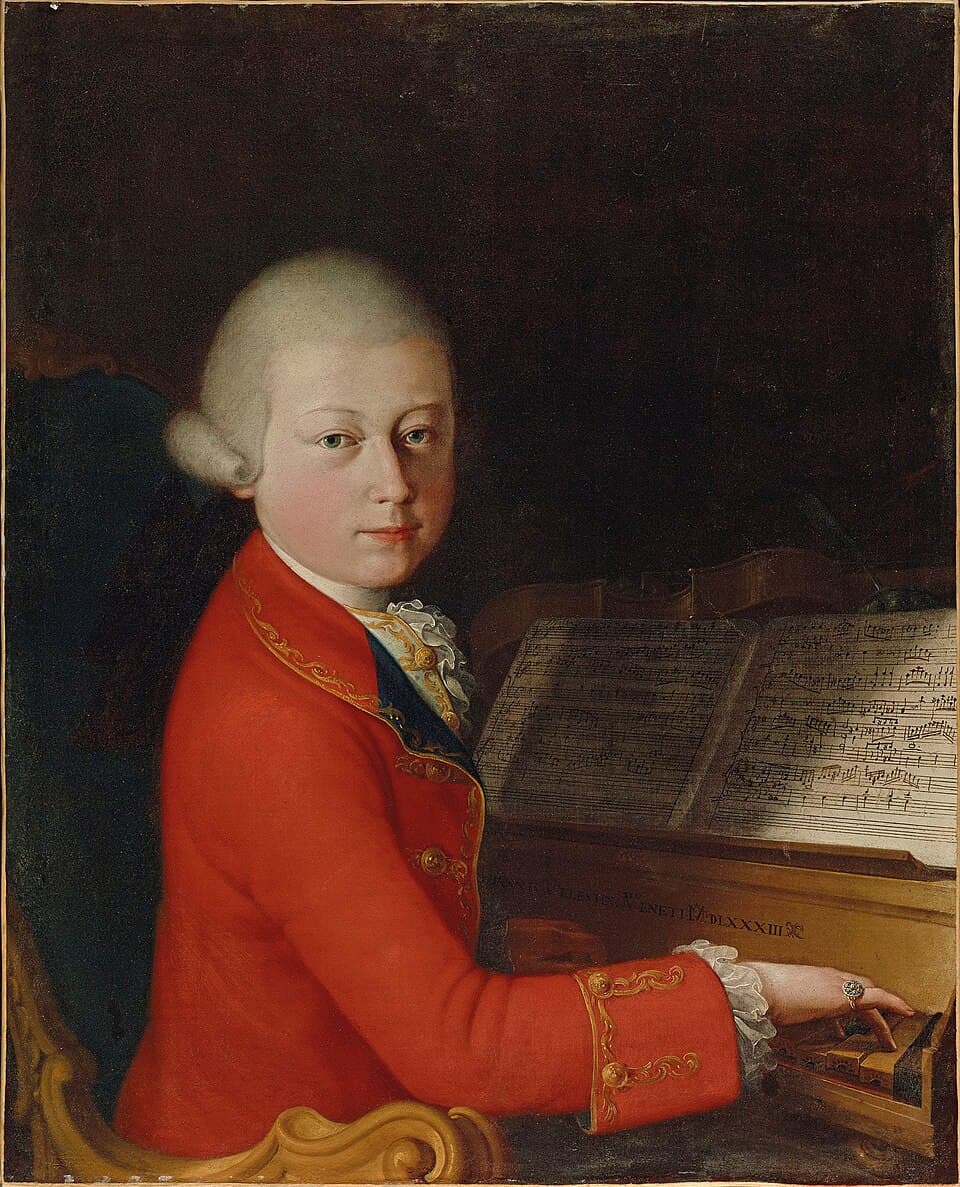
It is in Wolfgang's Vienna apartment that Leopold Mozart, come from Salzburg despite the fatigue of age, finds his son in this winter of 1787. On the pianoforte are piled scores still damp with ink, and the candlelight flickers over the scribbled staves. The father and former master observes, half-proud, half-anxious, this thirty-year-old man who was once his child prodigy. He has come not to applaud the public, but to hear, perhaps one last time, what his son's heart confides only to him.
—Wolfgang, do you remember that minuet scrawled at five years old, when I first took you on the roads of Europe?
How could I forget it, my father? You would set me on the benches of harpsichords when my feet did not yet touch the ground. I remember that endless tour, you driving the carriage from court to court, with my sister Maria Anna at my side. At Versailles, before Louis XV in 1765, they had me play harpsichord and violin like a curiosity, and the sovereigns marveled. But you alone knew that behind the little boy being exhibited, there was already a musician hearing symphonies in his head. You taught me to turn that astonishment of the great into a true craft.
Behind the little boy being exhibited, there was already a musician hearing symphonies in his head.
—When I wrote to your mother, in 1768, that the court musicians were astonished by the maturity of your symphony, was I exaggerating out of fatherly tenderness?
You were not exaggerating, and you knew it. At ten I had already put several symphonies on paper, and you made sure each note withstood the scrutiny of established masters. Then came Italy, that journey you wanted to perfect my art. In Milan, at fourteen, I composed Mitridate, re di Ponto, and it is hard to believe that an entire opera can be born from a child. But it was not magic, father: it was your exactingness, your corrections, those hours when you would correct me without mercy. People saw a prodigy; I saw hard work, yours as much as mine.
People saw a prodigy; I saw hard work, yours as much as mine.
—Here in Vienna, far from my watchful eye, tell me how your working days pass, my son.
I rise early, around six or seven, as you taught me. A little coffee or chocolate, some bread, and I immediately sit at the table, taking advantage of the morning light to write with pen and ink, the pianoforte within reach to check a chord. In the afternoon, I give lessons to round out my income, I rehearse with musicians, I dine. Evenings belong to concerts and salons of the Viennese aristocracy. It is a regulated life, almost monastic in its labor, but in the evening, before sleeping, melodies still come to me and I jot them down hastily before they flee.
Before sleeping, melodies still come to me and I jot them down hastily before they flee.
—Word of the triumph of The Marriage of Figaro reached me even in Salzburg. Wasn't that play by Beaumarchais too daring for the stage?
Daring it was, and that is precisely what attracted me. Beaumarchais's comedy dares to show a valet cleverer than his master, and I had to soften some audacities for it to be tolerated in Vienna. But what mattered to me was not the scandal: it was to make these characters sing, to blend the laughter of opera buffa with real human tenderness. Vienna received the work with restraint, but Prague embraced it wholeheartedly — there, I am told, they whistle my tunes even in the streets. You always told me that an opera is only worth the truth of its characters. With Figaro, I believe I finally understood what you meant.
What mattered to me was not the scandal, but to make these characters sing.
—And now Prague is already commissioning a new work from you, this Don Giovanni. Will you be able to honor such a contract on time?
The impresario Guardasoni did things properly: a contract in due form, an opera in several acts for the Prague theater. I confess, father, the subject excites me as much as it frightens me. This impious seducer, this Don Giovanni who defies Heaven and men, forces me to blend comedy with the darkest tragedy as I have never dared. Composing on commission, you taught me, is not betraying one's art: it is testing it against a deadline and a real stage. I work quickly, sometimes I carry the entire work in my head before writing the first stave. Prague awaits me, and I will not disappoint the city that made me king.
I carry the entire work in my head before writing the first stave.
—When I came to see you in Vienna in 1785, I myself was received in your lodge. What were you seeking, my son, by joining Freemasonry?
I sought, and I found, a brotherhood that neither the court nor the church offered me. You remember that ceremony where we found ourselves brothers as much as father and son — it moved me deeply. The lodge carries the ideas of our century: freedom, tolerance, equality of men regardless of rank. These values nourish my music more than one might guess; I already dream of a work that would bear its symbols, light triumphing over darkness. For a musician dependent on the goodwill of archbishops and princes, there is a breath of dignity here. We are not only at the service of the great: we also serve a higher idea of man.
We are not only at the service of the great: we also serve a higher idea of man.
—These apartments you rent are beautiful, Wolfgang, but your mother and I worry about your debts. Does glory not feed you?
Glory fills the halls, father, but not always the purse. I am applauded, I am commissioned operas, and yet I must multiply lessons and subscription concerts to maintain my standard. Vienna is expensive, and the status I wish to keep — these fine clothes, this lodging where I can receive my students and give private concerts — costs more than it brings in. I know your worry, and I share it some evenings. But I could not compose as a beggar: a musician who hides gets no commissions. I prefer to bet on my work than to hide in prudence. Money comes and goes; the works remain.
I prefer to bet on my work than to hide in prudence.
—I am growing old, my son, and illness presses me more than I admit. You who write for God as much as for princes, what does the thought of death inspire in you?
Do not speak thus, father — and yet, since you ask, I will answer you frankly, as I would to you alone. I have learned, perhaps in the lodge, perhaps in myself, no longer to see death as an enemy. It is the true end of our life, and I have accustomed myself to regard it as a friend rather than a threat. This thought does not sadden me: it consoles me and calms my nights. When I write sacred music, a Kyrie, an office for the dead, I do not compose the terror of judgment but the peace of one who entrusts himself. Know this well: what I feel when thinking of it has nothing bitter. Keep courage, and take care of yourself for me.
I have accustomed myself to regard death as a friend rather than a threat.
—You always told me that an opera is governed like a kingdom. How do you concretely give a soul to each character?
I begin by listening to my characters speak before making them sing. Each must have his own voice: the cunning valet does not have the same melody as the great lord, the lovesick maid does not breathe like the wounded countess. Music must embrace the drama without ever slowing it — an aria is only worth if it advances the action or reveals a heart. You taught me in Salzburg this balance between voice and orchestra, never to let one overwhelm the other. For Figaro as for this Don Giovanni, I first carry the entire plot in my head, then the notes come almost of themselves, as if the characters dictate their score to me. The art is only to listen to them long enough.
An aria is only worth if it advances the action or reveals a heart.
This imaginary interview was generated by artificial intelligence from sources documented in Wolfgang Amadeus Mozart's profile. It dramatises what the figure might have said based on what we know about them, but does not constitute attested historical testimony. For primary sources and factual documentation, refer to the full profile.