Imaginary interview with Wolfgang Amadeus Mozart
by Charactorium · Wolfgang Amadeus Mozart (1756 — 1791) · Music · 5 min read
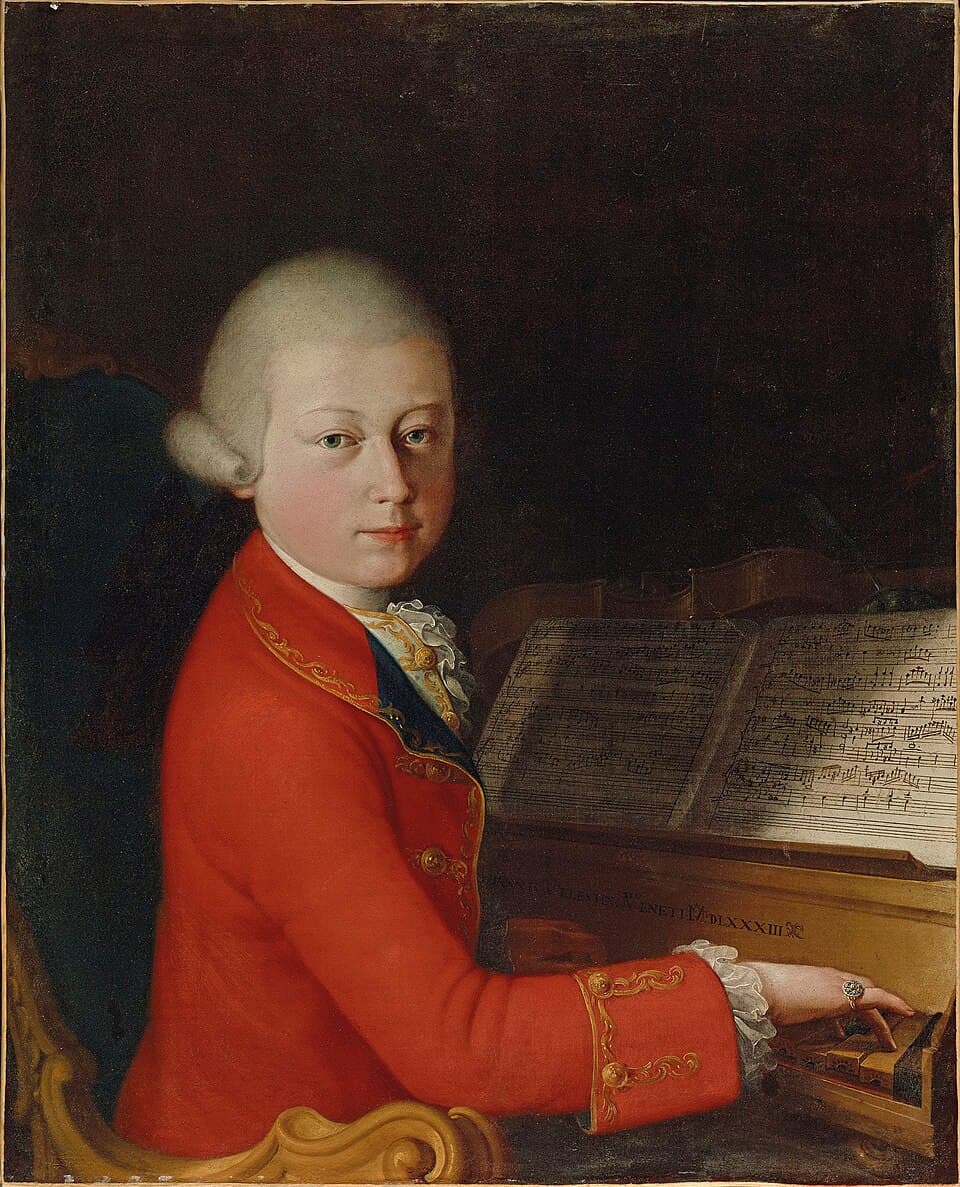
Vienna, one morning in autumn 1791. In a rented apartment where sheets of ruled paper and a nearly dry inkwell lie about, a small man, already weary, sets down his quill near the pianoforte. He agrees to the interview on condition that he is not detained too long: he has, he says, a Mass for the dead to finish.
—What is your earliest memory as a musician?
I am told I was five when I scribbled my first minuet, and I am willing to believe it, for I remember no time when I was not writing. My father Leopold very early cast us onto the roads, my sister Maria Anna and me, crammed into a travel carriage that smelled of leather and dust, from court to court. At Versailles, before Louis XV, they watched me play the harpsichord as one watches a little learned monkey that had swallowed an orchestra. I loved their applause, I will not hide it. But already I felt this strange thing: they marveled at my age, never quite at my music. The child amused; the composer, as yet, had to be born in their eyes.
They marveled at my age, never quite at my music.
—What did that exhibited childhood cost you?
Before I was ten, I had written symphonies, and at fourteen, in Milan, my Mitridate, re di Ponto held the bill as the work of a grown man. People think precocity is a gift; it is also a debt. I learned to please before I learned to live, to count bravos before counting my money. My father saw in every archbishop, every prince, a benefactor; I, later, saw masters in them. My whole childhood was a long audition. When I was applauded as a child, no one wondered what that child would become once the novelty wore off. I spent the rest of my life answering that question no one asked.
My whole childhood was a long audition.
—Why did you choose to settle in Vienna?
Because in 1781 I understood that one serves well only where one can breathe. Vienna is a city of musicians, full of salons, theaters, patrons who pride themselves on taste. There I broke with the livery of Salzburg to live by my own hands: lessons in the afternoon, subscription concerts, sold scores. My days there are as regular as a sonata. I rise around six, take my chocolate, and as long as the morning light is clear, I write; that is the hour when ideas come without being fetched. The afternoon belongs to pupils and rehearsals, the evening to aristocratic salons. Vienna gave me freedom — and, like all freedom, the fear of tomorrow.
Vienna gave me freedom — and, like all freedom, the fear of tomorrow.
—How does a work like your Symphony in G minor come to life?
My Symphony No. 40 came out of me in 1788 like something not entirely decided. People think me the composer of the smile, the galant style, melodies remembered at first hearing; they call me amiable. But G minor is a key in which I let in what I silence elsewhere: a feverishness, a foreboding. That same year, my Piano Concerto No. 21 offered the public its sweetness, its slow movement that everyone hums. And yet both come from the same workshop, the same pen, the same man bent over his ruled paper in the early morning. Gaiety and anxiety, you see, are not opposites: they share the same keyboard.
Gaiety and anxiety are not opposites: they share the same keyboard.
—What attracts you so much to opera?
Because in opera, music ceases to be ornament and becomes destiny. With The Marriage of Figaro, in 1786, I took a play by Beaumarchais deemed too daring, where a valet triumphs over his master, and I let each voice say what words alone dared not. A well-written ensemble is three or four hearts beating together without agreeing, and the orchestra knows what they still ignore. That is my true theater: not to illustrate a story, but to make audible the interior of beings. A symphony moves; an opera accuses, pardons, seduces, condemns. That is where I feel most free, and most dangerous.
A well-written ensemble is three or four hearts beating together without agreeing.
—They say Prague understood you better than Vienna. Is that true?
Prague loved me with a love I no longer expected. When director Guardasoni commissioned an opera for his theater, I set to work on Don Giovanni, in 1787, and I wrote to my family that it was a great enterprise, but that I was confident of producing something remarkable. There, people whistled my tunes in the streets, coachmen hummed them; in Vienna, they listened politely and then forgot me until the next season. My damned seducer, who defies heaven even in the flames, found in the Praguers an audience unafraid of brimstone. A city that loves your dark work is worth ten courts that love only your name.
A city that loves your dark work is worth ten courts that love only your name.
—What did you seek by joining Freemasonry?
In 1785, I entered a Viennese lodge, and there I found what the antechambers of princes had never given me: men who spoke to me as a brother, not a servant. Freemasonry carried the spirit of the times, those ideas of tolerance and brotherhood rising across Europe like a gentle tide. I put something of it into The Magic Flute, this year 1791: the trials, the light gained by crossing the night, those solemn chords that strike three times like a knock at a door. People see a fairy tale for the people, and it is one; but beneath the magic, I hid my faith in a man who rises by his own integrity.
Beneath the magic, I hid my faith in a man who rises by his own integrity.
—Why hide such serious ideas in a folk tale?
Because the people are the best of judges when one stops despising them. The Magic Flute is performed in a popular theater, with cardboard dragons and birdcatcher whistles, and I am proud of it. One can laugh at Papageno who thinks only of eating and marrying, and weep at the ordeal of silence and fire. I believe, like so many minds of my century, that one does not instruct men by lecturing them but by charming them. The classicism attributed to me is not a cold geometry: it is the art of saying grave things with clarity, so that the learned and the apprentice each find their account. Truth passes better when it sings.
One does not instruct men by lecturing them but by charming them.
—You are currently working on a Requiem. How did this commission come to you?
A messenger came, for an unnamed patron, to ask me for a Mass for the dead. I have been working on it since, and I confess that the words of the Dies irae — that day of wrath that will reduce the world to ashes — no longer leave me. I carry these lines within me: Kyrie eleison, have mercy, and that solvet saeclum in favilla that sounds like a warning. My body betrays me, my strength fails, and I sometimes believe, in my dark hours, that this Mass I write for myself. If I should not finish it, my pupil Süssmayr knows my intentions and will know how to carry the work where I wanted it to go. One does not leave a prayer unfinished orphaned.
I sometimes believe that this Mass I write for myself.
—How do you experience the contrast between your fame and your present difficulties?
That is the irony of my life: my name runs across Europe, I am played from Prague to Vienna, yet I count my florins. Fame pays neither the rent nor the doctor. I have known the suppers of the aristocracy, the wine and coffee of the salons, the embroidered clothes a court musician must wear — and I also know the anxiety of the letter written to borrow a few ducats. More than six hundred works from this pen, and I do not know if I will leave enough for my Constanze to live on. If anything of me survives, it will not be a fortune; it will be, I hope, a handful of melodies that people will continue to hum without knowing who wrote them.
Fame pays neither the rent nor the doctor.
This imaginary interview was generated by artificial intelligence from sources documented in Wolfgang Amadeus Mozart's profile. It dramatises what the figure might have said based on what we know about them, but does not constitute attested historical testimony. For primary sources and factual documentation, refer to the full profile.