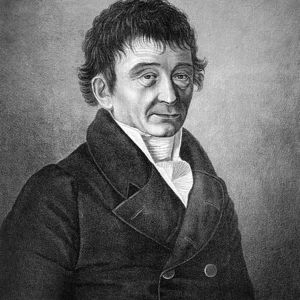

German physicist and musician, considered the father of modern acoustics. He revealed the vibration modes of plates through the figures that bear his name.
Ernst Chladni(1756 — 1827)
Ernst Chladni
royaume de Prusse
5 min read
Frequently asked questions
Key Facts
- Born in 1756 in Wittenberg, died in 1827 in Breslau
- Published in 1787 'Discoveries in the Theory of Sound', describing the Chladni figures
- Developed the method of acoustic figures by sprinkling sand on a plate set vibrating with a bow
- Demonstrated as early as 1794 the extraterrestrial origin of meteorites, founding the science of meteoritics
- Invented musical instruments such as the euphon and the clavicylinder
Works & Achievements
First work presenting sound figures; in it he describes the sand-and-bow method that made him famous.
A work defending the cosmic origin of meteorites, thereby founding the science of meteorites against the prevailing opinion.
A landmark treatise that systematized the scientific study of sound and earned Chladni the title of father of modern acoustics.
A keyboard musical instrument producing sounds through friction on glass, presented during his tours.
Demonstration of the vibration modes of plates, the experimental basis for the study of standing waves still taught today.
An extension of his acoustic research, in which he deepened the study of vibrations and the speed of sound.
Anecdotes
To make invisible vibrations visible, Chladni would sprinkle fine sand on a metal plate, then draw a violin bow across its edge. The sand fled the areas that vibrated the most and gathered along the motionless lines, tracing elegant geometric figures known today as “Chladni figures.”
In 1809, Chladni presented his sound figures before Emperor Napoleon in Paris. Fascinated, Napoleon is said to have declared that Chladni “made sound visible,” and offered a reward of 6,000 francs to anyone who could explain these figures mathematically.
Chladni spent much of his life on the roads of Europe as a travelling lecturer, carrying his instruments to give paid demonstrations. It was partly thanks to these tours that he funded his research, at a time when the profession of independent researcher barely existed.
In 1794, Chladni published a book arguing that certain stones fallen from the sky — meteorites — truly came from space. Most scholars mocked the idea, but he was right: he is also regarded as one of the founders of the science of meteorites.
Chladni invented two original musical instruments based on rubbed glass or steel rods, the euphone and the clavicylinder, with which he livened up his lectures to attract the public.
Primary Sources
By scattering sand over a plate and setting it vibrating with a bow, one sees the sand arrange itself into regular lines that mark the places which have remained at rest.
Acoustics is the science that deals with sound and everything related to it; it must be founded on the observation of the vibrations of sounding bodies.
These masses of iron cannot have come from the Earth; everything indicates that they fell from the sky and that they have a cosmic origin.
Key Places
Town in Saxony where Chladni was born in 1756 and grew up in a family of university-trained jurists.
City where Chladni studied law and philosophy before devoting himself to the physics of sound after his father's death.
Here Chladni presented his sound figures before the Academy of Sciences and Emperor Napoleon in 1809.
City in Silesia where Chladni died in 1827, during one of his many lecture tours.
Typical Objects

A square or circular metal plate fixed at its center, made to vibrate with a bow to reveal its modes of vibration. It is the emblematic instrument of his acoustics experiments.

Drawn against the edge of the plate, it transmits the energy that sets the metal vibrating. Chladni repurposed this musical object to turn it into a scientific tool.

Sprinkled over the plate, it flees the agitated areas and gathers along the motionless lines, tracing the visible figures. Without it, the vibrations would remain invisible.

A musical instrument invented by Chladni, producing sounds through the friction of a glass cylinder driven by a keyboard. He used it during his lecture-performances.

Another instrument created by Chladni, made of rubbed glass rods touched with wet fingers to produce crystalline sounds. It bears witness to the link between his research on sound and music.

A mass of cosmic iron that he studied to prove that certain stones really do fall from the sky. His analysis founded the science of meteorites.
School Curriculum
Vocabulary & Tags
Key Vocabulary
Daily Life
Morning
Chladni, an independent scholar and traveler, often began his mornings by preparing his demonstrations: polishing his metal plates, tuning his instruments, checking his bow. During his tours, he would go early to the rented halls to set up his equipment ahead of the audience to come.
Afternoon
His afternoons were devoted to writing his treatises, corresponding with other European scholars, and reading the latest scientific publications. He meticulously recorded his observations on vibrations and the figures he obtained.
Evening
In the evening, Chladni gave his famous lecture-performances: he combined acoustics experiments with concerts on the instruments he had invented. These paid sessions allowed him to fund a life of research without a permanent university position.
Food
Like a German bourgeois of the Enlightenment, Chladni ate rye bread, soups, vegetables, pork, and game, washed down with beer or wine. While traveling, he depended on the inns that dotted the roads of Europe.
Clothing
He wore the attire of the late-18th-century scholar and traveler: a dark frock coat, a waistcoat, breeches and later trousers, a collared shirt, and leather boots suited to long journeys by stagecoach.
Housing
With no permanent university residence, Chladni lived largely as an itinerant man, lodging in inns and with hosts as his lecture tours took him across Germany, France, and Central Europe.