Kids interview Yaa Asantewaa
by Charactorium · Yaa Asantewaa (1832 — 1921) · Military · 4 min read

That morning, two young visitors push open the door of a classroom transformed into a journey through time. Before them stands an elderly woman with a sharp gaze, draped in a cloth of a thousand colors. Yaa Asantewaa, queen mother of the Ashanti nation, greets them with a smile — she has so much to tell them.
—What was your job before the war, when you were queen mother?
You know, my child, I was queen mother of Ejisu. That means I was a respected woman, someone people came to for advice. Among us Ashanti, we trace the family through mothers, not fathers. So an older woman like me was listened to. In the morning, I would hear the complaints of the villagers. In the afternoon, I sat in the council of elders, those wise old men who made decisions together. In fact, I was the one who appointed my grandson as chief. Imagine: a grandmother choosing who will lead. That's why, on the day I spoke up, the warriors turned to me.
Among us, we listen to grandmothers — especially when they speak loudly.
—What did it smell like, and what did you eat in the morning in your palace?
Ah, you are curious! My palace in Ejisu was made of buildings around courtyards of earth, with the sun warming the walls. The morning smelled of wood fire and spices. I was served yam — a big root that is mashed — plantains, sometimes poultry offered as a gift. The sauces were spicy on the tongue, with peanuts and chili. I wore my handwoven kente cloth and gold on my wrists. You see, I lived like a great lady. But that comfort never made me forget my people.
The gold on my wrists never made me forget my people.
—Why did you stand up and speak before all those chiefs?
It was in March 1900. The British governor, Frederick Hodgson, had gathered our chiefs. And there, he dared to demand our Golden Stool! Can you imagine his audacity? The chiefs bowed their heads, afraid of war. The silence was heavy as a stone. Then my heart beat very fast, and I stood up. I told the men that if they would not go forward, then we, the women, would. A chronicle of the time, the Gold Coast News, recorded my words. That day, my voice awakened an entire people lulled by fear.
If the men will not go forward, then we, the women, will.
—Were you afraid when you said that? You were so old!
I was over seventy years old, my child. My hands trembled a little, it's true. But do you know what is more frightening than war? Living on your knees. Seeing your people humiliated without saying a word. That was unbearable for me. When I spoke, I did not think of my age or my old bones. I thought of my ancestors, who had fought for their dignity. The traditions passed down by word of mouth still remember that moment. Yes, I was afraid; but courage is precisely being afraid and moving forward anyway.
Courage is being afraid and moving forward anyway.
—Is it true that you commanded an army at your age?
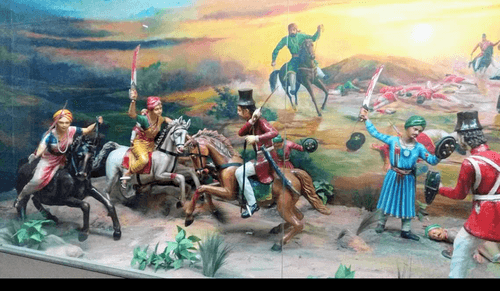
Yes, it's true! I was appointed commander-in-chief of the Ashanti armies. For an elderly woman, it was extremely rare — almost unheard of. This war is called the War of the Gold, in 1900-1901. I led the siege of the British fort at Kumasi. A siege means surrounding the enemy to prevent them from leaving. For weeks, we held out. I organized the positions, I oversaw the tactics. Imagine an old lady showing the warriors where to place their forces. It was no game: the freedom of my people was at stake there, before those walls.
An old lady can command an army, if her heart is stronger than her age.
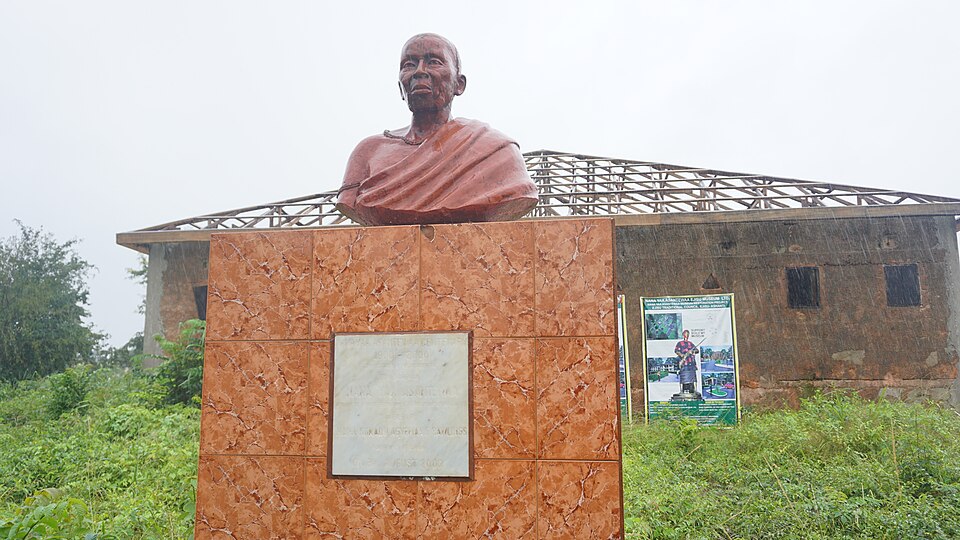
—What weapons did you have against the British?
Our warriors carried Martini-Henry rifles, captured or bought from the enemy. To signal each other during battle, we beat the great war drum, the Fontomfrom — its rumble carried orders through the forest. But be honest with yourself: the British had field cannons, terrible weapons that spit fire from afar. We had courage, knowledge of the terrain, and our protective talismans. It was like an elephant facing an armed ant. Yet that ant held out much longer than they ever thought possible.
We were the ant that stood up to the elephant.
—What was that famous Golden Stool they wanted so badly?
Ah, the Golden Stool! We call it the Sika Dwa Kofi. It is not a simple seat, my child. For us, it contains the soul of the entire Ashanti nation. Do you understand? It is as if the whole spirit of our people lives in that sacred object. So when the Englishman wanted to sit on it, it was like tearing out our heart. Not even a king himself places his body on that stool! In the evening, we paid homage to it during our ceremonies to the ancestors. Demanding that stool was to understand nothing of who we really were.
The Golden Stool is not a seat: it is the soul of an entire people.
—So, did they get the stool in the end?
Never! And that is my greatest pride. We hid the Sika Dwa Kofi so well that the British never found it. They searched, dug, looked everywhere, their faces red with anger. But our sacred treasure slipped through their fingers, like the water of a river. You see, you can win a battle with cannons. But you cannot take the soul of a people who refuse to give it. That is what the term traditional legitimacy defends: our power came from our customs, not from the strength of strangers.
You can take a land by cannons, but never the soul of a people.
—What happened to you when the war was lost?
The end was bitter, my child. The British were too many, too well armed. They captured me. Then they sent me far away, to islands in the middle of the ocean, the Seychelles. There I found our king, Prempeh I, also exiled. Imagine an old woman torn from her red earth, her trees, the smell of her village, placed on an unknown island. I never saw my country again. I died there, far from everything, in 1921. But I had no regret for having fought.
They took my land, but never the regret of having fought.
—It's sad to die so far away… were you remembered afterward?
Yes, and that warms my heart. My body remained nearly a hundred years in the Seychelles. Then, in 2002, the government of Ghana brought my remains home, in a great national ceremony. Imagine: an entire country remembering an old queen mother who left so far away. Today, my story is told to children like you. That is why I speak to you. A life does not truly end as long as your name is spoken. So remember mine well, and tell it. Thus I will continue to live, long after this drum has stopped beating.
A life does not end as long as your name is spoken.
This imaginary interview was generated by artificial intelligence from sources documented in Yaa Asantewaa's profile. It dramatises what the figure might have said based on what we know about them, but does not constitute attested historical testimony. For primary sources and factual documentation, refer to the full profile.