Pyrrhus(317 av. J.-C. — 271 av. J.-C.)
Pyrrhus I
Épire
6 min read
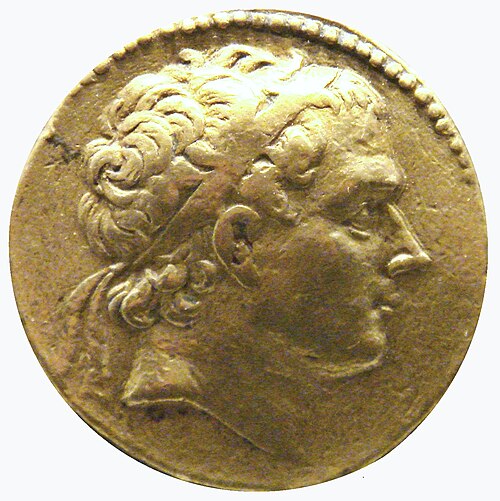
Pyrrhus I (c. 319-272 BC) was king of Epirus and one of the most brilliant Hellenistic strategists. A cousin of Alexander the Great, he fought the Romans in Italy and the Carthaginians in Sicily, remaining the model of the general whose victories cost too much.
Frequently asked questions
Famous Quotes
« One more such victory and I am undone.»
Key Facts
- Born around 319 BC, he becomes king of Epirus in 297 BC
- Battle of Heraclea (280 BC): first victory against Rome, thanks to war elephants
- Battle of Asculum (279 BC): a victory so costly that it gives rise to the expression “Pyrrhic victory”
- Campaign in Sicily (278-276 BC) against the Carthaginians
- Dies at Argos in 272 BC, killed during street fighting
Works & Achievements
First major victory against Rome, marked by the use of war elephants unknown to the Romans.
A military success bought with losses so heavy that it gave rise to the expression “Pyrrhic victory.”
Intervention on behalf of the Greeks of Sicily, where Pyrrhus drove back the Carthaginians before being forced to withdraw.
Pyrrhus drove out Antigonus Gonatas and had himself proclaimed king of Macedonia, the height of his power in Greece.
Writings on the art of war, now lost, cited and admired by the ancients, including the Romans themselves.
Pyrrhus made Ambracia his capital and embellished it, turning it into a center of Epirote power.
Anecdotes
After his bloody victory at Asculum in 279 BC against the Romans, Pyrrhus is said to have replied to those congratulating him: “One more victory like this and I am lost.” This is the origin of the expression “Pyrrhic victory,” which refers to a success won at such a heavy cost that it almost amounts to a defeat.
At the Battle of Heraclea in 280 BC, Pyrrhus deployed war elephants that the Romans had never faced before. Terrified, the Roman horses fled and the legions were broken. The Romans nicknamed these strange beasts the “Lucanian oxen.”
Pyrrhus was regarded as such a great tactician that Hannibal himself, according to Plutarch, ranked him among the greatest generals in history, just after Alexander the Great. His reputation endured through the centuries despite his ultimately unsuccessful campaigns.
Pyrrhus met an almost absurd death: in the middle of street fighting at Argos in 272 BC, an old woman watching from her roof threw a tile at his head. Stunned, the warrior king was finished off on the ground, brought down not by a soldier but by a townswoman.
From childhood, Pyrrhus led an adventurous life: driven from the throne of Epirus while still a child, he was raised at a foreign court, fought at the Battle of Ipsus at the age of eighteen, then lived for a time as a hostage in Egypt with Ptolemy before reconquering his kingdom.
Primary Sources
It is reported that Pyrrhus replied to Cineas that if they defeated the Romans once more in a similar battle, they would be utterly ruined.
Cineas asked the king: when we have conquered the Romans, what shall we do? We shall be masters of all Italy, said Pyrrhus. And after that? We shall cross into Sicily. And then? We shall rest and drink together. But what prevents us, said Cineas, from doing so right now?
Pyrrhus, king of Epirus, came to the aid of the Tarentines against the Romans and won a first battle thanks to the terror caused by his elephants.
Pyrrhus, summoned by the Tarentines, crossed into Italy with an army and elephants to make war on the Roman people.
Key Places
Kingdom in north-western Greece of which Pyrrhus was king. It was the base of his power and his ambitions.
City in southern Italy where Pyrrhus won his first victory over the Romans in 280 BC thanks to his elephants.
Site of the 279 BC battle where Pyrrhus defeated the Romans at the cost of enormous losses, the origin of the expression “Pyrrhic victory”.
Greek city in southern Italy that called on Pyrrhus for help against Rome and served as his base of operations in Italy.
Site of the 275 BC battle where Pyrrhus was checked by Rome, which forced him to leave Italy.
City in the Peloponnese where Pyrrhus died in 272 BC, killed in street fighting by a roof tile thrown from above.