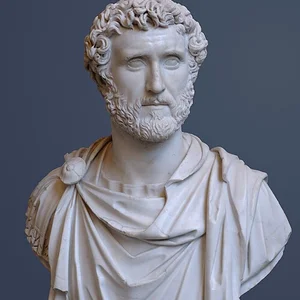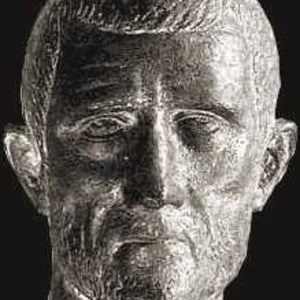

Aurelian was Roman emperor from 270 to 275, nicknamed “restorer of the world” (restitutor orbis). A general of Illyrian origin, he reunified the Roman Empire by reconquering the Gallic Empire and the kingdom of Palmyra, putting an end to the Crisis of the Third Century.
Aurelian(214 — 275)
Aurelian
Rome antique
6 min read
Frequently asked questions
Key Facts
- Becomes Roman emperor in 270, proclaimed by his troops after the death of Claudius II Gothicus
- From 271 onward, has the Aurelian Walls built to protect Rome from barbarian invasions
- Defeats Queen Zenobia in 272-273 and reconquers the kingdom of Palmyra in the East
- Reconquers the Gallic Empire ruled by Tetricus in 274, thereby reunifying the Roman Empire
- Assassinated in 275 during a conspiracy of officers while on campaign against the Persians
Works & Achievements
A vast defensive wall protecting Rome, still largely preserved today; it marks the capital's return to a defensive stance.
Reconquest of the Palmyrene Empire and then the Gallic Empire, putting an end to the division of the Roman state.
Through his victories over the barbarians and the breakaway states, Aurelian stabilized an Empire on the brink of collapse.
Establishment of a major official sun cult intended to religiously unify the Empire around the person of the emperor.
Reorganization of the mints and improvement of the coinage to combat runaway inflation.
Strategic withdrawal from the trans-Danubian province to shorten and consolidate the Danube frontier.
Reorganization of Rome's food supply, distributing bread rather than raw grain to the common people.
Anecdotes
Aurelian had an immense wall built around Rome, nearly 19 kilometers long, pierced with gates and bristling with towers. The capital had not had ramparts for centuries: it was an admission that even Rome could be threatened. These “Walls of Aurelian” are still largely standing today.
In 271, he crushed the army of Queen Zenobia of Palmyra, who had carved out an empire in the East. Captured, Zenobia was not executed but displayed bound in golden chains during Aurelian's triumph in Rome, before ending her days, so it is said, in a villa near Tivoli.
Aurelian gave the Empire a great new official cult, that of Sol Invictus, the “Unconquered Sun,” whose festival he fixed on December 25. Many historians see in this a distant ancestor of the date later chosen for Christmas.
Nicknamed “hand on sword” (manu ad ferrum) by his soldiers for his harshness and severity, Aurelian imposed iron discipline. Yet it was his own officers who assassinated him in 275, deceived by a secretary who had forged a list of death sentences.
Faced with the collapse of Roman currency, Aurelian launched a major reform and tried to reorganize the mints. In Rome itself, the workers of the Mint revolted: the repression was so violent that the sources speak of thousands of dead on the Caelian Hill.
Primary Sources
He restored the Roman Empire to its former state, subdued the Gauls, recovered the East, and was rightly named restorer of the world.
Aurelian restored the State to unity; he defeated Tetricus in Gaul and Zenobia at Palmyra, and celebrated a magnificent triumph in Rome.
Having received the Empire, Aurelian at once marched against the barbarians who were ravaging Italy and Pannonia, and everywhere restored order by force of arms.
Under his reign, through his military discipline and severity, the nearly ruined State was as if called back to life.
Key Places
Major city on the Danube, in the region Aurelian came from, which supplied many of the soldier-emperors of the 3rd century.
Capital of the Empire, which Aurelian endowed with a new defensive wall and where he celebrated his triumph and established the cult of Sol Invictus.
Oasis city in Syria, capital of the kingdom of Queen Zenobia, reconquered by Aurelian in 272 and then harshly punished after its revolt.
Site of the decisive battle of 274 where Aurelian defeated Tetricus and reabsorbed the Gallic Empire, completing the reunification.
A waystation on the road between Perinthus and Byzantium where Aurelian was assassinated by his officers in 275, while he was preparing a campaign against the Persians.
Typical Objects

Diadem adorned with rays representing the Sun, worn by Aurelian on his coins to associate himself with Sol Invictus. It symbolized imperial power protected by the Sun god.

Coin made of silvered bronze alloy, marked XXI, struck after Aurelian's monetary reform. It aimed to restore confidence in a currency ruined by inflation.

Long straight sword used by the Roman cavalry of the 3rd century, a typical weapon of the Illyrian soldiers from whom Aurelian came. It equipped the mobile units that formed his military strength.

Brick and concrete rampart nearly 19 km long encircling Rome, fitted with towers and monumental gates. It protected the capital, once again vulnerable to barbarian raids.

Large purple cloak fastened at the shoulder, worn by the emperor as commander of the armies. Its reserved color signaled Aurelian's supreme rank.

Torso armor worn by Roman soldiers and officers, made of mail or iron plates depending on the unit. It protected the fighter during Aurelian's many campaigns.
School Curriculum
Vocabulary & Tags
Key Vocabulary
Daily Life
Morning
On campaign, Aurelian rises before dawn to inspect the camp and review the troops. Known for his strictness, he checks the upkeep of weapons and discipline before holding council with his officers.
Afternoon
The afternoon is devoted to the affairs of the Empire: audiences, reading reports from the provinces, judgments and military decisions. In wartime, he directs marches, sieges and battles.
Evening
In the evening, the emperor sometimes shares the table of his officers, but remains sober and stern. He devotes time to imperial correspondence and to preparing the next day's campaigns.
Food
The diet of a soldier-emperor stays close to that of the legions: bread, cereal porridge (*puls*), vegetables, cheese, meat and wine watered down. Aurelian, of humble origins, was renowned for his frugality.
Clothing
On campaign, he wears military dress: a tunic, a cuirass and a purple cloak (*paludamentum*) clasped at the shoulder. During ceremonies, he displays the imperial insignia and, on his coins, the radiate crown of the Sun.
Housing
Always on the move, Aurelian resided mostly in the palaces of the great garrison cities (Sirmium, Antioch) or under the commander's tent (*praetorium*) at the heart of the legionary camp.
Historical Timeline
Period Vocabulary
Liens externes & ressources
Références
Œuvres
Enceinte d'Aurélien (murs de Rome)
271-275
Réunification de l'Empire
272-274
Fin de la crise du IIIe siècle
270-275
Culte de Sol Invictus
274
Réforme monétaire
274
Évacuation de la Dacie
271
Distributions de pain (annone)
270-275