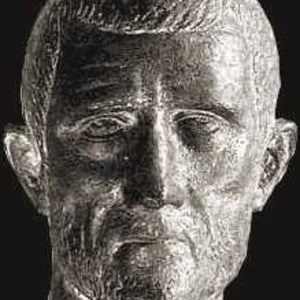

War chief of the Germanic Cherusci tribe. In 9 AD, he annihilated three Roman legions commanded by Varus in the Teutoburg Forest, lastingly halting Roman expansion east of the Rhine.
Arminius(16 av. J.-C. — 21)
Arminius
Rome antique
6 min read
Frequently asked questions
Key Facts
- Born around 16 BC into the Cheruscan aristocracy
- Served as an auxiliary officer in the Roman army and was granted Roman citizenship and equestrian rank
- In 9 AD, crushed three legions of Publius Quinctilius Varus at the Battle of the Teutoburg Forest
- Subsequently faced the campaigns of Germanicus (14–16 AD) without ever being decisively defeated
- Died around 21 AD, assassinated by members of his own kin
Works & Achievements
Arminius managed to unite several rival tribes (the Cherusci, Bructeri, Marsi…) against Rome, a rare political feat among the Germanic peoples.
The destruction of three Roman legions, one of the greatest defeats in the history of Rome, which permanently fixed the frontier at the Rhine.
During the battles of Idistaviso and the Angrivarian Wall, Arminius managed, despite setbacks, to prevent the Roman reconquest of Germania.
Arminius defeated the powerful Marcomannic king Maroboduus, asserting his dominance over the Germanic peoples of the region.
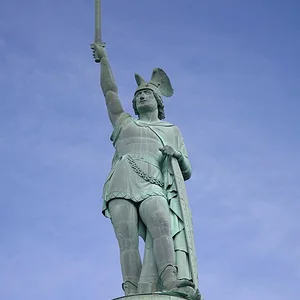
Rediscovered during the Renaissance under the name “Hermann,” Arminius became in the 19th century a symbol of German unity, celebrated by the Hermannsdenkmal monument.
Anecdotes
Before becoming Rome's enemy, Arminius served in the Roman army as an auxiliary officer and was even granted Roman citizenship along with the rank of knight. He therefore knew perfectly the tactics of the very enemy he would defeat.
In the year 9 AD, Arminius lured the legions of Varus into the Teutoburg Forest by feigning a distant revolt. The Romans, stretched out over kilometers in wooded, marshy terrain, were slaughtered over three days: Varus took his own life by throwing himself onto his sword.
The historian Suetonius reports that when the emperor Augustus learned of the disaster, he beat his head against the walls, crying out: “Quintilius Varus, give me back my legions!” The numbers of these three legions (XVII, XVIII, and XIX) were never assigned again.
Arminius's own father-in-law, the pro-Roman chief Segestes, denounced him to Rome and tried to hand him over. Arminius then abducted Segestes's daughter, Thusnelda, who became his wife: pregnant, she was later captured by the Romans and displayed during the triumph of Germanicus.
Arminius was not killed by the Romans but assassinated around 21 AD by members of his own family, who feared he sought to become king of the Germanic peoples. Tacitus writes that he was “unquestionably the liberator of Germania.”
Primary Sources
He was without doubt the liberator of Germania; he challenged the Roman people not in their early days, as other kings and chiefs had done, but at the very height of the Empire.
Arminius, son of Sigimer, chief of that nation, a young man of noble birth, valiant in action, quick of mind, with an intelligence far beyond that of a barbarian.
It is reported that he was so stricken that for months he let his beard and hair grow, and that he would sometimes beat his head against the doors, crying out: “Varus, give me back my legions!”
The Romans advanced through the woods, felling trees, building roads, and throwing up bridges wherever it was needed. A violent rain and a strong wind scattered them and left them unable to march.
Key Places
Presumed site of the 9 AD ambush where Arminius wiped out three Roman legions; excavations at Kalkriese have unearthed weapons and human remains there.
A wooded region between the Weser and the Elbe where Arminius's tribe lived, the heart of Germanic resistance to Rome.
Capital of the Empire where the young Arminius served in the army and received citizenship, and where his wife Thusnelda was paraded during Germanicus's triumph.
The river that, after Teutoburg, became the lasting border between the Roman Empire and free Germania.
A plain near the Weser where Arminius confronted Germanicus's legions in 16 AD during the Roman punitive campaigns.
Typical Objects

Short, narrow iron-tipped spear described by Tacitus, the main weapon of the Germanic warrior, usable in close combat as well as thrown.

Large shield of light wood, often painted in bright colors, that protected the warrior; losing it in battle was a disgraceful dishonor.

Short sword of the legion that Arminius learned to wield during his service with the Romans, a symbol of his knowledge of the enemy's weapons.

Gold ring marking membership in the equestrian order, a distinction Arminius received from Rome; it attests to his dual belonging, Germanic and Roman.

Standard topped with a silver eagle, the sacred emblem of the legions; the loss of Varus's eagles at Teutoburg was a dishonor that Rome long sought to avenge.

Short cloak of thick wool fastened at the shoulder, worn by Germanic warriors to protect themselves from the cold of the northern forests.
School Curriculum
Vocabulary & Tags
Key Vocabulary
Daily Life
Morning
On campaign, the Cheruscan chief rose at dawn in a camp pitched at the edge of the forest. The morning was devoted to inspecting the warriors, examining weapons, and receiving messengers from allied tribes.
Afternoon
The afternoon was spent training with the framea and the shield, or holding councils of war. Arminius, trained among the Romans, studied the routes and weak points of the enemy columns in the woods and marshes.
Evening
In the evening, around great fires, the warriors shared food and drink. They recited songs of valor, and at banquets that were sometimes well lubricated, they made the great decisions of war, which they confirmed sober the next day.
Food
The Germanic diet was based on meat (game, pork), milk, cheese, and porridges made from grains such as barley. Barley beer and mead were the common beverages, while wine remained a rare product imported from Rome.
Clothing
The Germanic peoples wore tunics of wool or linen, trousers (braies) suited to the cold, and a cloak (*sagum*) fastened at the shoulder. Animal skins completed the outfit in winter; a warrior of rank such as Arminius might display ornaments and rings.
Housing
People lived in long houses of wood and wattle-and-daub, with thatched roofs, often sheltering the family and the livestock under the same roof. Scattered in hamlets, these dwellings stood near clearings and watercourses, sheltered by the forests.
Historical Timeline
Period Vocabulary
Liens externes & ressources
Références
Œuvres
Coalition des tribus germaniques
vers 8-9 ap. J.-C.
Victoire de la forêt de Teutoburg
9 ap. J.-C.
Résistance aux campagnes de Germanicus
15-16 ap. J.-C.
Victoire sur Maroboduus
vers 19 ap. J.-C.
Héritage du mythe national germanique
postérité