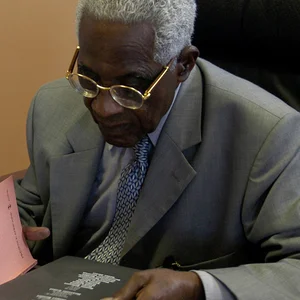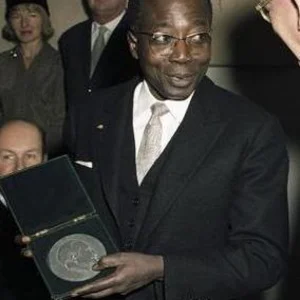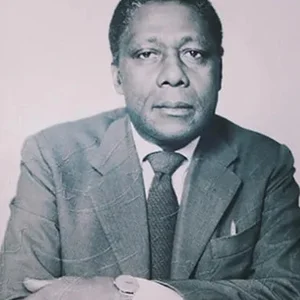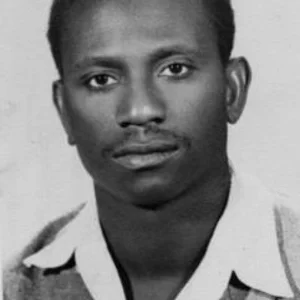

Senegalese historian, anthropologist, and physicist (1923-1986). He championed the precedence of Black African civilizations and the African origin of ancient Egypt, leaving a lasting mark on historiography and Pan-Africanism.
Cheikh Anta Diop(1923 — 1986)
Cheikh Anta Diop
Sénégal
6 min read
Frequently asked questions
Key Facts
- Born on December 29, 1923, in Caytou (Senegal), died on February 7, 1986, in Dakar
- Defended his thesis on the precedence of Black civilizations at the Sorbonne in 1960
- Published “Nations nègres et culture” (Black Nations and Culture) in 1954, a major work on the African origin of Egypt
- Founded a radiocarbon dating laboratory at IFAN in Dakar in 1966
- The University of Dakar was renamed Cheikh Anta Diop University in his honor in 1987
Works & Achievements
His founding work, which defends the African origin of Egyptian civilization. One of the most influential books in 20th-century African thought.
A comparative study of the political and social systems of African kingdoms before colonization. In it he demonstrates the existence of ancient, structured states.
In this work Diop develops the idea of a cultural foundation common to Black Africa, contrasted with the European model. A key text of cultural pan-Africanism.
A reasoned response to his critics, in which he reaffirms and refines his theses. He answers academic criticisms point by point.
A vast synthesis of his historical, anthropological, and scientific thought. Regarded as his intellectual testament.
One of the first African carbon-14 dating laboratories. It allowed Diop to conduct research independently of European centers.
Diop wrote major chapters of this great collective work. His participation marks his international recognition.
Anecdotes
In the early 1950s, Cheikh Anta Diop defended a thesis at the Sorbonne on the African origin of ancient Egypt, but at first it was rejected because it so disturbed the dominant ideas of the time. He would not earn his State doctorate until 1960, before a broadened jury of historians, sociologists, and physicists.
To prove his theories scientifically, Diop did not simply write: he trained in nuclear physics in Frédéric Joliot-Curie's laboratory in Paris. He developed a melanin test for analyzing the skin pigmentation of Egyptian mummies, thereby blending history with the exact sciences.
In 1974, UNESCO organized a major symposium in Cairo, bringing together the world's greatest Egyptologists to debate the peopling of ancient Egypt. Diop defended his ideas there with such rigor that, even without convincing everyone, he forced the scientific community to acknowledge the seriousness of his arguments.
During his lifetime, Diop gave his name to a radiocarbon dating laboratory that he ran in Dakar: he was one of the few historians in the world able to date his own samples. Today, the great university of Dakar bears his name: Cheikh Anta Diop University.
A committed political figure, Diop founded several opposition parties in Senegal and spent part of his career barred from university teaching because of his ideas. He nonetheless continued his research, convinced that giving Africans back their history was a form of struggle for independence.
Primary Sources
Ancient Egypt was a Black country, and Egyptian civilization a Black civilization. The whole of Mediterranean culture stems from it.
The aim is to restore to African historical consciousness the most brilliant pages of its past — pages that have been deliberately obscured.
The debate showed that the thesis of an exclusively white, or even mixed-race, Egypt could no longer be upheld without a critical examination of the sources.
The history of humanity will become a truly scientific discipline only on the day when it restores to Africa its rightful place in the development of civilization.
Key Places
Birth village of Cheikh Anta Diop, in Wolof country. There he received a traditional and Quranic education before his modern studies.
Diop studied physics, philosophy, and history here, and prepared his theses. He trained in carbon-14 dating with the team of Joliot-Curie.
Diop directed a radiocarbon laboratory here and carried out his research. The university has borne his name since 1987.
Site of the 1974 symposium where Diop debated the peopling of ancient Egypt with Egyptologists from around the world.
Capital where Diop conducted most of his career as a researcher and activist after independence, and where he died in 1986.
Typical Objects

A physics instrument used to measure the radioactivity of samples in order to determine their age. Diop ran one of the few laboratories of this kind in Africa.

Fragments of skin from Egyptian mummies that Diop analyzed to measure pigmentation. His method aimed to prove the African origins of the ancient Egyptians.

The typescript of his foundational book, published in 1954. In it he brings together linguistics, archaeology, and anthropology to demonstrate his theories.

Tools for linguistic work: Diop wanted to show that African languages could express the most complex scientific concepts. He thus translated mathematical theorems into Wolof.

An observation instrument he used in his physics and biology research applied to history. Diop was determined to base his conclusions on experiment.

A symbol of his activist commitment: Diop founded several opposition parties in independent Senegal. His scientific struggle and his political struggle went hand in hand.
School Curriculum
Vocabulary & Tags
Key Vocabulary
Daily Life
Morning
Diop often began his days early, dividing his time between reading scientific journals and preparing his classes and lectures. His correspondence with researchers from around the world took up a good part of his mornings.
Afternoon
In the afternoon, he would go to his laboratory at IFAN in Dakar, where he supervised carbon-14 dating and the analysis of samples. A demanding researcher, he checked the measurements and calculations himself.
Evening
In the evening, Diop wrote: this is how he produced his thousands of pages of works. He also received activists and students, for his home was a place of intellectual and political debate.
Food
Diop shared the Senegalese diet of his time: fish and rice (thiéboudiène), millet, vegetables, and tropical fruits. Mint tea accompanied the long discussions.
Clothing
Depending on the context, he wore Western dress — jacket and tie — at his lectures and the traditional Senegalese boubou in daily life. This dual attire reflected his roots that were at once African and universalist.
Housing
He lived in Dakar, in a house in the Senegalese capital that combined modern comfort with family life. Part of his home served as a library and workspace, as his research spilled well beyond the confines of the laboratory.
Historical Timeline
Period Vocabulary
Liens externes & ressources
Références
Œuvres
Nations nègres et culture
1954
L'Afrique noire précoloniale
1960
L'unité culturelle de l'Afrique noire
1959
Antériorité des civilisations nègres : mythe ou vérité historique ?
1967
Civilisation ou barbarie
1981
Création du laboratoire de radiocarbone de l'IFAN à Dakar
1966
Contribution à l'Histoire générale de l'Afrique (UNESCO)
1981