 flip
flipEveryday Yam Foutou
Everyday Yam Foutou
Why this dish? Yam is the sacred food of the Akan, from whom Pokou descends: it was the yam her people carried from the Ashanti kingdom to Côte d'Ivoire, and it was this yam, pounded daily, that sustained the long migration of the Baoulé.
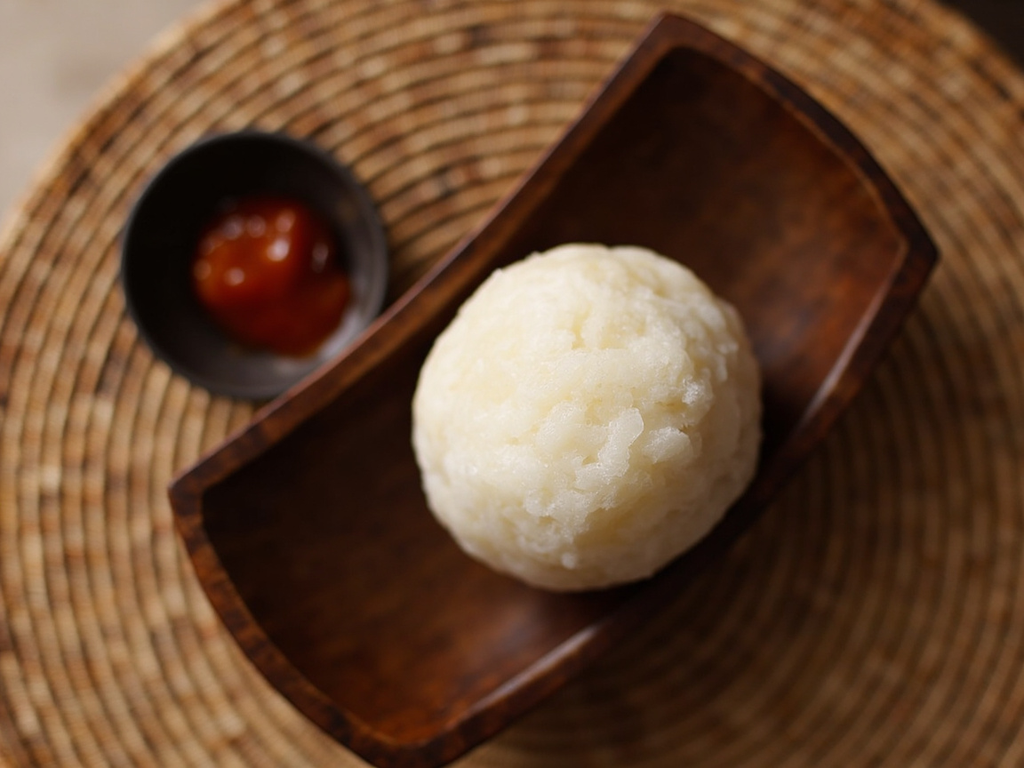
Yam tubers peeled, boiled, then pounded at length in a mortar until smooth and elastic, shaped into balls. You tear off a piece with your fingertips to scoop up the sauce. This is the daily gesture, from the humblest home to the queen's court.
Listen well, you who pass by: before eating yam, you must respect it, for it has walked with us since the land of Ashanti. At daybreak, my maids peel it, cook it in river water, then strike the mortar in pairs — one pounds, the other turns the dough with a quick hand, mind the fingers! When the ball is smooth as a child's skin and bounces under the pestle, then it is ready. We dip it in the sauce, never cut it with a knife: yam is broken by hand, just as we share words among brothers.
- •White forest yam — several large tubers (staple, sacred starch)
- •Spring or river water — enough to cover (cooking)
- •Trade salt (rock salt from trans-Saharan trade) — a pinch (light seasoning)
Everyday Yam Foutou
Yam tubers peeled, boiled, then pounded at length in a mortar until smooth and elastic, shaped into balls. You tear off a piece with your fingertips to scoop up the sauce. This is the daily gesture, from the humblest home to the queen's court.
Why this dish? Yam is the sacred food of the Akan, from whom Pokou descends: it was the yam her people carried from the Ashanti kingdom to Côte d'Ivoire, and it was this yam, pounded daily, that sustained the long migration of the Baoulé.
Listen well, you who pass by: before eating yam, you must respect it, for it has walked with us since the land of Ashanti. At daybreak, my maids peel it, cook it in river water, then strike the mortar in pairs — one pounds, the other turns the dough with a quick hand, mind the fingers! When the ball is smooth as a child's skin and bounces under the pestle, then it is ready. We dip it in the sauce, never cut it with a knife: yam is broken by hand, just as we share words among brothers.
Ingredients (period version)
- White forest yam — several large tubers (staple, sacred starch)
- Spring or river water — enough to cover (cooking)
- Trade salt (rock salt from trans-Saharan trade) — a pinch (light seasoning)
Ingredients
- Yam (white variety, e.g. Cécorou) — 1 kg (staple)
- Water — 2 L (cooking)
- Salt — 1 tsp (seasoning)
Method
- Peel the yam, cut into large chunks, and rinse.
- Plunge into boiling salted water and cook for 25–30 min, until a knife slides in without resistance.
- Drain, reserving a little cooking water.
- Pound the hot chunks in a mortar (or mash with a potato masher then work vigorously with a spatula), adding a splash of cooking water, until a smooth, dense, elastic dough forms.
- Wet your hands, shape into even balls, and serve immediately, hot, alongside the sauce.
How it was made : The two-person pounding in a large wooden mortar (one striking, the other moistening and turning the dough) remained the traditional method. Boiled yam was the base, but plantain alone or mixed with yam was also pounded depending on the region.
The contemporary twist : Serve the foutou ball as a quenelle drizzled with a streak of red palm oil, like a nest ready to receive the sauce.
Abla Pokou II · Charactorium