 flip
flipKwek-kwek (battered and fried quail eggs)
Kwek-kwek (battered and fried quail eggs)
Why this dish? Abra grew up in the underground scenes and studios of Metro Manila, where life happens on the street. Kwek-kwek, those bright orange fried eggs sold on sidewalks, is the neighborhood night snack – between two freestyles, you grab a skewer from the local vendor.
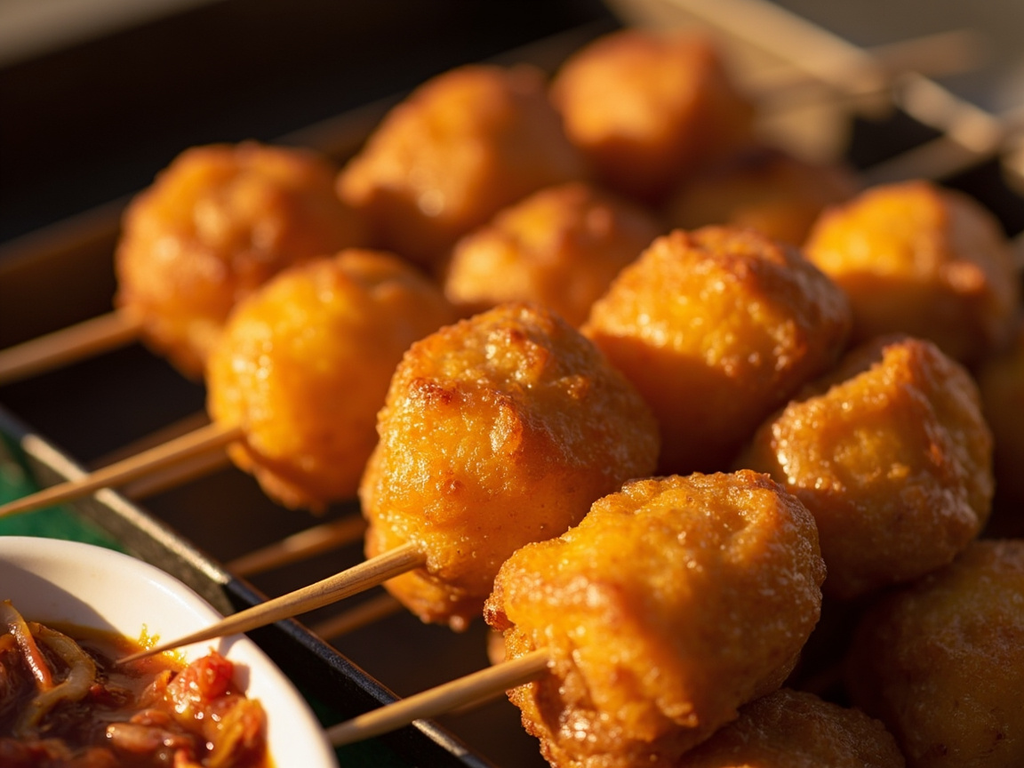
Hard-boiled quail eggs coated in an orange batter (colored with annatto) then fried until crispy, skewered and dipped in a spicy vinegar sauce. The ultimate street snack, crunchy outside, soft inside.
At night, after studio in Makati, we'd hang out on the street and there was always the mamang frying his kwek-kwek on his cart. That orange color calls you from afar, it's the achuete that does it. You grab your skewer, dip it in the suka with siling labuyo that's really strong, and eat standing up while talking beats. It's not a meal, it's a moment, a street thing, neighborhood thing. The batter has to be really crispy, otherwise it's not right – the secret is hot oil.
- •Quail eggs — a dozen, hard-boiled and peeled (heart)
- •Flour — for batter (coating)
- •Annatto seeds (achuete) — a pinch, infused (orange color)
- •Cane vinegar (suka) — a bowl (dipping sauce)
- •Small chili (siling labuyo) — according to courage (fire)
Kwek-kwek (battered and fried quail eggs)
Hard-boiled quail eggs coated in an orange batter (colored with annatto) then fried until crispy, skewered and dipped in a spicy vinegar sauce. The ultimate street snack, crunchy outside, soft inside.
Why this dish? Abra grew up in the underground scenes and studios of Metro Manila, where life happens on the street. Kwek-kwek, those bright orange fried eggs sold on sidewalks, is the neighborhood night snack – between two freestyles, you grab a skewer from the local vendor.
At night, after studio in Makati, we'd hang out on the street and there was always the mamang frying his kwek-kwek on his cart. That orange color calls you from afar, it's the achuete that does it. You grab your skewer, dip it in the suka with siling labuyo that's really strong, and eat standing up while talking beats. It's not a meal, it's a moment, a street thing, neighborhood thing. The batter has to be really crispy, otherwise it's not right – the secret is hot oil.
Ingredients (period version)
- Quail eggs — a dozen, hard-boiled and peeled (heart)
- Flour — for batter (coating)
- Annatto seeds (achuete) — a pinch, infused (orange color)
- Cane vinegar (suka) — a bowl (dipping sauce)
- Small chili (siling labuyo) — according to courage (fire)
Ingredients
- Quail eggs (or small eggs) — 12, hard-boiled and peeled (heart)
- Flour — 120 g (batter)
- Cornstarch — 2 tbsp (crispiness)
- Annatto powder (or achuete coloring) — 1 tsp (orange color)
- Water — about 150 ml (batter)
- Frying oil — for deep-frying (cooking)
- Vinegar, minced onion, chili, sugar — for the sauce (sweet-sour-spicy dip)
Method
- Hard-boil the quail eggs, peel them, roll them in a little dry flour.
- Prepare a thin batter: flour, cornstarch, annatto, salt, and water until it's a coating orange consistency.
- Dip each egg in the batter and plunge into hot oil (180°C) until golden and crispy.
- Mix vinegar, onion, chili, and a little sugar for the sawsawan dipping sauce.
- Skewer the kwek-kwek and serve immediately with the dip.
How it was made : The orange color comes from annatto (achuete), a natural dye from tropical America adopted early in the Philippines via the Manila galleon. Variants exist: tokneneng uses chicken eggs, larger. These fried snacks were born from the culture of the mobile cart in Philippine cities in the 20th century.
The contemporary twist : On Instagram, Manila vendors now serve them in trays with multi-level sauce (sweet, vinegary, ultra-spicy “extreme”), viral challenge style.
Sources : Doreen G. Fernandez, Tikim: Essays on Philippine Food and Culture, 1994
Abra · Charactorium