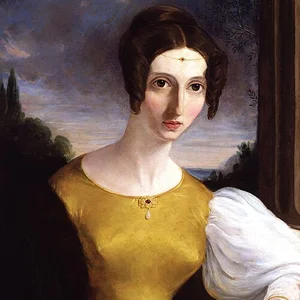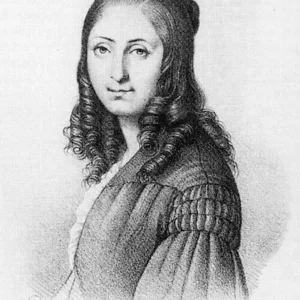

French journalist and feminist activist (1803–1844), Flora Tristan championed the emancipation of women and the condition of the working class in the 19th century. She was a pioneer of feminism and socialism, placing the question of women at the heart of political and social debate.
Flora Tristan(1803 — 1844)
Flora Tristan
France
7 min read
Frequently asked questions
Famous Quotes
« Woman is the proletarian of the proletarian.»
Key Facts
- 1835: Publication of 'On the Necessity of Welcoming Foreign Women', a founding text of her feminist thought
- 1838: Publication of 'Tristan of Araucania', an account of her travels in South America
- 1840: Publishes 'The Workers' Union', a manifesto linking the emancipation of women to that of the working class
- 1843: Embarks on a socialist propaganda tour of France to promote the emancipation of workers and women
- 1844: Dies in Bordeaux at the age of 41 after her journey, leaving behind a pioneering body of work in socialist feminism
Works & Achievements
Flora Tristan's first published work, a pamphlet advocating for the creation of a welcoming society for women traveling alone.
An autobiographical account of her journey to Peru. The work blends social observation, adventure narrative, and feminist advocacy, and caused a scandal upon publication.
A social novel denouncing the injustices of French society through the journey of a young man of the people. The work carries Flora's reformist ideas.
A social inquiry into the poverty of London's working classes. Flora describes the poor neighborhoods, prisons, and prostitution with remarkable documentary precision.
Flora Tristan's major work, a manifesto calling for the union of all workers, men and women, to defend their rights. Published five years before the Communist Manifesto.
A journal kept during her journey through the working-class cities of France, published posthumously. A valuable testimony on the condition of workers under the July Monarchy.
Anecdotes
Flora Tristan is the grandmother of the famous painter Paul Gauguin. Her daughter Aline married Clovis Gauguin, and their son Paul would become one of the greatest Post-Impressionist artists. Flora never knew her grandson, who was born four years after her death.
During her journey to Peru in 1833–1834, Flora Tristan attempted to claim her father's inheritance — a Peruvian aristocrat. Her paternal family refused to recognize her as a legitimate heir because her parents had not been married under Spanish law. This injustice deeply fueled her revolt against inequality.
In 1838, her husband André Chazal, from whom she had separated, shot her in broad daylight on a Paris street. The bullet lodged near her chest and could never be removed. Chazal was sentenced to twenty years of hard labor, and this tragic event heightened Flora's public profile in her fight for women's rights.
During her workers' Tour de France in 1844, Flora Tristan traveled through industrial cities to meet workers and preach labor union solidarity. Exhausted and ill, she died of typhus in Bordeaux on November 14, 1844, at only 41 years old, without having completed her journey.
Flora Tristan was one of the first women to publicly demand the right to divorce in France. At a time when married women had virtually no rights, she lived separated from her violent husband for years without being able to obtain a legal divorce, which had been abolished in 1816.
Primary Sources
I came into the world with a loving heart, a vivid imagination, and that disposition to believe in goodness which always makes one a fool. I had nothing to guide me but the instinct of my heart.
When society refuses to fulfil the obligations it has contracted towards its members, the pact is broken, and each one reclaims their natural freedom.
Workers, men and women alike, in the state of isolation in which you find yourselves, you are weak and you succumb, crushed under relations of force. Unite!
I went into the workshops, I saw the workers, I spoke with them, and everywhere I found the same misery, the same ignorance and the same desire to escape it.
Key Places
Flora Tristan was born and spent most of her Parisian life in the working-class neighborhoods of the capital, where she witnessed workers' poverty and fought her battles.
Flora stayed with her paternal family in 1833–1834. This Peruvian experience, marked by the rejection of her inheritance and the discovery of a civil war, transformed her worldview.
Flora visited London several times between 1826 and 1839. There she observed the condition of the working class in poor neighborhoods, material for her Promenades dans Londres.
The final stop of Flora Tristan's Tour de France. Exhausted by months of travel and lectures, she died there of typhus on November 14, 1844.
A major working-class city visited during the Tour de France. Flora met the canuts and silk workers there, heirs to the revolts of 1831 and 1834.
Flora Tristan's burial site. In 1848, Bordeaux workers pooled their money to erect a funerary monument bearing the inscription "Liberty, Equality, Fraternity, Solidarity".
Typical Objects

Flora Tristan meticulously recorded her observations in notebooks during her travels to Peru and across France. These notes served as the basis for her written works.

Essential tools of her struggle, Flora used them to write pamphlets, letters, and manuscripts to spread her feminist and socialist ideas.

Flora carried copies of her landmark work to distribute to workers during her Tour de France.

An inseparable companion on her journeys, from the Atlantic crossing to the Tour de France, this trunk held her personal belongings and writings.

Flora drafted petitions demanding the right to divorce and improvements to workers' conditions, which she addressed to deputies and authorities.

An indispensable document for her travels, her passport bears witness to the difficulty for a woman travelling alone to move freely in the 19th century.
School Curriculum
Vocabulary & Tags
Key Vocabulary
Tags
Mouvement
Concept
Daily Life
Morning
Flora Tristan rises early, often in a modest boarding house or hotel room during her travels. She devotes her mornings to correspondence and the drafting of her articles and manuscripts, writing with a quill pen at a small desk cluttered with papers.
Afternoon
In the afternoon, Flora walks through working-class neighborhoods to observe labor conditions and meet workers. She visits workshops, spinning mills, and factories, taking detailed notes on wages, working hours, and the poverty she witnesses.
Evening
In the evening, Flora attends workers' meetings or assemblies where she takes the floor to defend her ideas on workers' unions and the emancipation of women. She returns home late and records her observations in her journal before falling asleep.
Food
Flora Tristan eats simply, in the manner of the Parisian middle classes of the time: bread, soup, vegetables, and occasionally a little meat. Her financial means being limited, she often makes do with frugal meals taken in inns or cheap boarding houses.
Clothing
Flora wears dark, plain dresses suited to her constant travels. She dresses with the modest elegance typical of the Parisian petty bourgeoisie: a cotton or wool dress, a shawl, a bonnet or hat, and ankle boots for walking on cobbled streets.
Housing
Flora Tristan lives in modest lodgings in Paris, often rented rooms in working-class neighborhoods. During her Tour de France, she stays in boarding houses and with sympathetic workers. She never owned a comfortable permanent home, a reflection of her precarious life as an activist.
Historical Timeline
Period Vocabulary
Visual Style
Style réaliste romantique inspiré des lithographies sociales des années 1840, mêlant atmosphères industrielles enfumées et portraits engagés dans des tons sourds rehaussés de rouge.
Sound Ambience
Ambiance sonore du Paris ouvrier des années 1840 : rues pavées animées, ateliers bruyants, assemblées populaires et le calme studieux de l'écriture militante.
Liens externes & ressources
Références
Œuvres
Nécessité de faire un bon accueil aux femmes étrangères
1835
Pérégrinations d'une paria
1838
Promenades dans Londres
1840
L'Union ouvrière
1843
Le Tour de France, journal inédit
1844