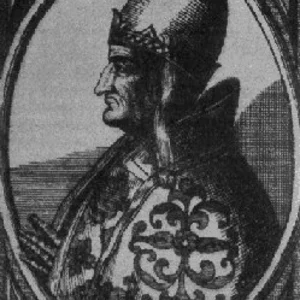

Pope of the Catholic Church from 1153 to 1154, Anastasius IV was the 168th successor of Peter. His brief pontificate was marked by efforts at reconciliation with the Byzantine Empire and the management of ecclesiastical affairs across Europe.
Anastasius IV
Anastasius IV
7 min read
Frequently asked questions
Key Facts
- Elected pope in 1153, succeeding Eugene III
- His pontificate lasted less than two years, until 1154
- He was one of the rare popes to be well received by the Roman people during his lifetime
- He sought to maintain peace among the various Christian powers of Europe
- Buried at the Lateran in a reused ancient Roman sarcophagus
Works & Achievements
Anastasius IV confirmed and extended the privileges of several monastic orders, notably the Cistercians and Premonstratensians, strengthening their autonomy from local bishops. These documents constituted an official recognition of their spiritual mission.
Faced with recurring conflicts over the appointment of bishops, Anastasius IV issued several rulings clarifying the canonical rules inherited from the Concordat of Worms. These texts fed into the developing body of medieval canon law.
Anastasius IV engaged in an exchange of letters with the Patriarchate of Constantinople to explore the possibilities of a rapprochement between the two Churches. These letters, partially preserved, bear witness to a cautious and theologically informed diplomacy.
As the immediate successor of Eugene III, Anastasius IV oversaw the first steps in implementing the agreement with Barbarossa, particularly regarding the protection of pontifical territories in central Italy.
Anecdotes
When Anastasius IV was elected pope in July 1153, he was already very old and frail. Despite this, he took charge of Church affairs with determination, seeking to ease the tensions tearing Christendom apart after the pontificate of Eugene III. His election surprised many, as few believed that such an elderly man could govern the universal Church.
Anastasius IV made a bold decision in choosing to be buried in an ancient porphyry sarcophagus kept at the Lateran — the very one that had once held the remains of Helena, mother of Emperor Constantine the Great. This symbolic gesture linked his pontificate to the grandeur of early Christian Rome, a powerful statement amid mounting tensions with the Empire.
During his short pontificate, Anastasius IV worked to warm relations with the Byzantine Empire, strained since the Schism of 1054. He exchanged diplomatic letters with Constantinople, hoping to reopen an interrupted ecumenical dialogue. These efforts came to nothing, but they testified to a broad vision of pontifical responsibilities.
Anastasius IV had to manage the difficult legacy left by Bernard of Clairvaux, who died in August 1153, just a few weeks after his own election. This influential monk had shaped the spirituality and politics of the Church for decades. The new pope had to mediate between the various religious currents that Bernard had inspired or opposed.
Primary Sources
In this bull, Anastasius IV regulates the procedures for episcopal elections in order to prevent local schisms, recalling that the unity of the Church rests on the observance of canon law and obedience to the Holy See.
Conradus natione Romanus, ex patre Johanne, sedit menses XVII, dies XXI. Hic sedit in Laterano et ibi sepultus est in sarcophago porfiretici.
Representatives of Pope Eugene III and Frederick Barbarossa sealed a defensive alliance: the Emperor pledged to protect the lands of the Church, and the pope to support the imperial crown in Italy. Anastasius IV inherited the task of implementing it.
John of Salisbury, secretary at the Roman curia, mentions in his letters the quiet and conciliatory governance of Anastasius IV, highlighting his prudence in ecclesiastical affairs in England and France.
Key Places
The pope's cathedral as Bishop of Rome and the historic seat of the papacy before the Vatican. Anastasius IV resided there, celebrated his ceremonies there, and was buried in its porphyry sarcophagus.
The official residence of the popes from Constantine until their departure to Avignon in the 14th century. It was from this palace that Anastasius IV governed the administration of the universal Church throughout his pontificate.
Capital of the Byzantine Empire and seat of the Orthodox patriarchate, with which Anastasius IV sought to reopen diplomatic dialogue. The two Churches had remained officially separated since the Schism of 1054.
Imperial city where the Treaty of Constance was signed in 1153 between the papacy and Frederick Barbarossa — a treaty whose implementation Anastasius IV inherited upon his election. This agreement shaped his entire Italian and imperial policy.
Typical Objects

Pontifical gold seal bearing the effigy of Saint Peter fishing, used to authenticate papal bulls. Each pope received his own at his enthronement, and it was broken upon his death to prevent forgery.

Lead seal suspended from official documents issued by the pontifical chancellery, guaranteeing their authenticity. The bulls of Anastasius IV bear his Latinized name Anastasius and the effigies of the apostles Peter and Paul.

Triple-crowned headpiece symbolizing the pope's authority over the Church, the world, and purgatory. In the twelfth century it had only two crowns; the third was added later.

Ancient funerary monument in imperial red stone, preserved at the Lateran, in which Anastasius IV chose to be buried. This sarcophagus had once held the remains of Helena, mother of Constantine the Great.

Pastoral staff topped with a double-barred cross, distinguishing pontifical authority from that of ordinary bishops. Anastasius IV carried it during solemn processions in the Roman basilicas.

Collection of pontifical letters serving as legal precedents in canon law, copied and distributed to episcopal chancelleries throughout Christendom. Anastasius IV contributed to this corpus by issuing several rescripts on ecclesiastical elections.
School Curriculum
Vocabulary & Tags
Key Vocabulary
Daily Life
Morning
Anastasius IV rose at dawn to celebrate the office of Lauds with the clerks of his private chapel at the Lateran. He then devoted the morning to personal prayer and the reading of Scripture, following the rule of life required of all clergy since the Gregorian reforms.
Afternoon
The afternoon was taken up with audiences, dictating letters to his secretaries, and examining petitions addressed to the Holy See from across Christendom. The cardinals gathered in consistory to deliberate on important matters, such as episcopal appointments or responses to sovereigns.
Evening
In the evening, Anastasius IV presided over solemn Vespers in the Lateran Basilica, surrounded by his chaplains and the dignitaries of the curia. Aging and in fragile health, he retired early to rest, leaving his collaborators to handle the day's remaining correspondence.
Food
The pontifical table strictly observed the liturgical calendar: fast days on Wednesdays and Fridays, and abstinence from meat during Advent and Lent. Ordinary meals combined bread, legumes, fish, and cheese, accompanied by wine diluted with water according to the monastic custom inherited by the curia.
Clothing
Anastasius IV wore the white cassock reserved for popes, covered by a red mozzetta and a white woolen pallium decorated with black crosses, symbol of his authority over the universal Church. During solemn ceremonies, he donned the full pontifical vestments: an embroidered chasuble, dalmatic, liturgical sandals, and mitre.
Housing
The Lateran Palace, a vast architectural complex adjoining the basilica, had served as the papal residence since the fourth century. Anastasius IV occupied apartments with high ceilings adorned with mosaics and frescoes, warmed by braziers in winter, at the heart of a domain encompassing chapels, gardens, and administrative offices.
Historical Timeline
Period Vocabulary
Liens externes & ressources
Références
Œuvres
Bulles de privilèges aux ordres religieux
1153-1154
Rescrits sur les élections épiscopales
1153-1154
Correspondance diplomatique avec Byzance
1153-1154
Gestion du legs du Traité de Constance
1153