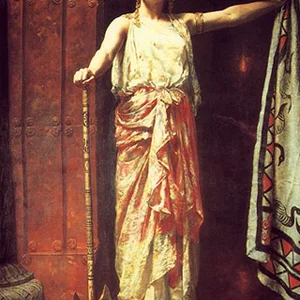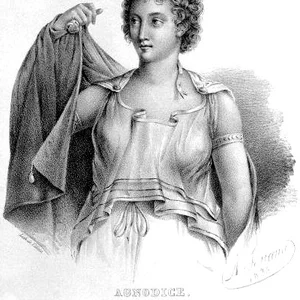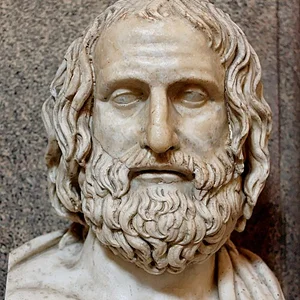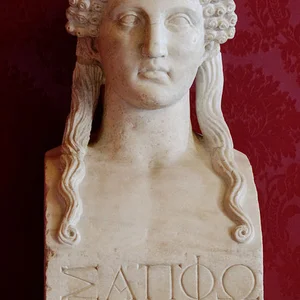

Greek lyric poet of the 7th century BCE, from the island of Lesbos. Recognized as one of the greatest poets of ancient Greece, she composed intimate lyric poems expressing personal emotions, particularly about love and friendship. Her work, largely lost, has profoundly influenced Western literature.
Sappho(650 av. J.-C. — 569 av. J.-C.)
Sappho
Mytilène
7 min read
Frequently asked questions
Famous Quotes
« Love is a loosener of limbs»
« Come here to me, golden Aphrodite»
Key Facts
- 7th century BCE: born in Mytilene, on the island of Lesbos, into an aristocratic family
- Around 600 BCE: composed her lyric poems in the Aeolic dialect, gathered into nine books
- Possible political exile to Sicily due to political unrest on Lesbos
- Late Antiquity: recognized as one of the nine canonical lyric poets, included in the Greek literary canon
- Progressive loss of her work: only one complete fragment (the Ode to Aphrodite) and scattered quotations survive
Works & Achievements
A collection of nine volumes of lyric poems composed by Sappho, organized by genre and theme. This major work established the conventions of Greek lyric poetry and has had a lasting influence on Western literature.
One of the few complete poems by Sappho to have survived, addressed to the goddess of love. The poem conveys the intensity of passionate emotion and remains a masterpiece of ancient lyric poetry.
Fragmentary poems celebrating intimate relationships, particularly friendship among women and feelings of love. These works revolutionized poetry by foregrounding the authentic expression of personal emotions.
Poetic compositions written for wedding ceremonies, noted for their delicate lyricism and musicality. These epithalamia shaped the tradition of the wedding poem in later literature.
Sappho founded and led a community of poets on the island of Lesbos, dedicated to the study of poetry and music. This institution trained many poets and stands as a major cultural achievement of the ancient world.
Anecdotes
On the island of Lesbos, Sappho led a circle of young women whom she trained in poetry, music, and dance, most likely in connection with the cult of Aphrodite. This group, sometimes called a 'thiasos', was a center of artistic and spiritual education recognized throughout the Greek world.
Antiquity credited her with nine books of poems, but nearly all of her work has been lost over the centuries. In 2014, two new poems by Sappho were discovered on an Egyptian papyrus, proving that fragments of her work can still emerge from millennia of obscurity.
Plato himself called her the 'Tenth Muse' — an extraordinary title that placed Sappho alongside the divine patrons of poetry. This recognition by the greatest of Greek philosophers speaks to the immense prestige she had earned both during her lifetime and after her death.
Legend has it that Sappho threw herself from the Leucadian Rock out of love for a ferryman named Phaon. This story, most likely invented later by comic writers, reflects the fascination that her intense romantic life inspired throughout the ancient world.
Sappho was exiled to Sicily, probably for political reasons connected to factional struggles on Lesbos. This episode shows that she was a significant public figure whose family ties to the local aristocracy had real political consequences.
Primary Sources
Deathless Aphrodite of the spangled mind, daughter of Zeus, who tangles lures, I beg you, do not break my spirit with grief and bitterness, but come here to me — as once before you heard my voice calling from afar.
He seems to me equal to the gods, that man who sits across from you and listens close to your sweet speaking and lovely laughter. At that, my heart in my chest is shaken.
Some say an army of horsemen is the finest thing on the dark earth, some say infantry, some a fleet of ships. But I say it is whoever one loves.
Sappho of Mytilene, most illustrious poetess, has been admired throughout all ages — and is still admired by scholars today — for the excellence and originality of her lyric poems.
Key Places
Capital of the island of Lesbos, where Sappho was born and lived. This city was the cultural and political heart of the island, the place where she composed most of her lyric poems and led a community of young women.
Sappho's homeland, located off the coast of Greek Asia Minor. The island inspired much of her poetic work and has become inseparable from her name, giving rise to the term 'lesbian lyric poetry'.
A Sicilian city where Sappho is said to have been exiled during a period of political unrest on Lesbos. She reportedly stayed there before returning to Mytilene.
A temple dedicated to the god Apollo in Mytilene, connected to Sappho's religious and cultural life. Archaic Greek poets maintained important ties with civic religious cults.
Although Sappho lived long before Plato, her work was studied and celebrated in ancient Greek schools. She was counted among the nine canonical women poets of Greek antiquity.
The place where many fragments of Sappho's work were preserved as papyri in the Library of Alexandria. These archaeological discoveries have allowed scholars to partially reconstruct her poems.
Typical Objects

A fundamental stringed instrument of Greek lyric poetry. Sappho accompanied her poems with music, the lyre being the emblematic instrument of lyric poets in ancient Greece.
📷 CC BY-SA 4.0 · Wikimedia Commons ↗
The writing medium used in antiquity to transcribe poems. Sappho's works were composed orally and then written on papyrus, though the majority of her nine books of poetry have been lost over time.
📷 CC BY-SA 4.0 · Wikimedia Commons ↗
A typical fired-clay vessel of archaic Greece, used for storing and transporting wine and oil. Amphorae from Lesbos of this period offer a window into daily life and the material culture of the 7th century BCE.

A symbol of poetic recognition in ancient Greece. Though most commonly associated with Apollo, it represents the honors bestowed upon poets of great renown, such as Sappho.

A portable, reusable writing surface used in ancient Greece for drafts and notes. Lyric poets used them to compose and temporarily preserve their creations before committing them to a final written form.
A linen or wool tunic worn by Greek women of the period. This everyday garment is representative of the lives of women on Lesbos in the 7th century BCE, particularly in the context of female poetic gatherings.
📷 Domaine public · Wikimedia Commons ↗
The architectural style characteristic of Ionia, the region to which Lesbos belonged. The Ionic colonnades of temples and public buildings embody the art and architecture of Sappho's archaic age.
School Curriculum
Vocabulary & Tags
Key Vocabulary
Daily Life
Morning
Sappho wakes at dawn in her home on Lesbos. After dressing, she takes part in domestic rituals and household management, as was common among elite women of her time. She may also devote these early hours to composing poetry or teaching the aristocratic young women who gather in her circle.
Afternoon
Afternoons are often spent on social and cultural activities within her thiasos, a community of young women brought together around her for the practice of the arts and poetry. Sappho composes, teaches music and dance, or takes part in religious festivities in honor of Aphrodite and Artemis, goddesses particularly revered on Lesbos.
Evening
In the evenings, Sappho may attend banquets (women's symposia), less formal than those of men, where food, wine, and conversation are shared among educated women. She continues her poetic and musical creation — cherished moments for expressing her feelings and connecting with her companions in the thiasos.
Food
Sappho's diet, like that of the Greek aristocracy of the time, includes barley bread, vegetables, fruits (figs, grapes), cheese, and fresh fish, thanks to Lesbos's proximity to the sea. Meat is eaten during religious festivals following sacrifices, and wine — diluted with water according to Greek custom — accompanies meals.
Clothing
Sappho wears the Ionian chiton, a long, elegant tunic of linen or wool characteristic of elite Lesbian women. She may be adorned with gold or bronze jewelry, reflecting her high social standing. Her hair is likely carefully styled in the elaborate manner typical of aristocratic Greek women of the 7th century BCE.
Housing
Sappho lives in a typically Greek dwelling, with an interior peristyle and rooms arranged around a central courtyard. Her home includes women's quarters (the gynaikeion) and regularly welcomes young women of the Lesbian aristocracy in an environment well suited to artistic and poetic pursuits.
Historical Timeline
Period Vocabulary
Visual Style
Direction artistique inspirée de la céramique grecque antique associée à des techniques picturales délicates, évoquant l'intimité lyrique et l'atmosphère méditerranéenne de Lesbos, avec des teintes chaudes, des ornementations dorées et une ambiance contemplative.
Sound Ambience
Une ambiance méditerranéenne intime et poétique, mêlant les sons délicats d'une lyre antique, le murmure des vagues de Lesbos et les voix féminines évoquant la passion lyrique de Sappho, baignée dans la chaleur nostalgique du coucher de soleil grec.
Liens externes & ressources
Références
Œuvres
Neuf livres de poésie lyrique
VIIe-VIe siècles av. J.-C.
Ode à Aphrodite
VIIe siècle av. J.-C.
Fragments sur l'amour et l'amitié
VIIe-VIe siècles av. J.-C.
Poèmes de mariage (Épithalames)
VIIe siècle av. J.-C.
École poétique de Lesbos
VIIe-VIe siècles av. J.-C.