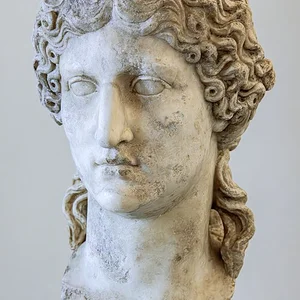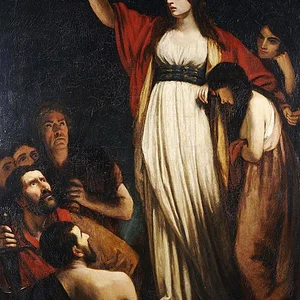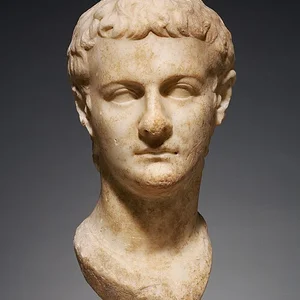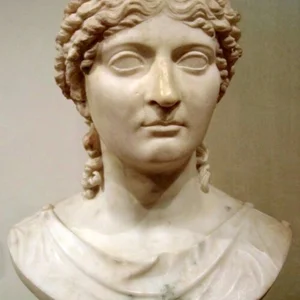

Agrippina the Younger (15–59 AD) was a Roman empress, sister of Caligula, and mother of Nero. She wielded considerable influence over imperial power, most notably by marrying her uncle, Emperor Claudius, and arranging for her son Nero to be adopted as his heir.
Agrippina the Younger(15 — 59)
Agrippina the Younger
Rome antique
8 min read
Frequently asked questions
Key Facts
- AD 15: born at Oppidum Ubiorum (Cologne), daughter of Germanicus and Agrippina the Elder
- AD 49: marries Emperor Claudius, her uncle, consolidating her influence at court
- AD 50: secures Claudius's adoption of her son Nero, placing him ahead of Britannicus in the line of succession
- AD 54: Claudius dies (poisoned, according to tradition); Nero becomes emperor
- AD 59: assassinated on the orders of her own son, Nero
Works & Achievements
An autobiography, now lost, in which Agrippina recounted her own life and that of her Julio-Claudian family. Tacitus and Pliny the Elder explicitly cited it as a source, making it one of the very rare female literary testimonies from ancient Rome.
Agrippina obtained from Claudius the elevation of her birthplace to the status of a Roman colony, which was renamed after her. This major political act permanently embedded her memory in the history of the city that would become Cologne.
Under Claudius's reign, sestertii and aurei bearing the face-to-face portraits of the emperor and Agrippina were struck across the Empire. These coins sent a clear political message: Agrippina was co-holder of imperial power.
A legal act orchestrated entirely by Agrippina: Claudius officially adopted Lucius Domitius under the name Nero Claudius Caesar Drusus Germanicus, placing him ahead of Britannicus in the line of succession. This political masterstroke was Agrippina's greatest achievement.
Upon Claudius's death, Agrippina managed the transfer of power by having Nero acclaimed by the Praetorian Guard before the emperor's death was even announced. Her mastery of the mechanisms of power allowed a succession without civil war.
Anecdotes
To marry Agrippina, Emperor Claudius had to change Roman law: marriage between an uncle and his niece had until then been strictly forbidden. The Senate, won over to Agrippina's cause, voted an exception in 49 AD. It was an unprecedented measure in Roman history, illustrating the hold she exercised over power.
Tacitus recounts that Agrippina allegedly poisoned Emperor Claudius in 54 AD by serving him death cap mushrooms — Amanita phalloides — mixed in with his favorite porcini. She reportedly hastened her husband's death to allow Nero, her son, to seize power before Claudius could change his will in favor of Britannicus.
During Claudius's triumph over Britain in 44 AD, Agrippina appeared in public wearing a gold-embroidered ceremonial cloak — a garment reserved for victorious generals. This highly symbolic gesture signaled to Romans that she considered herself the equal of men in power, far beyond the traditional role assigned to women.
In 59 AD, Nero decided to have his mother killed. He had a rigged ship built with a hull designed to break apart at sea. Agrippina survived the wreck by swimming to shore. Upon learning she was still alive, Nero sent assassins to her villa at Baiae. Tradition holds that she bared her stomach to the killers, saying: 'Strike the womb that bore a monster.'
Agrippina wrote Commentarii (memoirs) recounting her own life and that of her family. This autobiography, now lost, was still consulted by Tacitus and Pliny the Elder in the 1st century AD. It stands as one of the exceedingly rare literary works attributed to a woman of Roman antiquity.
Primary Sources
Agrippina never strayed from her ambition for power, and she wanted to be co-participant in it, as an equal. She carried herself with gravity and often with arrogance, except when it suited her to be conciliatory.
It is said that when astrologers were consulted about her son's fate, Agrippina replied: 'Let him reign and let him kill me.' She bore the full weight of maternal power with the same excess as imperial power itself.
Agrippina received the title of Augusta, and coins were struck bearing her likeness. She sat beside Claudius during audiences with foreign ambassadors — something unheard of for a woman in Rome.
Agrippina, mother of Nero — the most destructive creature ever born to the human race — came into the world with two canine teeth on the right side, an omen of power and an extraordinary destiny.
Key Places
A city on the Germanic Rhine where Agrippina was born in 15 AD, in the military camp of her father Germanicus. In 50 AD, she had the colony renamed Colonia Claudia Ara Agrippinensium after herself — a name still echoed in 'Cologne' today.
The heart of imperial power on the Palatine Hill, where Agrippina resided first as the wife of Claudius, then as the mother of Nero. It was here that she orchestrated major political decisions and received ambassadors and senators.
A Tyrrhenian Sea island where Caligula exiled Agrippina in 39 AD after accusing her of conspiracy. She endured two years of humiliation there before being recalled by Claudius.
An aristocratic resort on the Bay of Naples where Nero lured his mother under the pretense of a reconciliation, then attempted to drown her aboard a rigged ship before having her murdered at her nearby villa in 59 AD.
The institution where, in 49 AD, a law was passed permitting marriage between uncle and niece in order to allow the wedding of Claudius and Agrippina. Agrippina influenced several senatorial decrees from behind the scenes of imperial power.
Typical Objects

A long tunic (stola) and large draped veil (palla) made of fine wool or silk, the hallmark of a high-ranking Roman matron. Agrippina wore hers embroidered with purple and gold at official ceremonies, visually asserting her exceptional status.

Common writing materials used for correspondence and notes. Agrippina used them to compose her Commentarii and manage her extensive political correspondence from the Palatine Hill.

Under Claudius, sestertii were struck with the facing portraits of the emperor and Agrippina side by side — an unprecedented iconographic innovation signaling her symbolic co-regency.

Agrippina secured the right to sit beside Claudius during official audiences on a curule chair, a privilege traditionally reserved for men. A gilded litter transported her through Rome with the escort normally granted to pontiffs.

Ancient tradition associates Agrippina with the use of toxic substances, most notably in the death of Claudius. Sources refer to the notorious poisoner Locusta, whose preparations were said to have been delivered in locked boxes.

During Claudius's British triumph in AD 44, Agrippina appeared wearing a gold-embroidered ceremonial cloak — a martial and imperial accessory no Roman woman had ever worn in public before her.
School Curriculum
Vocabulary & Tags
Key Vocabulary
Tags
Daily Life
Morning
Agrippina rose at dawn, attended by several specialized slaves (ornatrices) who braided her hair into an elaborate nodus and applied cosmetics and perfumes. She would dictate political correspondence to her secretary (ab epistulis) before the imperial household stirred, using these quiet hours to plan her strategies.
Afternoon
Afternoons were devoted to political audiences: senators, imperial freedmen, clients, and foreign ambassadors would file through the portico of the Palatine. Agrippina sometimes attended Claudius's official audiences, positioned behind a curtain or at his side depending on the circumstances, pulling the strings of power with calculated discretion.
Evening
Dinners (cenae) were opportunities to strengthen political alliances around tables laden with refined dishes — Mediterranean fish, roasted meats, and Falernian wines. Agrippina used these gatherings to observe the balance of power, recruit loyal supporters, and outmaneuver rivals, surrounded by her circle of devoted freedmen such as Pallas.
Food
Agrippina's table reflected imperial luxury: oysters, moray eels, roasted peacock, marinated olives, fine cheeses, and candied fruits. Falernian wine, mixed with warm water sweetened with honey, accompanied meals. Sources also note her wariness toward certain dishes — fear of poison was a daily reality on the Palatine.
Clothing
Agrippina wore the stola of a Roman matron in fine wool or silk, often dyed in Tyrian purple — a color reserved for the imperial family. The palla, a large draped veil, covered her in public. During ceremonies, she wore gold fibulae, amber and carnelian bracelets, and a diadem marking her title of Augusta.
Housing
Agrippina resided in the imperial apartments on the Palatine, a complex of interconnected palaces overlooking Rome. The state rooms were lined with colored marble (cipollino, pavonazzetto) and architectural frescoes. She also owned several villas in Campania, notably at Baiae, along with properties inherited from her Germanican lineage.
Historical Timeline
Period Vocabulary
Visual Style
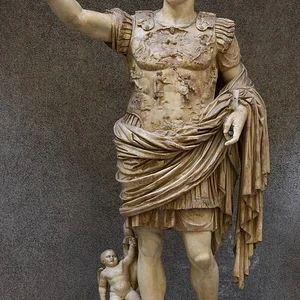
Le style visuel s'inspire des portraits sculptés julio-claudiens et des fresques pompéiennes : austérité marmoréenne, palette impériale pourpre et or, architecture palatiale grandiose et lumière chaude des lampes à huile.
Sound Ambience
L'univers sonore d'Agrippine oscille entre les salles de marbre du Palatin où résonnent chuchotements et pas feutrés, et les villas côtières de Campanie baignées par le bruit des vagues et des vents méditerranéens.
Liens externes & ressources
Références
Œuvres
Commentarii (Mémoires d'Agrippine)
vers 50-54 apr. J.-C.
Fondation de Colonia Claudia Ara Agrippinensium
50 apr. J.-C.
Émission de monnaies à double effigie
50-54 apr. J.-C.
Adoption de Néron par Claude
50 apr. J.-C.
Accession de Néron au trône
54 apr. J.-C.