 flip
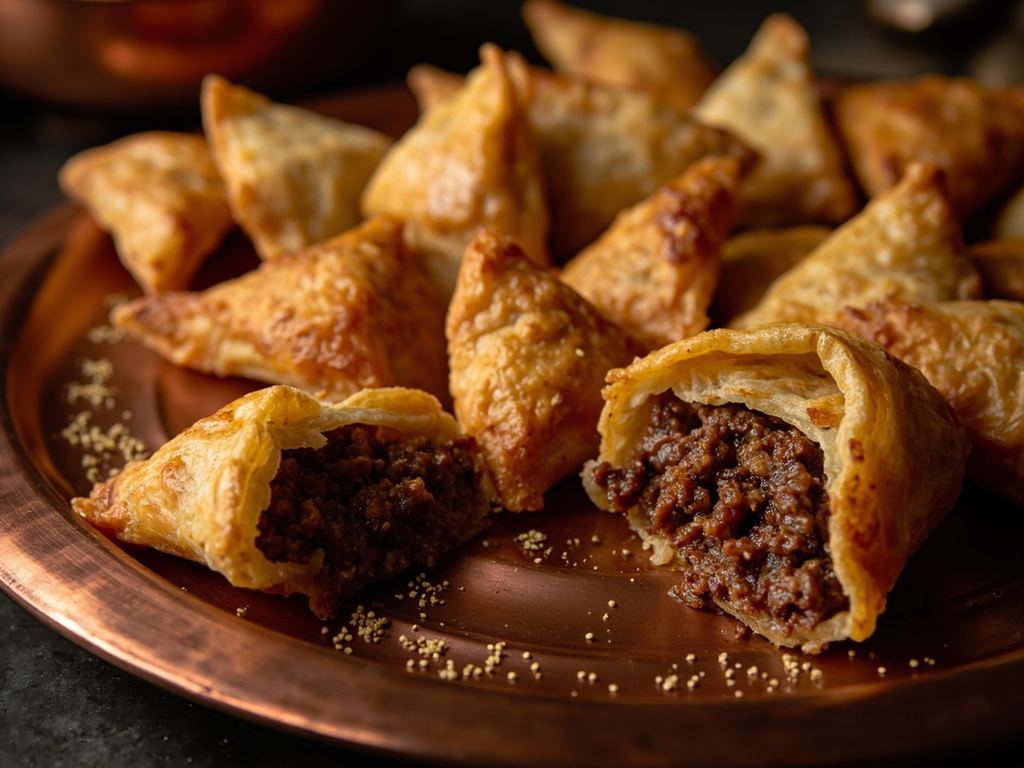
flipSanbusa — Fried Pastries with Spiced Meat
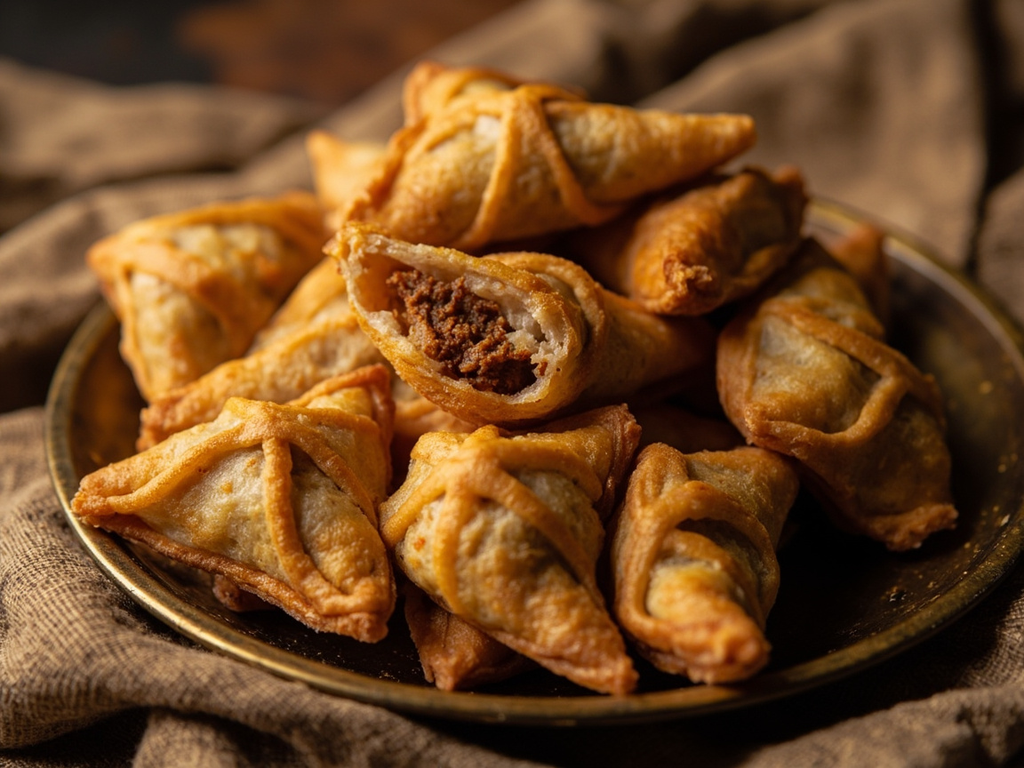
Sanbusa — Fried Pastries with Spiced Meat
Why this dish? Akbar spent his life on the move, from the battlefields of Panipat to the roads between Agra and Lahore. The sanbusa, crispy and portable, was sold in markets and fed armies on campaign—the food of a horseman emperor.
Thin pastry triangles filled with minced meat flavored with ginger, pepper, and coriander, fried in ghee until golden and crispy. The ancestor of the samosa, already served at Akbar's table.
I have spent more days in the saddle than on my throne, and a horseman must be able to eat without dismounting. My camp cooks mince the meat fine, season it with ginger, pepper, and coriander, wrap it in a thin dough folded into a triangle, and plunge it into boiling ghee. You bite it still burning, the juice runs into your beard—that is the true cuisine of the roads of Hindustan, the one that marched with my armies.
- •Wheat flour — one measure (dough)
- •Ghee — for dough and frying (fat)
- •Minced mutton — a good portion (filling)
- •Onion — one, sliced (filling)
- •Fresh ginger — a piece (fresh spice)
- •Black pepper and coriander seeds — equal parts (spices)
- •Salt — to taste (seasoning)
Sanbusa — Fried Pastries with Spiced Meat
Thin pastry triangles filled with minced meat flavored with ginger, pepper, and coriander, fried in ghee until golden and crispy. The ancestor of the samosa, already served at Akbar's table.
Why this dish? Akbar spent his life on the move, from the battlefields of Panipat to the roads between Agra and Lahore. The sanbusa, crispy and portable, was sold in markets and fed armies on campaign—the food of a horseman emperor.
I have spent more days in the saddle than on my throne, and a horseman must be able to eat without dismounting. My camp cooks mince the meat fine, season it with ginger, pepper, and coriander, wrap it in a thin dough folded into a triangle, and plunge it into boiling ghee. You bite it still burning, the juice runs into your beard—that is the true cuisine of the roads of Hindustan, the one that marched with my armies.
Ingredients (period version)
- Wheat flour — one measure (dough)
- Ghee — for dough and frying (fat)
- Minced mutton — a good portion (filling)
- Onion — one, sliced (filling)
- Fresh ginger — a piece (fresh spice)
- Black pepper and coriander seeds — equal parts (spices)
- Salt — to taste (seasoning)
Ingredients
- Wheat flour — 250 g (dough)
- Ghee — 2 tbsp (dough) + neutral oil for frying (fat)
- Warm water — about 120 ml (dough)
- Minced lamb or mutton — 300 g (filling)
- Onion — 1, finely chopped (filling)
- Grated ginger — 1 tbsp (spice)
- Ground black pepper — 1 tsp (spice (heat, no chili))
- Ground coriander seeds — 1 tsp (spice)
- Salt — 1 tsp (seasoning)
Method
- Knead the flour with ghee, salt, and warm water into a firm dough; let rest for 30 minutes.
- Sauté the onion in a little ghee, add the ginger, then the minced meat.
- Season with pepper, coriander, and salt; cook until the meat is browned and dry. Let cool.
- Roll out the dough thinly, cut into discs, halve them, and form cones.
- Fill each cone with the stuffing, seal the edges with a little water.
- Deep-fry in ghee or hot oil until golden brown; drain and serve warm.
How it was made : The sanbusah (which the Ain-i-Akbari lists among imperial kitchen dishes) is the direct ancestor of the samosa. In Akbar's time, it was filled with spiced minced meat, and the heat came from black and long pepper, as chili was introduced to India by the Portuguese only at the very beginning of its spread. It was fried in ghee in large pans, in markets and military camps.
The contemporary twist : A baked version, brushed with ghee, for a lighter pastry—and a yogurt-mint sauce for dipping.
Sources : Abu'l-Fazl, Ain-i-Akbari (trans. H. Blochmann) · K. T. Achaya, A Historical Dictionary of Indian Food
Akbar · Charactorium