 flip
flipNon-i obi (Tandyr Flatbread)
Non-i obi (Tandyr Flatbread)
Why this dish? Flatbread (non) is the most sacred food of the Central Asian dastarkhan — it is never cut with a knife, but broken by hand. Al-Marghinani, whose diet was 'frugal and governed by religious law,' ate non at every meal, from the simplest to the most lavish.
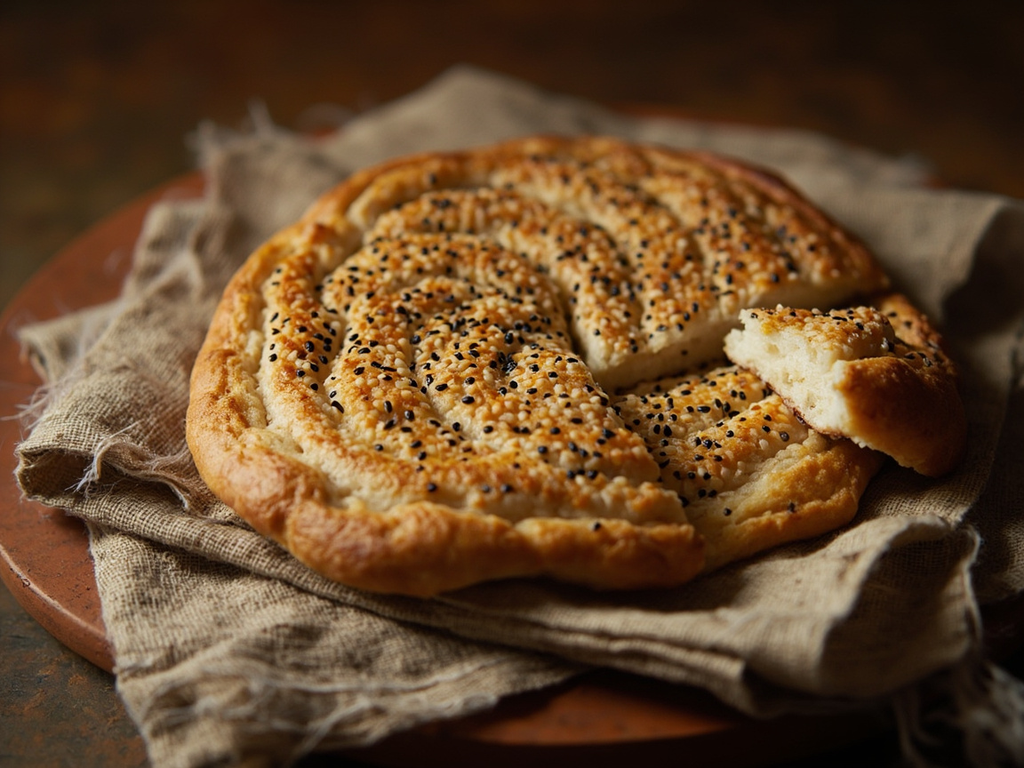
A round, dense flatbread baked against the scorching wall of a clay tandyr oven. Marked with patterns in the center using a chekich (bread stamp), golden and slightly crispy on the surface, soft inside. Perfumed with nigella and sesame.
Non is the first thing placed on the dastarkhan and the last thing removed. In our home in Marghinan, one never breaks bread with one hand — that is disrespectful to Allah's blessing. The baker slaps the dough against the tandyr wall and it puffs, scorching, marked with the chekich. I recommend sprinkling kalonji before baking — those black seeds of which the Prophet, peace be upon him, said they cure everything except death.
- •Wheat flour — A generous measure (Base)
- •Warm water — Enough for a supple dough (Hydration)
- •Sourdough starter — A piece from the day before (Leavening)
- •Salt — A pinch (Seasoning)
- •Nigella seeds (kalonji) — A pinch (Fragrance and tradition)
- •Sesame seeds — A pinch (Garnish)
- •Milk or whey — A little (Egg wash)
Non-i obi (Tandyr Flatbread)
A round, dense flatbread baked against the scorching wall of a clay tandyr oven. Marked with patterns in the center using a chekich (bread stamp), golden and slightly crispy on the surface, soft inside. Perfumed with nigella and sesame.
Why this dish? Flatbread (non) is the most sacred food of the Central Asian dastarkhan — it is never cut with a knife, but broken by hand. Al-Marghinani, whose diet was 'frugal and governed by religious law,' ate non at every meal, from the simplest to the most lavish.
Non is the first thing placed on the dastarkhan and the last thing removed. In our home in Marghinan, one never breaks bread with one hand — that is disrespectful to Allah's blessing. The baker slaps the dough against the tandyr wall and it puffs, scorching, marked with the chekich. I recommend sprinkling kalonji before baking — those black seeds of which the Prophet, peace be upon him, said they cure everything except death.
Ingredients (period version)
- Wheat flour — A generous measure (Base)
- Warm water — Enough for a supple dough (Hydration)
- Sourdough starter — A piece from the day before (Leavening)
- Salt — A pinch (Seasoning)
- Nigella seeds (kalonji) — A pinch (Fragrance and tradition)
- Sesame seeds — A pinch (Garnish)
- Milk or whey — A little (Egg wash)
Ingredients
- All-purpose wheat flour — 500 g (Base)
- Warm water — 300 ml (Hydration)
- Active dry yeast — 7 g (1 packet) (Leavening)
- Salt — 1 tsp (Seasoning)
- Vegetable oil — 2 tbsp (Softness)
- Nigella seeds — 1 tbsp (Fragrance)
- Sesame seeds — 1 tbsp (Garnish)
- Milk (for brushing) — 2 tbsp (Egg wash)
Method
- Dissolve the yeast in warm water and let foam for 5 minutes.
- In a large bowl, mix flour and salt. Make a well, pour in the yeast water and oil.
- Knead for 10 minutes until a supple, elastic dough forms. Cover and let rise for 1 hour.
- Preheat oven to 250°C with a pizza stone or inverted baking sheet inside.
- Divide dough into 3 balls. Flatten each into a 20 cm disc, leaving the edge slightly thicker than the center.
- Prick the center of the disc with a fork in a regular pattern (simulating the traditional chekich).
- Brush the surface with milk, sprinkle with nigella and sesame seeds.
- Bake directly on the hot stone for 8-10 minutes, until golden.
- Wrap in a clean cloth immediately after baking to keep soft.
How it was made : Non (naan, nan) baked in a tandyr has been attested in Central Asia since antiquity. The tandyr — a cylindrical clay oven buried or semi-buried — was common in every medieval neighborhood. The chekich, a patterned wooden or bone stamp that pricks the center of the bread to prevent uneven puffing, is a tool specific to Uzbek baking. Nigella (Nigella sativa) is mentioned in hadith and was ubiquitous in medieval Islamic baking.
The contemporary twist : Bake on a pizza stone to replicate the tandyr's crispiness, and mark the center with the back of a cork to imitate chekich patterns.
Sources : Paul Buell and Eugene Anderson, 'A Soup for the Qan' (medieval Central Asian breads) · Glenn Mack and Asele Surina, 'Food Culture in Russia and Central Asia' (Ferghana baking traditions)
Al-Marghinani · Charactorium