 flip
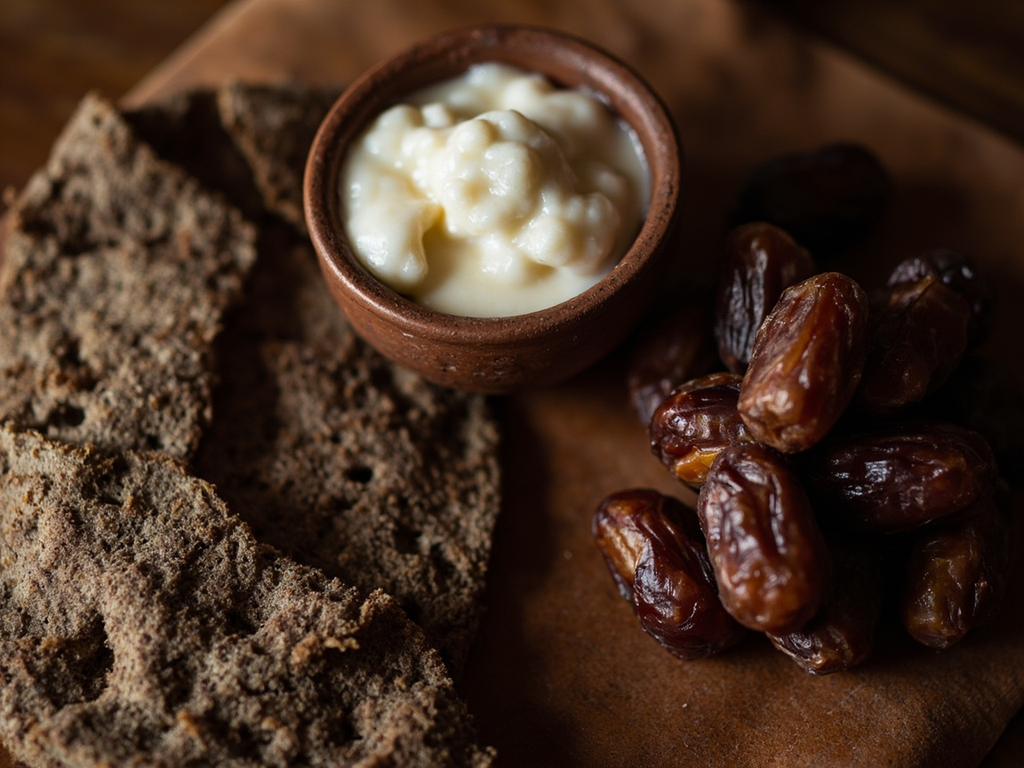
flipBarley bread, dates, and curdled milk
Barley bread, dates, and curdled milk
Why this dish? Before becoming governor of Egypt, Abdallah grew up in the world of Medina and the desert, where the ordinary meal consisted of three things: a barley bread baked on a stone, a handful of dates, and milk. This is the food that accompanied him on campaign trails before the splendors of Fustat.
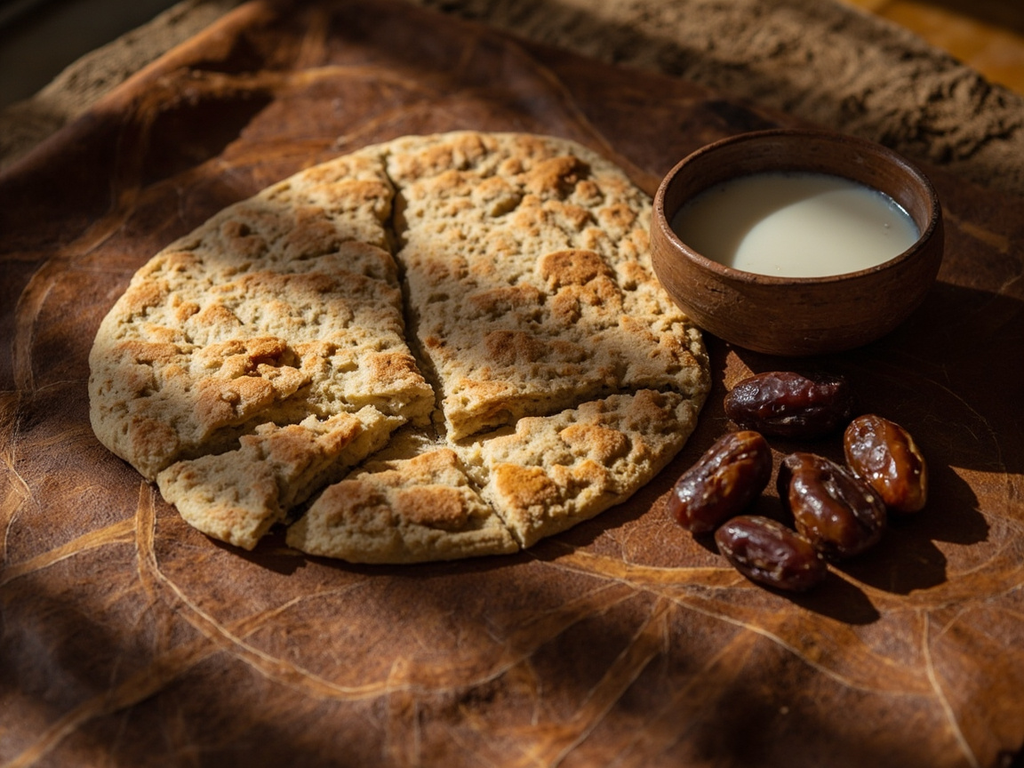
The simplest and most frequent meal: a dense barley flatbread, soft dates, and a bowl of slightly tangy curdled milk. Nothing superfluous, but enough to sustain a day of walking or riding.
In the name of God, you who share my sufra, do not despise this barley bread because it is black and coarse. It is from this that I drew my strength before commanding men: we break it by hand, dip it in milk to soften it, and squeeze a date between two bites for sweetness. The rich eat wheat, but the wise soldier keeps the taste of barley in his mouth, for wheat does not grow along the trails. Praise God for what satisfies, and keep the rest for the brother who has nothing.
- •Barley flour — two handfuls per person (base of the bread)
- •Water — as needed (kneading)
- •Salt — a pinch (seasoning)
- •Dates — a good handful (sweetness)
- •Curdled milk (goat or sheep) — one bowl (fresh accompaniment)
Barley bread, dates, and curdled milk
The simplest and most frequent meal: a dense barley flatbread, soft dates, and a bowl of slightly tangy curdled milk. Nothing superfluous, but enough to sustain a day of walking or riding.
Why this dish? Before becoming governor of Egypt, Abdallah grew up in the world of Medina and the desert, where the ordinary meal consisted of three things: a barley bread baked on a stone, a handful of dates, and milk. This is the food that accompanied him on campaign trails before the splendors of Fustat.
In the name of God, you who share my sufra, do not despise this barley bread because it is black and coarse. It is from this that I drew my strength before commanding men: we break it by hand, dip it in milk to soften it, and squeeze a date between two bites for sweetness. The rich eat wheat, but the wise soldier keeps the taste of barley in his mouth, for wheat does not grow along the trails. Praise God for what satisfies, and keep the rest for the brother who has nothing.
Ingredients (period version)
- Barley flour — two handfuls per person (base of the bread)
- Water — as needed (kneading)
- Salt — a pinch (seasoning)
- Dates — a good handful (sweetness)
- Curdled milk (goat or sheep) — one bowl (fresh accompaniment)
Ingredients
- Barley flour — 250 g (base of the bread)
- Whole wheat flour — 50 g (makes shaping easier)
- Warm water — 180 ml approx. (kneading)
- Salt — 1 tsp (seasoning)
- Medjool or Deglet Nour dates — 8 to 10 (sweetness)
- Plain stirred yogurt or buttermilk — 250 g (tangy curdled milk)
Method
- Mix the flours and salt, add water gradually and knead for 5 minutes until a soft, slightly sticky dough forms.
- Divide into balls the size of a mandarin, flatten by hand into 1 cm thick rounds.
- Cook dry on a cast-iron skillet or very hot griddle, 3 to 4 minutes per side, until brown blisters appear.
- Serve warm with the dates and a bowl of yogurt or buttermilk to dip the bread.
How it was made : Barley, more rustic and cheaper than wheat, was the cereal of the common people and nomads. The flatbread was baked on a flat stone placed on embers (the malla), or directly under the ashes. Milk, which quickly soured in the heat, was often consumed curdled.
The contemporary twist : A spoonful of samn (clarified butter) melted on the hot flatbread and a drizzle of honey: the 'feast day' version of the poor bread.
Sources : Lilia Zaouali, L'Islam à table. Du Moyen Âge à nos jours, La Découverte, 2004
Abdallah ibn Saad · Charactorium