 flip
flipCouscous with Vegetables from the Gardens of Fez
Couscous with Vegetables from the Gardens of Fez
Why this dish? Couscous is the common food of the entire Marinid Maghreb, from the palace of Fez to the humblest homes; at the sultan's table, it bound the people and the court around a single gesture, and daily fed a large court of officials, scholars and guests.
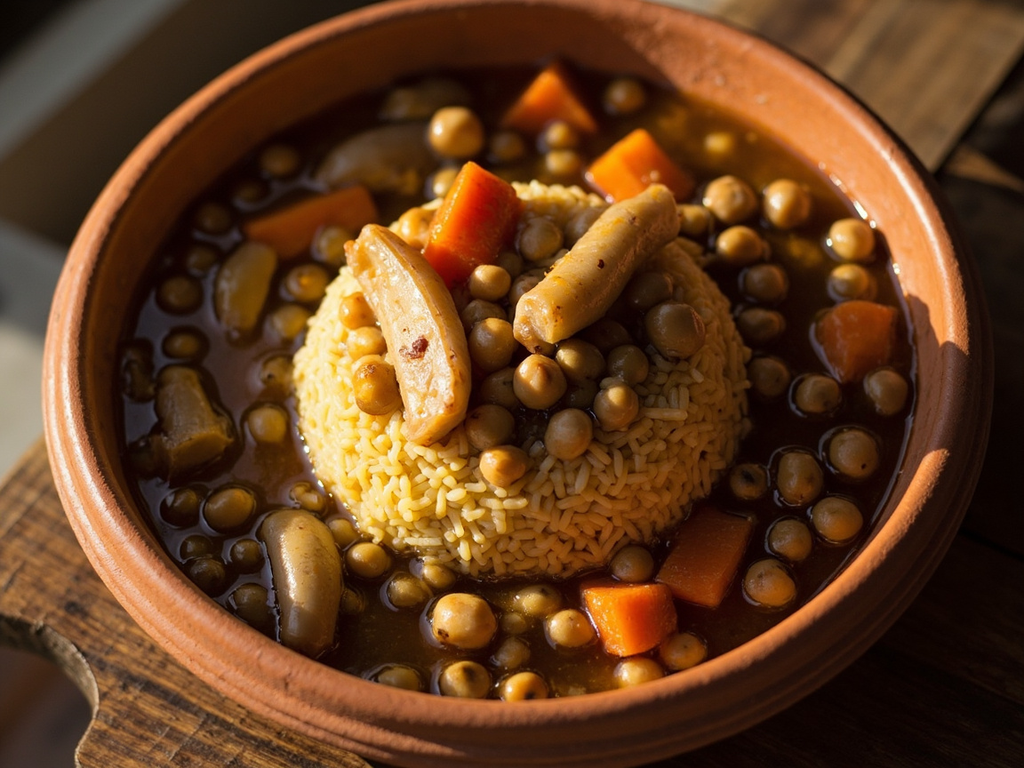
Grains of semolina rolled and steamed, light and golden, crowning a broth of garden vegetables: turnips, carrots, onions, chickpeas, fava beans and cardoons. Mild, comforting, perfumed with saffron and ginger.
Couscous, traveler, is the bread of our land and equality before God: both the poor man and the prince dip their hand into it. My kitchen women roll the grain between their palms until it is fine as desert sand, then steam it three times over the vegetable broth — never fewer than three, else it remains heavy. We mount it as a hill, hollow its peak to pour in the turnips and fava beans from our gardens. This is what a sultan eats on an ordinary day, and he gives thanks.
- •Hand-rolled durum wheat semolina — a full measure (base)
- •Turnips — a few (root vegetable)
- •Carrots — a bunch (sweetness)
- •Onions — two (aromatic base)
- •Soaked chickpeas — a handful (legume)
- •Fresh fava beans — a bowl (seasonal vegetable)
- •Cardoons — a few ribs (mild bitterness)
- •Saffron and ginger — a pinch (spices)
- •Smen — a knob (perfumed fat)
Couscous with Vegetables from the Gardens of Fez
Grains of semolina rolled and steamed, light and golden, crowning a broth of garden vegetables: turnips, carrots, onions, chickpeas, fava beans and cardoons. Mild, comforting, perfumed with saffron and ginger.
Why this dish? Couscous is the common food of the entire Marinid Maghreb, from the palace of Fez to the humblest homes; at the sultan's table, it bound the people and the court around a single gesture, and daily fed a large court of officials, scholars and guests.
Couscous, traveler, is the bread of our land and equality before God: both the poor man and the prince dip their hand into it. My kitchen women roll the grain between their palms until it is fine as desert sand, then steam it three times over the vegetable broth — never fewer than three, else it remains heavy. We mount it as a hill, hollow its peak to pour in the turnips and fava beans from our gardens. This is what a sultan eats on an ordinary day, and he gives thanks.
Ingredients (period version)
- Hand-rolled durum wheat semolina — a full measure (base)
- Turnips — a few (root vegetable)
- Carrots — a bunch (sweetness)
- Onions — two (aromatic base)
- Soaked chickpeas — a handful (legume)
- Fresh fava beans — a bowl (seasonal vegetable)
- Cardoons — a few ribs (mild bitterness)
- Saffron and ginger — a pinch (spices)
- Smen — a knob (perfumed fat)
Ingredients
- Medium couscous (durum wheat semolina) — 500 g (base)
- Turnips — 3 (root vegetable)
- Carrots — 4 (sweetness)
- Onions — 2 (base)
- Chickpeas (soaked or canned) — 200 g (legume)
- Shelled fava beans — 200 g (vegetable)
- Cardoons or fennel — 300 g (mild bitterness)
- Saffron + ground ginger — 1 pinch + 1 tsp (spices)
- Smen or olive oil + butter — 2 tbsp (fat)
- Salt — to taste (seasoning)
Method
- Sweat the onions in smen, add saffron, ginger and salt, then cover with water to make the broth.
- Add chickpeas, then vegetables in order of cooking time (turnips and carrots first, fava beans and cardoons later).
- Meanwhile, moisten and break up the semolina, then steam it over the broth in three passes, aerating and buttering between each.
- Mound the semolina in a dome, hollow the top and arrange the vegetables.
- Ladle hot broth over and serve immediately, with extra broth on the side.
How it was made : Couscous is attested throughout the Maghreb from the Middle Ages; it was steamed in a couscoussier (keskes) over a pot of vegetables or meat. New World vegetables (tomato, squash, chili) being unknown before 1492, cooks relied on roots, fava beans, chickpeas and cardoons from Mediterranean gardens.
The contemporary twist : A finish of candied lemon zest and a drizzle of new olive oil, to revive the sweetness of the roots without betraying the period spirit.
Sources : Ibn Razin al-Tujibi, Fadalat al-khiwan (13th c.) · Anonymous Andalusian, Kitab al-tabikh fi al-Maghrib wa-l-Andalus (13th c.)
Abou Inan · Charactorium