 flip
flipMission Garden Vegetable Rice
Mission Garden Vegetable Rice
Why this dish? Schweitzer ate little and simply: rice, vegetables and local products, shared with his colleagues. This unpretentious dish is the literal daily fare at his table in Lambaréné, where frugality was as much a discipline as a necessity.
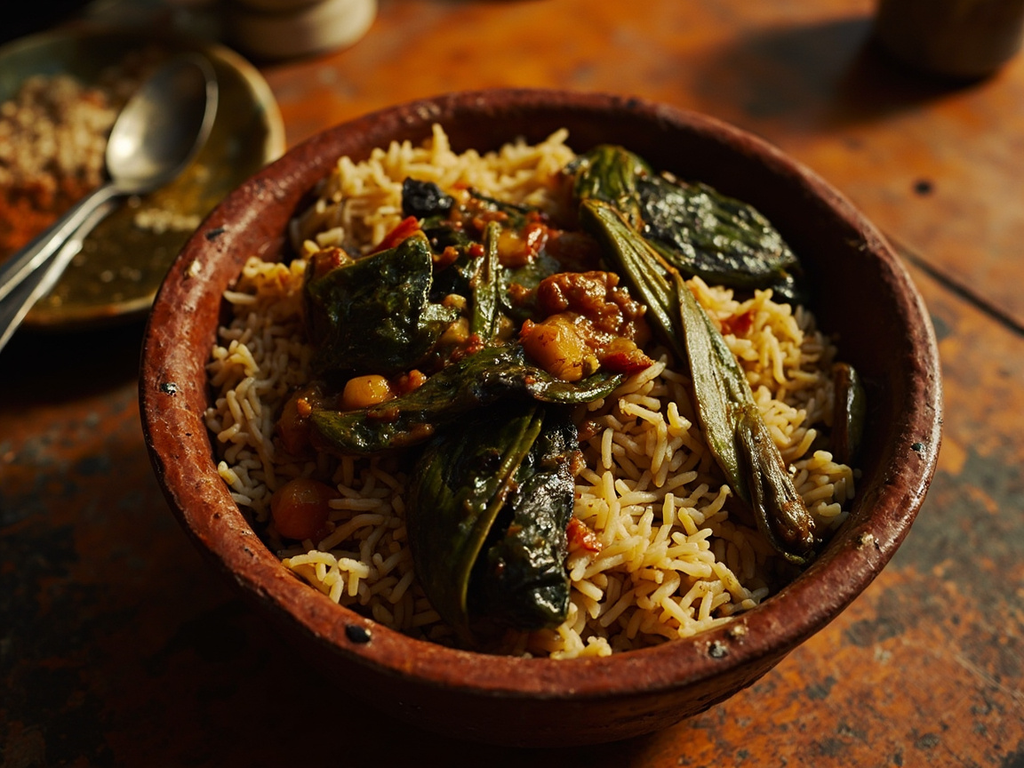
A rice simmered with vegetables from the hospital garden—okra, leafy greens, onion—bound with a drizzle of red palm oil. Nourishing, economical, made to satisfy a table without waste.
You see, in Lambaréné we did not eat for the pleasure of the senses but to keep standing before the work. The rice cooked in the large pot, we threw in whatever the garden would give, a little palm oil for strength, and each held out his bowl. I insisted that the table be the same for the doctor and for the patient: respect for life begins at mealtime, in the bread we break together.
- •Rice — a good measure (nourishing base)
- •Fresh okra — a handful (binding vegetable)
- •Leafy greens (African spinach / boiled cassava leaves) — a bunch (greens)
- •Onion — one (aromatic)
- •Red palm oil — a drizzle (fat and color)
- •Salt — to taste (seasoning)
Mission Garden Vegetable Rice
A rice simmered with vegetables from the hospital garden—okra, leafy greens, onion—bound with a drizzle of red palm oil. Nourishing, economical, made to satisfy a table without waste.
Why this dish? Schweitzer ate little and simply: rice, vegetables and local products, shared with his colleagues. This unpretentious dish is the literal daily fare at his table in Lambaréné, where frugality was as much a discipline as a necessity.
You see, in Lambaréné we did not eat for the pleasure of the senses but to keep standing before the work. The rice cooked in the large pot, we threw in whatever the garden would give, a little palm oil for strength, and each held out his bowl. I insisted that the table be the same for the doctor and for the patient: respect for life begins at mealtime, in the bread we break together.
Ingredients (period version)
- Rice — a good measure (nourishing base)
- Fresh okra — a handful (binding vegetable)
- Leafy greens (African spinach / boiled cassava leaves) — a bunch (greens)
- Onion — one (aromatic)
- Red palm oil — a drizzle (fat and color)
- Salt — to taste (seasoning)
Ingredients
- Long-grain rice — 250 g (nourishing base)
- Okra (fresh or frozen) — 150 g, sliced into rounds (binding vegetable)
- Spinach or Swiss chard — 200 g, chopped (greens)
- Onion — 1 large, sliced (aromatic)
- Red palm oil (or, failing that, neutral oil + 1 pinch turmeric) — 2 tbsp (fat and color)
- Salt — 1 tsp (seasoning)
- Water or vegetable broth — 500 ml (cooking liquid)
Method
- Sauté the onion in palm oil over low heat until soft.
- Add the okra rounds and sweat for 3 to 4 minutes.
- Pour in the rice, stir to coat, then add the water or broth and salt.
- Cover and cook over low heat for 15 minutes, until liquid is absorbed.
- Fold in the chopped leafy greens at the end of cooking, just until wilted (3 minutes).
- Let rest off heat for 5 minutes, then serve in a large shared dish.
How it was made : At the hospital, cooking was done over a wood fire in large pots, with whatever the garden and village donations provided. Rice, imported then locally cultivated, formed the base; boiled cassava leaves replaced our spinach. Nothing was wasted.
The contemporary twist : Serve it in a large calabash or earthenware bowl placed at the center of the table, with spoons stuck in—the spirit of sharing before any plating.
Sources : Albert Schweitzer, *À l'orée de la forêt vierge* (*Zwischen Wasser und Urwald*), 1921 · Albert Schweitzer, *Ma vie et ma pensée*, 1931
Albert Schweitzer · Charactorium