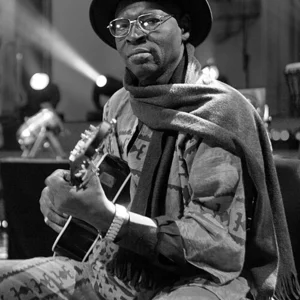

Ali Farka Touré was a Malian guitarist and singer, a major figure in African music. Nicknamed the "African John Lee Hooker," he revealed to the world the African roots of the blues by fusing Malian traditions with American blues.
Ali Farka Touré(1939 — 2006)
Ali Farka Touré
Mali
6 min read
Frequently asked questions
Key Facts
- Born in 1939 in Kanau, in the Timbuktu region (Mali), he grew up in Niafunké on the banks of the Niger River
- Self-taught, he started with the njarka (single-stringed fiddle) before taking up the guitar in the 1950s-1960s
- His album "Talking Timbuktu" (1994), recorded with Ry Cooder, won a Grammy Award
- He became mayor of Niafunké and invested in agriculture and the development of his region
- He died on 6 March 2006 in Bamako; his posthumous album "Savane" was acclaimed by critics
Works & Achievements
The album that brought him to international attention and established his “desert blues” among world-music fans.
An acclaimed album blending Malian traditions with international guests, confirming his stature as a major figure in African music.
A collaboration with American guitarist Ry Cooder, winner of a Grammy Award and a symbol of the bridge between African and American blues.
An album recorded in his home village to stay true to his roots, celebrating rural life and Songhai music.
A duo with kora player Toumani Diabaté, honored with a Grammy Award and hailed as a high point of Malian music.
A posthumous album regarded as his masterpiece, likewise crowned with a Grammy Award and summing up his entire art.
Anecdotes
His real first name is Ali Ibrahim Touré, but everyone knows him by the nickname “Farka.” In Songhai, this word means “donkey”: Ali explained that it had been given to him to honor his stubbornness and his capacity for hard work, and he would add with a laugh that he was “the donkey that no one can ride.”
The first time he heard a record by the American bluesman John Lee Hooker, Ali Farka Touré was convinced that this American had “stolen” a Malian music. For him, the blues was not born in America but in Africa, carried across the ocean by enslaved people: his entire career served to demonstrate this kinship.
At the height of his international fame, Ali refused to leave his village of Niafunké for long. He kept saying that music came second to the land: he was first and foremost a rice farmer and herder, and he devoted his musician's earnings to irrigating and sustaining his fields.
In 1994, his album *Talking Timbuktu*, recorded with the American guitarist Ry Cooder, won a Grammy Award. It was one of the first times that music from the Malian desert received such worldwide recognition.
In 2004, Ali Farka Touré was elected mayor of Niafunké. Rather than waiting for help from the State, he financed irrigation and development works for his town himself, putting his fame at the service of its inhabitants.
Primary Sources
“For me, the blues comes from Africa. A lot of people think it's American, but this music was carried away by those who were deported. When I heard John Lee Hooker, I recognized something of our own in it.”
“Music is not my main profession. My profession is farming. I am a farmer from Niafunké before I am a guitarist.”
A recording showcasing the meeting of Ali Farka Touré's Malian blues and Ry Cooder's American guitar playing, hailed as a bridge between the two shores of the Atlantic.
Key Places
Town in the bend of the Niger River where Ali Farka Touré grew up, farmed his rice paddies, and eventually became mayor. He set up his studio there to record as close as possible to his roots.
Region in northern Mali, near which Ali Farka Touré was born in 1939, in the heart of the Songhai country watered by the Niger River.
Mythical city of the Malian desert, a former caravan crossroads and a symbol of northern culture. Its name is linked to the world and to Ali Farka Touré's album “Talking Timbuktu”.
Capital of Mali and the center of the country's musical life, where Ali Farka Touré recorded and where he died in 2006.
Typical Objects

Ali Farka Touré's emblematic instrument, on which he transposed traditional Malian melodies. His hypnotic, repetitive playing brought recognition to the link between Sahelian music and the blues.

A small traditional single-stringed Songhai fiddle, played with a bow. Ali Farka Touré played it to connect his modern music to the ancestral instruments of northern Mali.

A small West African plucked-string lute that Ali Farka Touré played in his early days before favouring the guitar. It embodies the heritage of Sahelian string instruments.

The medium through which Ali Farka Touré's music spread around the world, notably his award-winning albums. It helped carry the “desert blues” far beyond Mali.

The farming implements Ali Farka Touré used to grow rice in Niafunké. They are a reminder that he saw himself first and foremost as a farmer devoted to his land.

A flowing traditional West African robe that Ali Farka Touré wore proudly both on stage and in everyday life. In doing so, he displayed his attachment to Malian culture.
School Curriculum
Vocabulary & Tags
Key Vocabulary
Daily Life
Morning
In Niafunké, Ali Farka Touré often began his day like a farmer: rising early, he would go to his rice paddies on the banks of the Niger to oversee the irrigation and the crops. Working the land set the rhythm of his morning long before the music.
Afternoon
In the afternoon, he might tend to his fields, welcome relatives, or practice the guitar in the shade, away from the heat. When he was preparing an album, he devoted these hours to rehearsals and recordings carried out on site.
Evening
In the evening, when the heat eased, it was time for shared music: guitar playing, songs in Songhai or Bambara, and long conversations with family and visitors. These evening gatherings carried on an ancient oral tradition.
Food
His diet was that of the Malian Sahel: rice he grew himself, millet, fish from the Niger River, sauces, and green tea served in several rounds. Mint tea accompanied conversations and moments of music.
Clothing
Ali Farka Touré gladly wore the large traditional boubou and a headdress, both on stage and in his village. This loose, colorful attire affirmed his rootedness in Malian culture.
Housing
He lived in his house in Niafunké, within a family compound close to his land and the river. Despite his worldwide fame, he preferred this rural setting to life in the great capitals.