 flip
flipGrissini Stirati Torinesi (Hand-Stretched Turin Breadsticks)
Grissini Stirati Torinesi (Hand-Stretched Turin Breadsticks)
Why this dish? The grissino was born in Turin and remains, even today, the companion of every Piedmontese table. For a musicologist bent over manuscripts at the Biblioteca Nazionale for hours, these thin crunchy sticks can be nibbled without dirtying fingers or folios — the ideal snack for the Turinese scholar between cataloguing sessions.
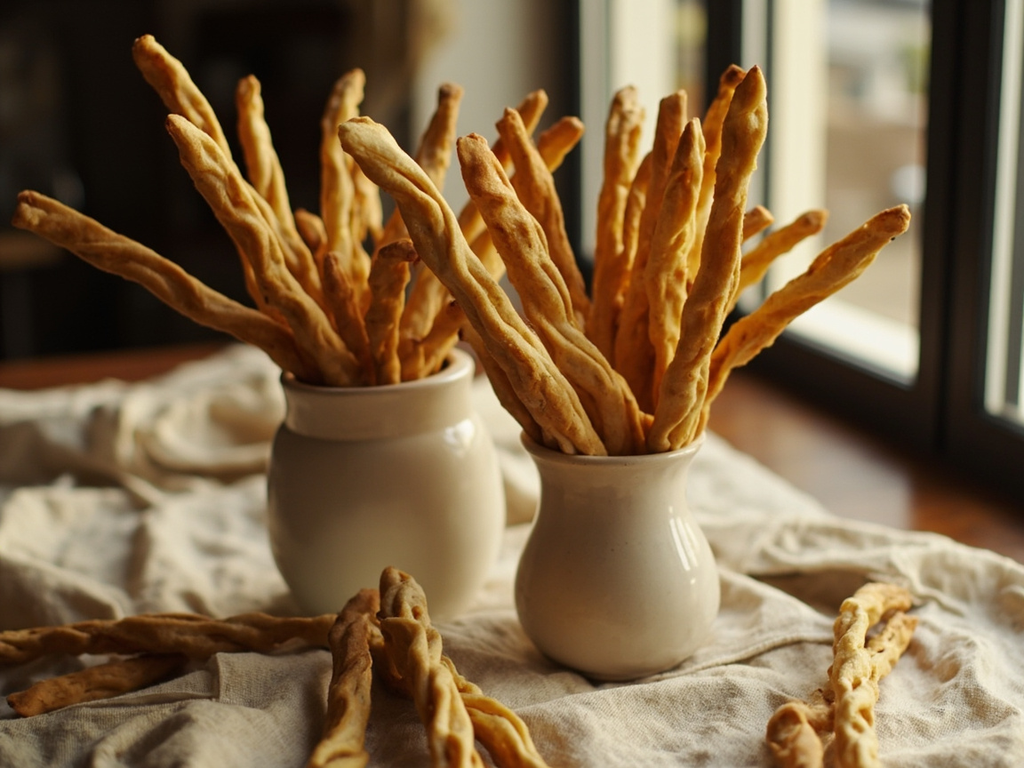
Long, thin hand-stretched breadsticks, crunchy all the way through, lightly salted and perfumed with a drizzle of oil. The quintessential bread of Turin, which keeps for days and can be eaten at any hour.
You see, in Turin, we could never sit down to table without these breadsticks — at home we call them grissini stirati, stretched by hand until they are as long as your forearm. I confess that at the library I used to slip a few into my pocket: they don't soil Vivaldi's pages, and their crunch keeps the mind company. My mother used to say a good grissino should sing under the tooth like a bow on a string. Stretch them very thin, and do not be afraid to let them turn golden.
- •Wheat flour — a good measure (base)
- •Sourdough or brewer's yeast — a little (fermentation)
- •Olive oil — a drizzle (softness and crunch)
- •Lard (optional) — a knob (rustic flakiness)
- •Salt — a pinch (seasoning)
- •Warm water — enough (hydration)
Grissini Stirati Torinesi (Hand-Stretched Turin Breadsticks)
Long, thin hand-stretched breadsticks, crunchy all the way through, lightly salted and perfumed with a drizzle of oil. The quintessential bread of Turin, which keeps for days and can be eaten at any hour.
Why this dish? The grissino was born in Turin and remains, even today, the companion of every Piedmontese table. For a musicologist bent over manuscripts at the Biblioteca Nazionale for hours, these thin crunchy sticks can be nibbled without dirtying fingers or folios — the ideal snack for the Turinese scholar between cataloguing sessions.
You see, in Turin, we could never sit down to table without these breadsticks — at home we call them grissini stirati, stretched by hand until they are as long as your forearm. I confess that at the library I used to slip a few into my pocket: they don't soil Vivaldi's pages, and their crunch keeps the mind company. My mother used to say a good grissino should sing under the tooth like a bow on a string. Stretch them very thin, and do not be afraid to let them turn golden.
Ingredients (period version)
- Wheat flour — a good measure (base)
- Sourdough or brewer's yeast — a little (fermentation)
- Olive oil — a drizzle (softness and crunch)
- Lard (optional) — a knob (rustic flakiness)
- Salt — a pinch (seasoning)
- Warm water — enough (hydration)
Ingredients
- T65 flour (all-purpose) — 300 g (base)
- Active dry yeast — 5 g (fermentation)
- Olive oil — 30 ml + a little for brushing (softness and crunch)
- Fine salt — 6 g (seasoning)
- Warm water — 160 ml (hydration)
- Fine durum wheat semolina — for the work surface (facilitates stretching)
Method
- Dissolve the yeast in the warm water, then knead with the flour, oil, and salt until you obtain a smooth, supple dough.
- Let it rise for 1 hour under a cloth, in a warm place, until the dough doubles in size.
- Roll the dough into a thick rectangle on a surface dusted with semolina, brush with oil, and let rest for 15 min.
- Cut into 1 cm wide strips, then gently stretch them by hand, pulling from both ends, until they reach the length of the baking sheet.
- Place on a baking sheet, not too close together, and bake at 200 °C for 12 to 15 min until golden and dry.
- Let cool: they should snap cleanly and be crunchy.
How it was made : The grissino is said to have been created in Turin at the end of the 17th century by a baker for a young Duke of Savoy with a delicate stomach, as very dry bread was more digestible. In the 19th century, they were still entirely hand-stretched, each baker having his own length. Napoleon, it is said, called them 'little sticks of Turin.'
The contemporary twist : Roll the dough in sesame seeds, chopped rosemary, or a veil of Parmesan before baking, and present them standing up in a tall glass, like a bouquet to share.
Alberto Gentili · Charactorium