 flip
flipBagna càuda
Bagna càuda
Why this dish? Bagna càuda is the totem dish of Primo Levi's Piedmont, the winter evenings in Turin when the family gathers around a single small earthenware pot. For a man who knew the hunger of Auschwitz, this ritual of collectively dipping vegetables into a shared 'hot sauce' embodies exactly what he called the regained dignity of the table.
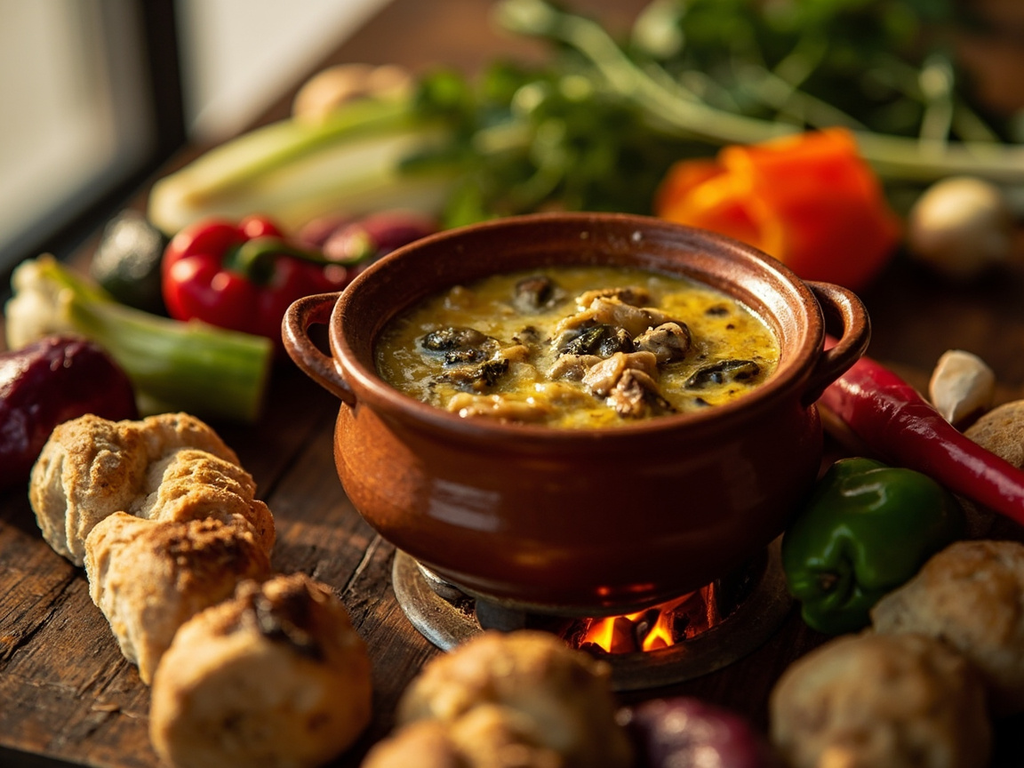
A 'hot sauce' of olive oil, melted garlic, and salted anchovies, kept warm over a small flame, into which one dips raw and cooked vegetables from the Piedmontese garden: cardoons, peppers (by the 20th century), cabbage, Jerusalem artichokes, beets.
You see, at home in Turin, bagna càuda is not a dish, it's a gathering. We would place the earthenware fojòt in the center, on its little embers, and each of us would dip their cardoon or cabbage — you had to reach over your neighbor's hand, and that was already a way of talking. The garlic, we would first let it turn golden very slowly in milk, never rush it, otherwise it becomes bitter and follows you all night. And the anchovies, those anchovies that came from the sea over the mountains, melted in the oil until they were nothing but a scent. I learned much later, after returning, what that simple gesture of dipping your food into a shared dish, without fear, among your own, was worth.
- •Anchovies preserved in salt — a good handful, deboned (salty umami base)
- •Piedmontese garlic — several heads (aromatic body)
- •Olive oil (and a little butter) — enough to cover (binder and heat)
- •Milk — one bowl (to soften the garlic)
- •Seasonal vegetables: cardoons, cabbage, peppers, Jerusalem artichokes, beets — as much as you like (for dipping)
Bagna càuda
A 'hot sauce' of olive oil, melted garlic, and salted anchovies, kept warm over a small flame, into which one dips raw and cooked vegetables from the Piedmontese garden: cardoons, peppers (by the 20th century), cabbage, Jerusalem artichokes, beets.
Why this dish? Bagna càuda is the totem dish of Primo Levi's Piedmont, the winter evenings in Turin when the family gathers around a single small earthenware pot. For a man who knew the hunger of Auschwitz, this ritual of collectively dipping vegetables into a shared 'hot sauce' embodies exactly what he called the regained dignity of the table.
You see, at home in Turin, bagna càuda is not a dish, it's a gathering. We would place the earthenware fojòt in the center, on its little embers, and each of us would dip their cardoon or cabbage — you had to reach over your neighbor's hand, and that was already a way of talking. The garlic, we would first let it turn golden very slowly in milk, never rush it, otherwise it becomes bitter and follows you all night. And the anchovies, those anchovies that came from the sea over the mountains, melted in the oil until they were nothing but a scent. I learned much later, after returning, what that simple gesture of dipping your food into a shared dish, without fear, among your own, was worth.
Ingredients (period version)
- Anchovies preserved in salt — a good handful, deboned (salty umami base)
- Piedmontese garlic — several heads (aromatic body)
- Olive oil (and a little butter) — enough to cover (binder and heat)
- Milk — one bowl (to soften the garlic)
- Seasonal vegetables: cardoons, cabbage, peppers, Jerusalem artichokes, beets — as much as you like (for dipping)
Ingredients
- Anchovy fillets in salt or oil — 100 g, rinsed and deboned (salty umami base)
- Garlic cloves — 12 cloves (aromatic body)
- Extra virgin olive oil — 250 ml (binder and heat)
- Butter — 30 g (roundness)
- Whole milk — 250 ml (to soften the garlic)
- Assorted vegetables (cardoon, cauliflower, bell pepper, fennel, Jerusalem artichoke, cooked beet) — 1.5 kg for 4-6 (for dipping)
Method
- Peel the garlic cloves, cut them in half, remove the germ, and poach them in the milk over very low heat for 10 minutes to soften.
- Drain the garlic, return it to a heavy saucepan with the olive oil and butter.
- Add the rinsed anchovies; cook over very low heat for 20 to 30 minutes, crushing them, never letting them fry, until a homogeneous sauce is obtained.
- Pour into a caquelon or small pot placed over a tealight or very low burner.
- Serve surrounded by raw and cooked vegetables; each person dips as they wish.
How it was made : Traditionally, the sauce was kept warm in a fojòt, a small earthenware container with a cavity for embers. The golden rule, passed down through generations, is never to let the garlic or anchovies fry: the heat must remain gentle. The bell pepper, a New World vegetable, only joined the recipe after its acclimatization in Europe — by Levi's time, it was perfectly common.
The contemporary twist : Serve as a 'shared aperitif' with Turin breadsticks (grissini) planted in the sauce, a nod to Levi's hometown, the historical capital of grissino.
Primo Levi · Charactorium