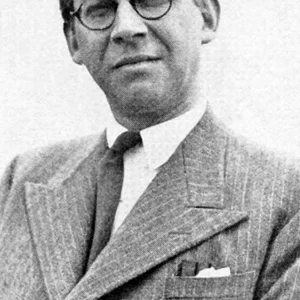

Hungarian-born film director and producer who became a naturalised British citizen. Founder of the company London Films, he was a major figure in British cinema between the two world wars and the first film professional to be knighted.
Alexander Korda(1893 — 1956)
Alexander Korda
Hongrie, Royaume-Uni, Royaume-Uni de Grande-Bretagne et d'Irlande
5 min read
Frequently asked questions
Key Facts
- Born on 16 September 1893 in Pusztatúrpásztó (Hungary)
- Founded the company London Films in 1932
- Directed The Private Life of Henry VIII (1933), an international success
- Producer of The Third Man (1949) and many prestigious films
- First film professional knighted by the British Crown in 1942; died on 23 January 1956 in London
Works & Achievements
The first major international success of British cinema, with an Oscar-winning Charles Laughton. It established Korda's worldwide reputation.
A science-fiction film based on H. G. Wells, imagining the future of humanity. A visionary work with spectacular sets.
An adventure film set during the French Revolution, a great popular success. Korda supervised its production.
An oriental tale in Technicolor with groundbreaking special effects, completed in the United States during the war. It won several technical Oscars.
A historical drama with Vivien Leigh and Laurence Olivier, celebrating British heroism. Churchill is said to have admired it greatly.
A masterpiece co-produced by Korda, directed by Carol Reed in post-war Vienna. Regarded as one of the greatest British films.
A production company that became the spearhead of an ambitious British cinema. Its Big Ben logo came to symbolize English quality.
Anecdotes
Alexander Korda was Hungarian and arrived in London without speaking perfect English. Yet in 1933, his film *The Private Life of Henry VIII* was a worldwide triumph and became the first British film to win over American audiences on a massive scale, proving that Hollywood could be challenged from England.
In 1942, King George VI made Korda the first film figure to be knighted (“Sir”). Curiously, it was long suspected that his frequent trips between London and Hollywood also served as cover for British intelligence activities before the Second World War.
To produce *The Thief of Bagdad* (1940), Korda had to contend with the war: filming, which began in England, was interrupted by the bombing raids and completed in the United States. With its special effects and dazzling Technicolor, the film amazed audiences during a very dark period.
In 1932, Korda founded the company London Films, whose logo featured Big Ben. He had the vast Denham studios built, among the largest in Europe, betting colossal sums to rival the American majors — a gamble often on the brink of bankruptcy.
Three Korda brothers worked together in cinema: Alexander produced and directed, Zoltán directed adventure films, and Vincent was a set designer and art director, creating the sumptuous sets for their films.
Primary Sources
Charles Laughton, in the role of Henry VIII, plays a gluttonous and imposing king; the film wins the Academy Award for Best Actor, the first statuette for a British production.
Alexander Korda is knighted (Knight Bachelor) for services rendered, becoming the first film producer and director to receive this honour.
The film, in Technicolor, unfolds an Oriental fantasy of unprecedented visual richness, offering wartime audiences a spectacular escape.
Key Places
Village on the Great Hungarian Plain where Alexander Korda was born in 1893. He spent his childhood there in a modest Jewish family.
Hungarian capital where Korda began as a journalist and then as a director in the budding silent film industry. He directed his first films there before going into exile.
City where Korda founded London Films in 1932 and built his career as a British film mogul. He died there in 1956.
Vast film studios built by Korda near London, opened in 1936. They were among the largest in Europe.
Centre of American cinema where Korda worked in the 1920s and completed “The Thief of Bagdad” during the war. He forged ties there with the major studios.
Typical Objects

A heavy device mounted on a tripod used to film scenes; Korda's studios owned several for their big-budget productions. It recorded the image onto a 35-millimetre strip of film.

A strip of celluloid carrying the successive photographic images of a film. Spliced end to end, it formed the reels projected in cinemas.

A text describing the story, dialogue, and scenes of a film. Korda placed great importance on it for the quality of his productions.

A special camera that recorded colour onto three separate films, used for “The Thief of Bagdad.” It produced images with vivid colours, rare at the time.

A powerful light used on sets to illuminate the scenery and the actors. Lighting gave the images their atmosphere and depth.

A slate fitted with a hinged arm clapped at the start of each take to synchronise picture and sound. The scene and take numbers were written on it.
School Curriculum
Vocabulary & Tags
Key Vocabulary
Tags
Daily Life
Morning
A producer as much as an artist, Korda often began his day reading scripts and business correspondence. He met with collaborators and financiers, since keeping London Films running demanded a constant search for money.
Afternoon
His afternoons were spent on the sets of the Denham studios, supervising filming, set design, and editing. He talked with directors, actors, and technicians, attending to the smallest visual detail.
Evening
Korda's evenings were social: dinners, receptions, and meetings with writers, politicians, and stars. This network helped him finance his films and win over talent.
Food
A cultured and refined man, Korda frequented London's great restaurants and elegant clubs. Business meals there were an integral part of his work as a producer.
Clothing
Korda took care of his appearance with elegant, made-to-measure suits in the style of British gentlemen. This attention reflected his ambition to embody the prestige of English cinema.
Housing
Having become rich and famous, Korda lived in comfortable London residences and traveled between Europe and the United States. His luxurious lifestyle contrasted with the modest origins of his Hungarian childhood.
Historical Timeline
Period Vocabulary
Liens externes & ressources
Références
Œuvres
Le Voleur de Bagdad
1940
Lady Hamilton (That Hamilton Woman)
1941