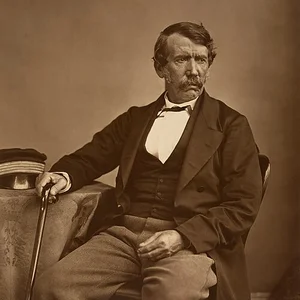

Physician, Protestant missionary, and Scottish explorer (1813–1873), Livingstone was one of the first Europeans to cross Africa from east to west. He contributed to the geographical knowledge of the continent and actively fought against the slave trade.
David Livingstone(1813 — 1873)
David Livingstone
Écosse, Royaume-Uni
8 min read
Frequently asked questions
Famous Quotes
« I am resolved not to leave Africa until I have done something for it.»
« I go where no man has ever been.»
Key Facts
- 1841: Arrives in South Africa as a missionary
- 1855: Discovery of Victoria Falls on the Zambezi River
- 1856: First European to cross Africa from east to west
- 1866–1871: Expedition in search of the sources of the Nile, with no news for months
- 1871: Found by journalist Henry Morton Stanley, who utters the famous phrase: “Dr. Livingstone, I presume?”
Works & Achievements
An account of his early years in Africa and his crossing of the continent, this book was an immediate bestseller, selling over 70,000 copies. It helped shape the romantic image of the explorer-missionary in Europe.
An account of the official Zambezi expedition (1858-1864), less celebrated than its predecessor but rich in geographical, naturalist, and ethnographic observations. The work strongly condemns the Arab slave trade.
Edited by Horace Waller from notebooks brought back by his servants, these journals cover his final great expedition (1866-1873). They bear witness to his growing exhaustion and his obsession with finding the source of the Nile.
Livingstone's topographic surveys enabled the first reliable maps of vast regions of central and southern Africa, incorporated into publications of the Royal Geographical Society of London.
Anecdotes
In November 1871, after months of fruitless searching, American journalist Henry Morton Stanley found Livingstone, exhausted and ill, in the village of Ujiji on the shores of Lake Tanganyika. He greeted him with the now-legendary phrase: “Dr. Livingstone, I presume?” This encounter, reported in the world press, transformed the explorer into a romantic hero of the Victorian era.
Between 1853 and 1856, Livingstone completed the first coast-to-coast crossing of Africa, from Cape Dilolo to the mouth of the Zambezi. He covered more than 11,000 kilometres on foot, suffering repeated bouts of malaria but refusing to give up. On his return to England, he was welcomed as a hero and received the gold medal of the Royal Geographical Society.
On 17 November 1855, Livingstone became the first European to behold the Mosi-oa-Tunya Falls, the vast cataract of the Zambezi. Struck by their majesty, he renamed them “Victoria Falls” in honour of the Queen of England. He would write in his journal that they were so beautiful that they “must have been gazed upon by angels in their flight.”
When Livingstone died in May 1873 at Chitambo (in present-day Zambia), kneeling in prayer, his African servants — notably Susi and Chuma — made an extraordinary decision: they embalmed his body and carried it for nine months across hundreds of kilometres of bush to the coast, so that it could be repatriated. This unwavering loyalty bears witness to the deep bonds he had formed with local populations.
Livingstone was a determined opponent of the slave trade, still practised on a massive scale by Arab-Swahili merchants in East Africa at the time. He recorded horrific scenes in his notebooks and hoped that opening legitimate trade routes into Africa would deprive the traffickers of their market. His struggle directly influenced Britain’s decision to increase pressure on the Sultanate of Zanzibar to abolish this trade.
Primary Sources
I resolved to go into the interior, and in 1840 started from the Cape. The country was entirely new to me, and I had to learn to travel in Africa.
We resolved to ascertain, if possible, whether the Zambesi had any connection with the great Lake Nyassa, and whether it was navigable for steamers.
I am pale, the slave-traders killed my heart long ago. It is all broken with misery. I can do no more.
All I can add in my loneliness is, may Heaven's rich blessing come down on every one — American, English, Turk — who will help to heal this open sore of the world.
I beg to direct your attention to Africa. I know that in a few years I shall be cut off in that country, which is now open. Do not let it be shut again. I go back to Africa to try to make an open path for commerce and Christianity.
Key Places
Livingstone's birthplace, where he grew up in a working-class family and began working in a cotton mill at the age of ten. A museum and memorial are dedicated to him there today.
The first mission where Livingstone settled in 1841 alongside Robert Moffat, whose daughter Mary he would later marry. It was here that he learned local languages and began his missionary work in southern Africa.
Livingstone was the first European to see these majestic falls in November 1855, naming them in honour of Queen Victoria. The site is a UNESCO World Heritage Site.
A village on the shores of Lake Tanganyika where Stanley found Livingstone in November 1871, in one of the most celebrated encounters in the history of exploration. A monument today marks the supposed location of the scene.
The village where Livingstone died on 1 May 1873, kneeling in prayer. His faithful servants preserved his heart, buried beneath a tree, before carrying the rest of his remains back to Britain.
Livingstone was interred here in April 1874 with a state funeral, in recognition of his achievements as an explorer and his fight against slavery. His tomb is still visible in the central nave.
Typical Objects

Essential instruments that Livingstone used daily to determine his geographical position with precision. His topographical surveys became a major cartographic source for the era.

Livingstone was above all a missionary: he always carried a Bible in his luggage and held his Christian convictions as the driving force behind his explorations. He read it every evening despite the exhaustion of long marches.

His exploration journals, spanning decades, constitute a precious historical and geographical source. He recorded naturalist observations, positions, encounters with local populations, and descriptions of the slave trade.

A qualified physician, Livingstone treated local populations during his travels, which earned him their trust and protection. His remedies against malaria — particularly quinine — saved his life on several occasions.

The flat peaked cap worn by Livingstone became one of his iconic attributes, visible in portraits from the period. It shielded him from the African sun during his long marches.

To explore the great African rivers — the Zambezi, the Lualaba, the Tanganyika — Livingstone used local dugout canoes or small boats, often built on the spot. River navigation was at the heart of his exploration strategy.
School Curriculum
Vocabulary & Tags
Key Vocabulary
Tags
Daily Life
Morning
The day's march began before dawn to take advantage of the cool air. Livingstone rose around 4 a.m., prayed, then organized the column of porters before setting off. He noted weather conditions and took position readings with his sextant as soon as the light allowed.
Afternoon
Afternoons under the African sun were reserved for medical care — he would see patients in the villages they passed through, distributing quinine and medicines. He took botanical notes, observed wildlife, and spoke with local chiefs to gather geographical and commercial information.
Evening
In the evenings, around the fire, Livingstone wrote up his field journals with meticulous care, recording distances covered, naturalist observations, and descriptions of the peoples he encountered. He read the Bible and sometimes held brief religious ceremonies for his traveling companions.
Food
In the bush, Livingstone ate whatever the land provided: sorghum or cassava porridge, dried meat, hunted game, wild fruits, and local vegetables. In welcoming villages, he might enjoy flatbread, poultry, and curdled milk. Tinned European food was reserved for periods of great weakness.
Clothing
Livingstone wore practical clothing suited to the African bush: sturdy canvas trousers, a light jacket, and his characteristic peaked cap to shield himself from the sun. He repaired his torn clothes himself; in his final expedition years, he was often in rags, his supplies having run out.
Housing
On the move, he slept under a rudimentary tent or in a hut provided by village chiefs. At mission stations and trading posts, he had a simple room. He lived for several months among the local inhabitants in Ujiji, in a thatched hut, completely stripped of equipment after his baggage had been plundered.
Historical Timeline
Period Vocabulary
Liens externes & ressources
Références
Œuvres
Missionary Travels and Researches in South Africa
1857
Narrative of an Expedition to the Zambesi and its Tributaries
1865
The Last Journals of David Livingstone in Central Africa (posthume)
1874
Cartographie du Zambèze et du lac Nyassa
1856-1864