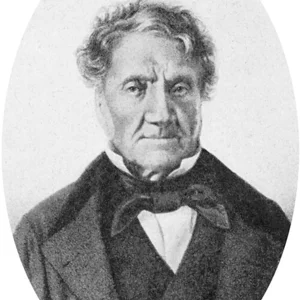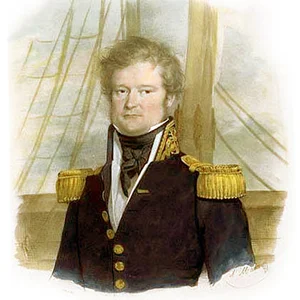

French naval officer and explorer (1790–1842), he led several expeditions to the southern seas and Antarctica. He discovered Adélie Land in 1840 and helped identify the Venus de Milo.
Dumont d'Urville(1790 — 1842)
Jules Dumont d'Urville
France
8 min read
Frequently asked questions
Key Facts
- 1820: takes part in identifying and transporting the Venus de Milo to France
- 1826–1829: commands the Astrolabe expedition, a scientific circumnavigation of Oceania
- 1837–1840: second Astrolabe expedition to the South Pole and the southern seas
- 1840: discovers and names Adélie Land in honour of his wife Adèle
- 1842: dies in the Meudon rail disaster, France's first major railway catastrophe
Works & Achievements
A multi-volume account of his second major Pacific exploration voyage, accompanied by botanical, zoological, and hydrographic atlases; a landmark reference work of 19th-century French scientific exploration.
A monumental 23-volume publication recounting his Antarctic expedition of 1837–1840 and the discovery of Adélie Land; completed after his death by his scientific collaborators.
A foundational article in which he proposed dividing the peoples of the Pacific into Polynesia, Melanesia, and Micronesia — a geographic and ethnographic classification still in use today.
An account of his first major expedition (aboard the corvette *Coquille*, 1822–1825), tracing his Pacific explorations and the collection of thousands of natural history specimens.
A collection of technical reports and official letters in which Dumont d'Urville describes the statue and argues for its acquisition by France — the document that led to the Venus de Milo entering the French royal collections.
Anecdotes
In 1820, while conducting hydrographic surveys near the Greek island of Milos, Dumont d'Urville spotted an ancient statue that a peasant had just unearthed. Immediately recognizing its exceptional value, he alerted the French ambassador in Constantinople, who arranged for the work to be acquired for the King of France. This statue, now known as the Venus de Milo, is one of the absolute masterpieces of the Louvre.
During his Antarctic expedition, Dumont d'Urville discovered new land on 21 January 1840 and named it “Terre Adélie” in tribute to his wife Adèle. This gesture, at once romantic and scientific, has gone down in history: since 1956, France has maintained there a permanent polar research station that bears the explorer’s name.
Dumont d'Urville was a man of remarkable erudition: he was fluent in ancient and modern Greek, Arabic, Hebrew, Russian, and several Oceanian languages. Aboard his ships, he collected plants as readily as vocabularies of unknown indigenous languages, making him as much a linguist as a naturalist.
On 8 May 1842, Dumont d'Urville, his wife, and his son were returning from Versailles on the brand-new railway when the locomotive derailed and caught fire. The Meudon disaster, which claimed the lives of around fifty people including the entire Dumont d'Urville family, is one of the first major railway catastrophes in French history.
Dumont d'Urville was the first geographer to propose a systematic classification of Pacific peoples into three major groups: Polynesians, Melanesians, and Micronesians. These terms, introduced in an 1832 article, are still used today by geographers and anthropologists around the world.
Primary Sources
At four o'clock in the morning, we sighted land… The coasts presented a severe and imposing aspect; sheer cliffs, blackened by sea spray, rose to a considerable height almost everywhere, and nowhere could we make out a beach suitable for landing.
On 21 January 1840, at nine o'clock in the morning, we sighted land that I named Adélie Land, in memory of my dear companion, whose kind qualities have constantly sustained me through life's hardships.
We shall distinguish these three great divisions under the names of Polynesia, Micronesia and Melanesia; these names alone indicate the general character of each of these divisions with regard to the nature and the colour of the inhabitants.
I have carefully examined the statue discovered on the island of Milo; it represents, in my opinion, a deity of Antiquity of remarkable workmanship and surprising state of preservation. I cannot stress enough how important it is that France should acquire it without delay.
Key Places
Norman town where Jules Dumont d'Urville was born on 23 May 1790. His childhood in Normandy, a region traditionally oriented toward the sea, nurtured his maritime vocation from an early age.
Section of the Antarctic continent discovered by Dumont d'Urville on 21 January 1840 and named in honour of his wife Adèle. Since 1956, France has maintained there a permanent polar research station bearing his name.
It was on this island in the Cyclades that in 1820 Dumont d'Urville spotted the Venus de Milo, freshly unearthed by a Greek farmer, and persuaded France to acquire it for the royal collections.
On this small Pacific island, Dumont d'Urville discovered in 1828 the wreck of La Pérouse's ships (1788), thereby solving one of the great mysteries of French maritime exploration.
A major Mediterranean naval port and home base of the French Navy, Toulon was Dumont d'Urville's home port, from which most of his expeditions departed and to which they returned.
It was at Meudon, on 8 May 1842, that the locomotive of the Paris–Versailles train derailed and caught fire, killing Dumont d'Urville, his wife, and his son in one of the first major railway disasters in French history.
Typical Objects

An essential navigation instrument aboard his corvettes, the sextant allowed Dumont d'Urville to measure the altitude of celestial bodies in order to calculate the ship's latitude with precision during his ocean crossings.

A high-precision clock carried aboard the Astrolabe, the marine chronometer made it possible to calculate longitude by comparing local time to that of a reference meridian — a crucial technical breakthrough for deep-sea navigation.

A passionate botanist, Dumont d'Urville used wooden presses and blotting paper to collect and preserve thousands of plant specimens brought back from his expeditions in the Pacific and Antarctica.

Often incomplete or inaccurate before his voyages, nautical charts were the central tool of his work as an explorer; he corrected existing ones and drew new charts as he surveyed coastlines.

Used for both astronomical navigation and observing coastlines from a distance, the telescope equipped the command post of his corvettes and allowed him to spot ice in Antarctic waters.

At once an official and a scientific document, Dumont d'Urville's ship's log recorded meteorological data, zoological and botanical observations, encounters with indigenous peoples, and all notable events of the voyage.

A symbol of his rank, the sword was worn during ceremonies on board and at official landings on newly discovered shores — most notably during the solemn act of claiming Adélie Land in January 1840.
School Curriculum
Vocabulary & Tags
Key Vocabulary
Daily Life
Morning
Aboard his corvettes, Dumont d'Urville rose before dawn to check the ship's course and navigation instruments. He inspected the deck with the officers on watch, verified the marine chronometer, and calculated the ship's position using a sextant as soon as the sun appeared on the horizon.
Afternoon
Afternoons at sea were devoted to scientific work: collecting plant and marine specimens during port calls, writing observation notes, correcting hydrographic charts, and coordinating the teams of scholars on board (geologists, zoologists, and naturalist illustrators).
Evening
In the evenings, Dumont d'Urville wrote his logbook and personal notes by oil lamp in his cabin. A highly learned man, he spent part of his evenings reading — linguistics, botany, travel accounts — or engaged in scientific discussions with his officers over the charts.
Food
On board, the diet consisted of ship's biscuits (hard, dry crackers), salt meat, dried legumes, and rum. During port calls, the crew restocked urgently on fresh fruit and drinking water, precious remedies against scurvy, the disease dreaded by all sailors on long voyages.
Clothing
On duty, Dumont d'Urville wore the uniform of the French Navy: a blue coat with gold epaulettes, white trousers, a bicorne hat, and a sword for ceremonies. In Antarctic polar latitudes, he wore thick woolen garments and a waterproof overcoat to withstand the icy spray and extreme temperatures.
Housing
Aboard the *Astrolabe*, he had a captain's cabin — small but separate from the crew's communal quarters — with a fixed bunk, a worktable, and storage for his instruments, charts, and books. On shore, between expeditions, he lived in Toulon with his wife Adèle in a naval officer's apartment.
Historical Timeline
Period Vocabulary
Liens externes & ressources
Références
Œuvres
Voyage de découvertes de l'Astrolabe (1826–1829)
1830–1834
Voyage au pôle Sud et dans l'Océanie sur les corvettes l'Astrolabe et la Zélée
1841–1854
Sur les îles du Grand Océan (Bulletin de la Société de Géographie)
1832
Voyage autour du monde et à la recherche de La Pérouse
1832–1833
Rapport et lettres sur la statue de Vénus découverte à Milos
1821