 flip
flipTsampa, Roasted Barley Dumpling
Tsampa, Roasted Barley Dumpling
Why this dish? Tsampa was Alexandra's daily bread during her Himalayan years: easy to carry, it alone sufficed, kneaded in the butter tea dregs of her bowl, to fuel a day's walk.
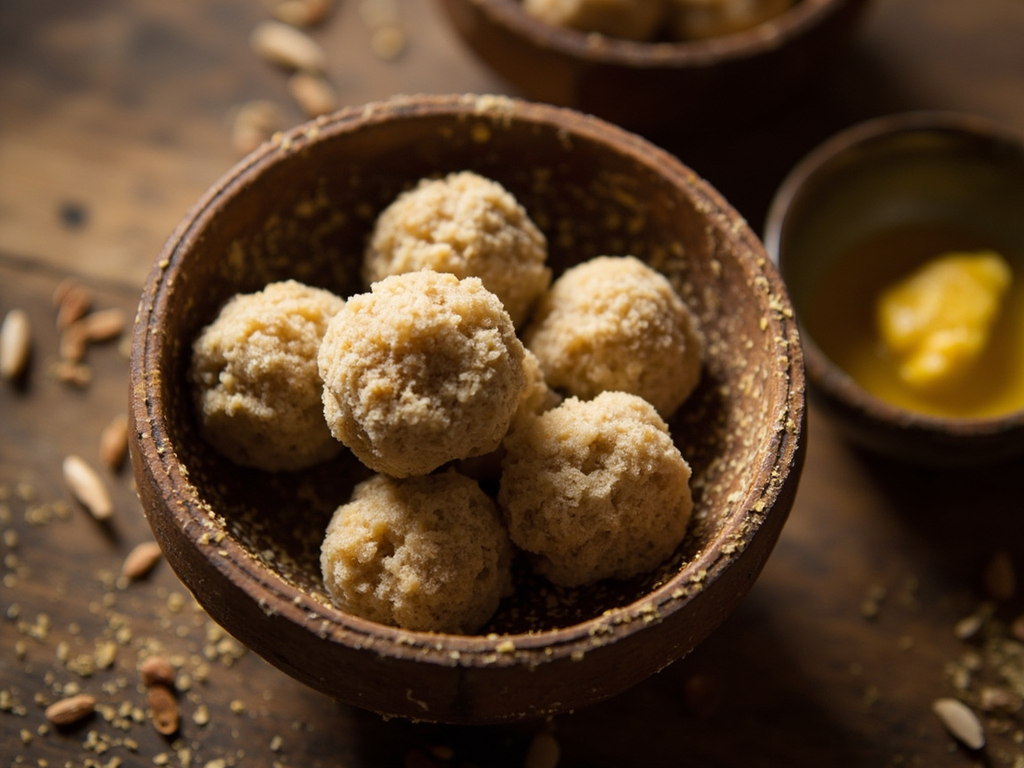
Roasted barley flour that is mixed directly in the bowl with butter tea to form, with the fingertips, a firm dough shaped into a dumpling. It is the staple food of all Tibet: nutritious, portable, ready in an instant.
Here is the whole secret of my endurance on the trails! I kept a mouthful of butter tea at the bottom of my bowl, threw in a handful of this roasted barley flour, and with my fingertips — it takes a bit of skill, I grant you — I kneaded a firm dumpling. No fire, no pot: tsampa is eaten anywhere, even crouched in a cave watching for caravans. I always had a small sack under my pilgrim's robe; it was my bread for months, and I never found it monotonous.
- •Ground roasted barley (tsampa) — two handfuls (basic starch)
- •Salted butter tea (po cha) — a little left in the bowl (fatty and salty binder)
- •Extra yak butter — to taste (enrichment)
- •Crumbled dry cheese (chhurpi) — optional (protein addition)
Tsampa, Roasted Barley Dumpling
Roasted barley flour that is mixed directly in the bowl with butter tea to form, with the fingertips, a firm dough shaped into a dumpling. It is the staple food of all Tibet: nutritious, portable, ready in an instant.
Why this dish? Tsampa was Alexandra's daily bread during her Himalayan years: easy to carry, it alone sufficed, kneaded in the butter tea dregs of her bowl, to fuel a day's walk.
Here is the whole secret of my endurance on the trails! I kept a mouthful of butter tea at the bottom of my bowl, threw in a handful of this roasted barley flour, and with my fingertips — it takes a bit of skill, I grant you — I kneaded a firm dumpling. No fire, no pot: tsampa is eaten anywhere, even crouched in a cave watching for caravans. I always had a small sack under my pilgrim's robe; it was my bread for months, and I never found it monotonous.
Ingredients (period version)
- Ground roasted barley (tsampa) — two handfuls (basic starch)
- Salted butter tea (po cha) — a little left in the bowl (fatty and salty binder)
- Extra yak butter — to taste (enrichment)
- Crumbled dry cheese (chhurpi) — optional (protein addition)
Ingredients
- Roasted barley flour (tsampa, or hulled barley toasted then ground) — 100 g (base)
- Salted butter tea (recipe r1) — 100 to 150 ml (binder)
- Butter — 1 tsp (creaminess)
- Salt — 1 pinch (seasoning)
Method
- If you don't have ready-made tsampa: dry-roast hulled barley in a pan until golden brown and nutty-smelling, then grind finely.
- Pour the hot butter tea into a bowl, add the butter and a pinch of salt.
- Sprinkle the barley flour in a steady stream, little by little, turning with your fingertips against the side of the bowl.
- When the dough pulls away, knead it into a firm dumpling and eat it by hand, in small bites.
How it was made : Every Tibetan carried their own tsampa and personal wooden bowl. Barley, the only cereal that ripens above 3,500 m altitude, was roasted and then ground in water mills by streams. The dumpling was kneaded directly in the bowl, without any utensil.
The contemporary twist : As a "hiker's bowl": tsampa, a splash of hot tea, and a few shards of dry ewe's cheese — the world's oldest high-altitude snack, revisited at the mountain hut.
Sources : Alexandra David-Néel, Voyage d'une Parisienne à Lhassa, Plon, 1927 · Rinjing Dorje, Food in Tibetan Life, Prospect Books, 1985
Alexandra David-Néel · Charactorium