 flip
flipChampenois Potée with Cabbage and Bacon
Champenois Potée with Cabbage and Bacon
Why this dish? Son of a modest family from Nogent-sur-Seine — his father was a gamekeeper turned farmer — Boucher grew up on this Champenois peasant cuisine, where a single pot simmered for a long time and made the whole meal. This one-pot dish, economical and nourishing, was exactly the "ordinary" fare of his rural youth in the Aube.
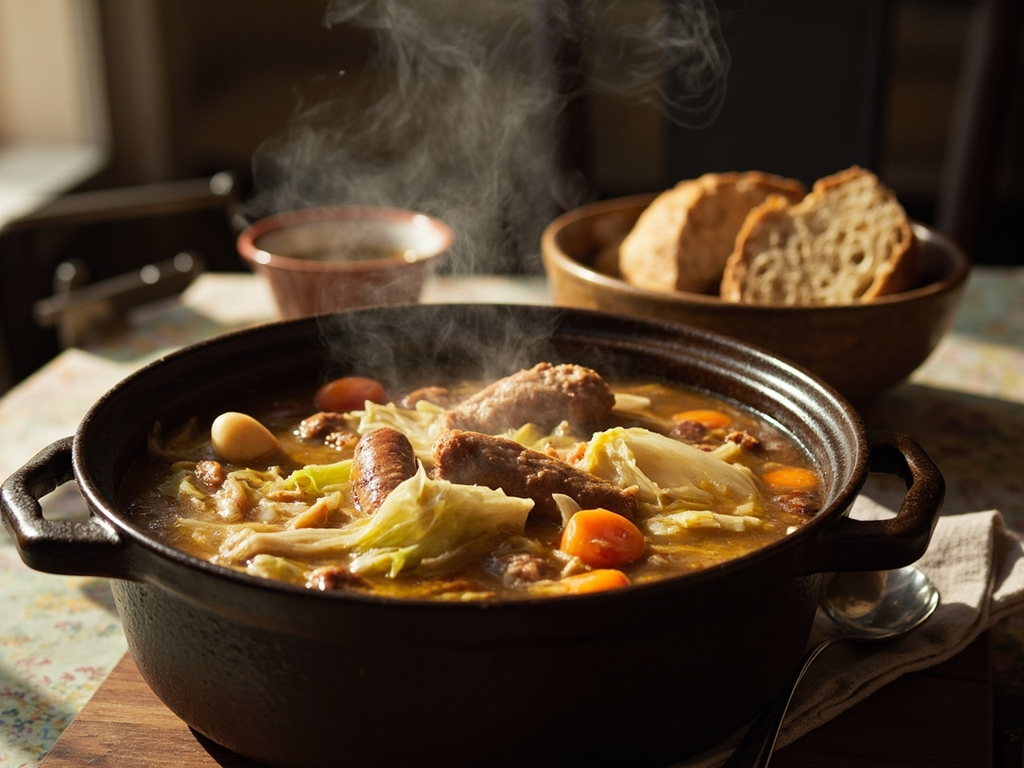
A large pot where cabbage, root vegetables, bacon, and country sausage simmer together. The broth is eaten first with bread, then the meat and vegetables: one fire, one pot, a whole table fed.
Draw near your bowl, don't be shy! At home in Nogent, my mother would put the pot on the corner of the stove in the morning, and it would sing softly until noon. The secret, you see, is never to rush the cabbage — you must let it melt into the bacon, slowly, like roughing out a block before seeking the form within. We'd dip our bread into the boiling broth, and believe me, after a morning in the open air, there was no finer feast.
- •Curly green cabbage — 1 nice head (base vegetable)
- •Smoked bacon and salt pork — a good piece (fat and salt)
- •Country sausage to cook — 1 (meat)
- •Turnips, carrots, leeks — from the garden (root vegetables)
- •Potatoes — a handful (starch)
- •Onion, clove, thyme — as needed (aromatics)
Champenois Potée with Cabbage and Bacon
A large pot where cabbage, root vegetables, bacon, and country sausage simmer together. The broth is eaten first with bread, then the meat and vegetables: one fire, one pot, a whole table fed.
Why this dish? Son of a modest family from Nogent-sur-Seine — his father was a gamekeeper turned farmer — Boucher grew up on this Champenois peasant cuisine, where a single pot simmered for a long time and made the whole meal. This one-pot dish, economical and nourishing, was exactly the "ordinary" fare of his rural youth in the Aube.
Draw near your bowl, don't be shy! At home in Nogent, my mother would put the pot on the corner of the stove in the morning, and it would sing softly until noon. The secret, you see, is never to rush the cabbage — you must let it melt into the bacon, slowly, like roughing out a block before seeking the form within. We'd dip our bread into the boiling broth, and believe me, after a morning in the open air, there was no finer feast.
Ingredients (period version)
- Curly green cabbage — 1 nice head (base vegetable)
- Smoked bacon and salt pork — a good piece (fat and salt)
- Country sausage to cook — 1 (meat)
- Turnips, carrots, leeks — from the garden (root vegetables)
- Potatoes — a handful (starch)
- Onion, clove, thyme — as needed (aromatics)
Ingredients
- Curly green cabbage — 1 (approx. 1 kg) (base vegetable)
- Half-salt bacon — 400 g (fat and salt)
- Half-salt pork shoulder — 500 g (meat)
- Sausage to cook — 1 (300 g) (meat)
- Carrots — 4 (vegetable)
- Turnips — 3 (vegetable)
- Leeks — 2 (vegetable)
- Potatoes — 6 (starch)
- Onion studded with 2 cloves, thyme, bay leaf — 1 bouquet (aromatics)
Method
- The day before, desalt the bacon and shoulder in cold water; blanch the cabbage for 5 min in boiling water then drain.
- Put the salted meats in a large pot of cold water, bring to a simmer and skim carefully.
- Add the clove-studded onion, thyme, bay leaf; cover and simmer for 1 hour.
- Add carrots, turnips, leeks and cabbage; continue for 45 min.
- Add the sausage and potatoes, cook another 30 min until tender.
- Serve the broth first over slices of stale bread, then the sliced meats surrounded by the vegetables.
How it was made : In the Champenois countryside of the 19th century, the potée was both a Sunday and everyday dish: it cooked in the cast-iron pot hanging from the chimney hook or on the wood stove. Pork was salted at home in autumn to last the winter, hence the ubiquity of salt pork and bacon.
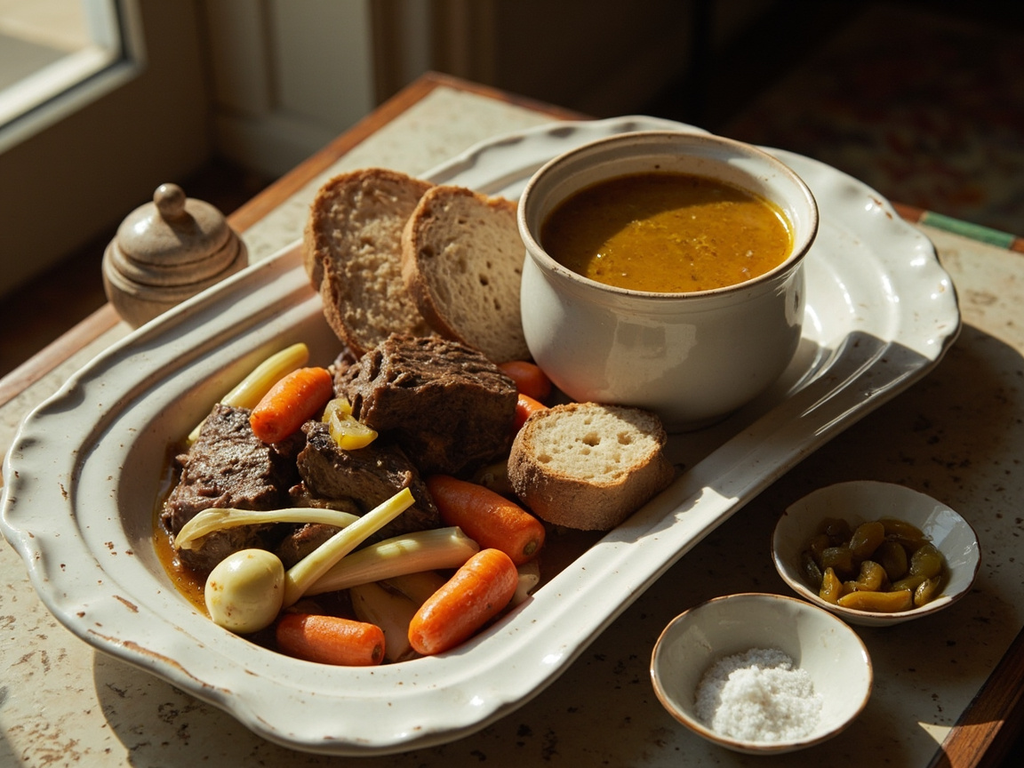
The contemporary twist : Serve the broth separately in a cup, sprinkled with chives, like a "studio consommé" — a nod to the sculptors of La Ruche who warmed themselves with a bowl between sessions.
Alfred Boucher · Charactorium