 flip
flipBoiled Beef Pot-au-Feu of the Lawyer
Boiled Beef Pot-au-Feu of the Lawyer
Why this dish? Pot-au-feu was the quintessential Sunday and weekly dish of the Parisian bourgeoisie of the 19th century, the class from which Ledru-Rollin came as a lawyer before entering politics. It was the meal you had when returning from hearings or sessions, a dish that simmered while you worked on cases.
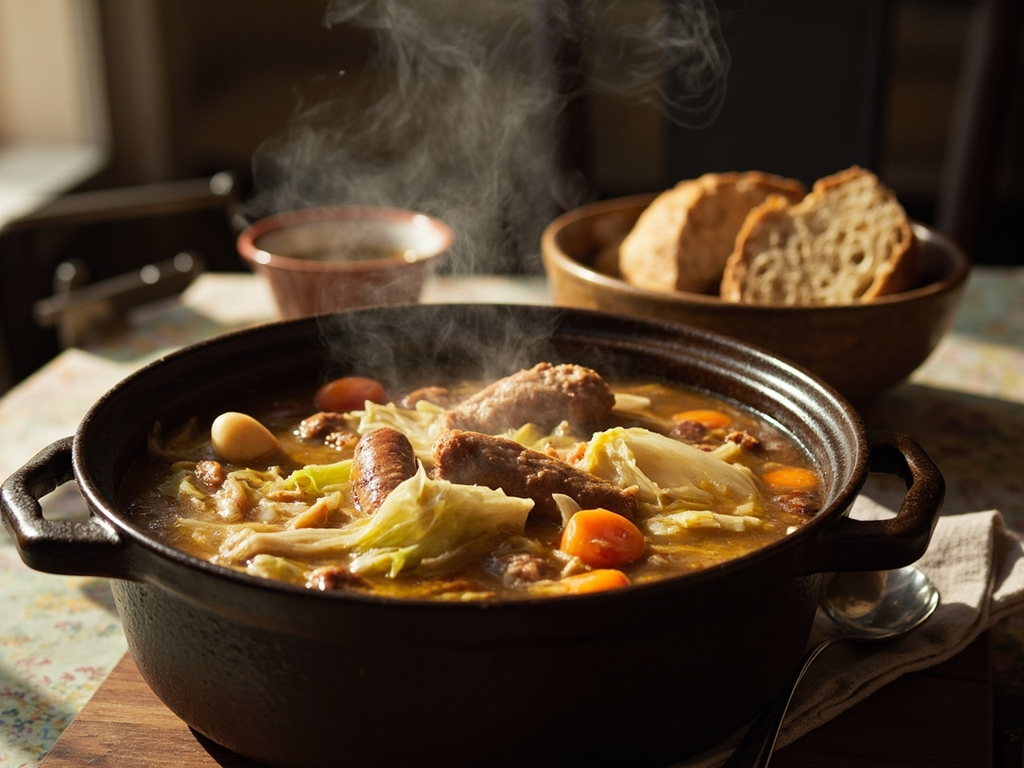
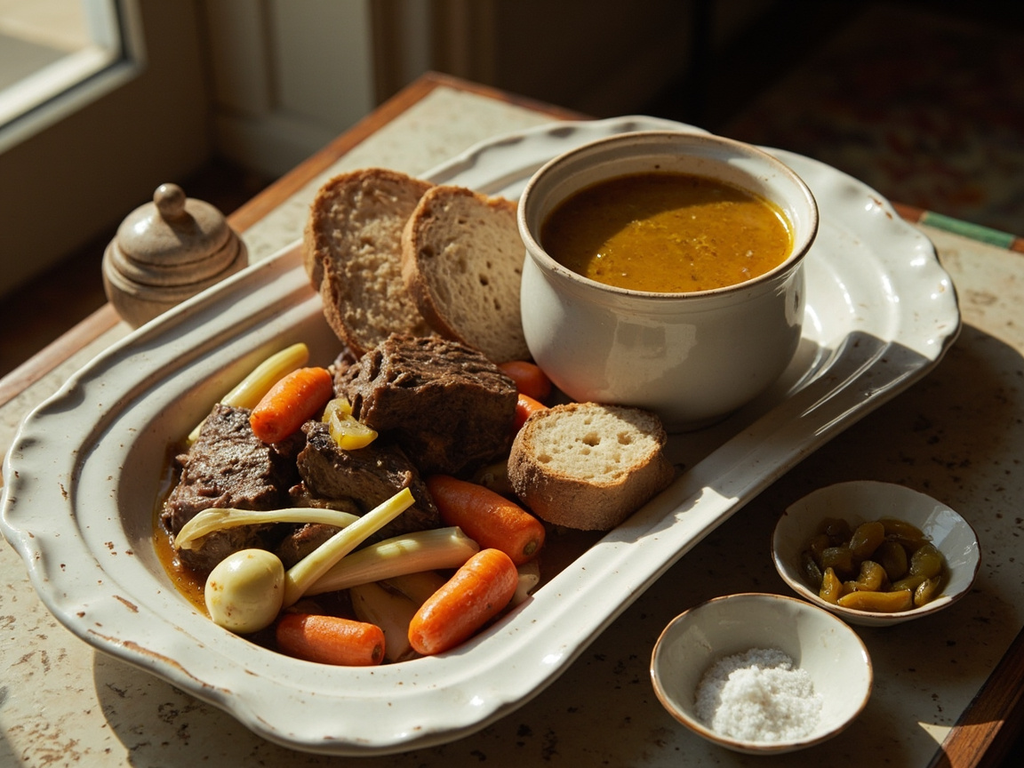
A piece of beef long-poached with root vegetables: the broth is drunk first over slices of bread, then the meat is eaten with the vegetables, coarse salt, and gherkins. Economical, nourishing, it is the pillar of the family table.
You see, citizen, when I came back from the assizes, exhausted from pleading, it was this pot-au-feu that awaited me on the corner of the stove. You start by inhaling the broth, piping hot, poured over a crust of stale bread—that sets a man right again. The meat, we want it tender, dipped in coarse salt and gherkin. It is the dish of the people as much as of the bourgeois, and that is why I love it: it makes no distinction between men.
- •Beef shin or chuck — a nice piece (meat for poaching)
- •Marrow bones — a few (richness of the broth)
- •Leeks, turnips, carrots — according to season (broth vegetables)
- •Onion studded with cloves — one (aromatic)
- •Coarse salt, stale bread — to taste (seasoning and support)
Boiled Beef Pot-au-Feu of the Lawyer
A piece of beef long-poached with root vegetables: the broth is drunk first over slices of bread, then the meat is eaten with the vegetables, coarse salt, and gherkins. Economical, nourishing, it is the pillar of the family table.
Why this dish? Pot-au-feu was the quintessential Sunday and weekly dish of the Parisian bourgeoisie of the 19th century, the class from which Ledru-Rollin came as a lawyer before entering politics. It was the meal you had when returning from hearings or sessions, a dish that simmered while you worked on cases.
You see, citizen, when I came back from the assizes, exhausted from pleading, it was this pot-au-feu that awaited me on the corner of the stove. You start by inhaling the broth, piping hot, poured over a crust of stale bread—that sets a man right again. The meat, we want it tender, dipped in coarse salt and gherkin. It is the dish of the people as much as of the bourgeois, and that is why I love it: it makes no distinction between men.
Ingredients (period version)
- Beef shin or chuck — a nice piece (meat for poaching)
- Marrow bones — a few (richness of the broth)
- Leeks, turnips, carrots — according to season (broth vegetables)
- Onion studded with cloves — one (aromatic)
- Coarse salt, stale bread — to taste (seasoning and support)
Ingredients
- Beef chuck or shin — 1.2 kg (meat for poaching)
- Marrow bones — 2 sections (richness of the broth)
- Carrots — 4 (vegetable)
- Leeks — 3 (vegetable)
- Turnips — 3 (vegetable)
- Onion studded with 2 cloves — 1 (aromatic)
- Bouquet garni (thyme, bay leaf, parsley) — 1 (aromatic)
- Coarse salt, whole peppercorns — to taste (seasoning)
- Stale country bread — a few slices (support for broth)
Method
- Place the meat in a large pot of cold water, slowly bring to a simmer, and carefully skim off the gray foam.
- Add the studded onion, bouquet garni, and peppercorns. Season with coarse salt.
- Poach at a very gentle simmer for 2.5 to 3 hours, with the lid slightly ajar.
- Add the carrots, turnips, and tied leeks one hour before the end; add the marrow bones 20 minutes before.
- Serve first the strained broth over slices of stale bread, then the sliced meat and vegetables, with coarse salt and gherkins.
How it was made : In the 19th century, pot-au-feu simmered on the *potager* (charcoal stove) all morning. It was stretched over several days: the broth served as a base for soups, the cold meat was eaten the next day in a salad. It was the symbol of the economical and regular table of Parisian families.
The contemporary twist : Serve the broth separately in cups as a welcome consommé, then arrange the shredded meat on a board with glazed vegetables and three sauces: mustard, coarse salt, and gribiche sauce.
Sources : Jean-Baptiste Reboul et la tradition du pot-au-feu bourgeois ; Alexandre Dumas, Grand Dictionnaire de cuisine (1873)
Alexandre Auguste Ledru-Rollin · Charactorium