 flip
flipMillet Tô with Dried Okra Sauce
Millet Tô with Dried Okra Sauce
Why this dish? Tô, a millet or sorghum paste, is the staple food of Sahel farmers and the Niger bend—exactly the world of Ali Farka Touré, who defined himself first as a farmer. Dried okra and dried fish made it possible to get through the off-season when the river gave less: this is the cuisine of foresight.
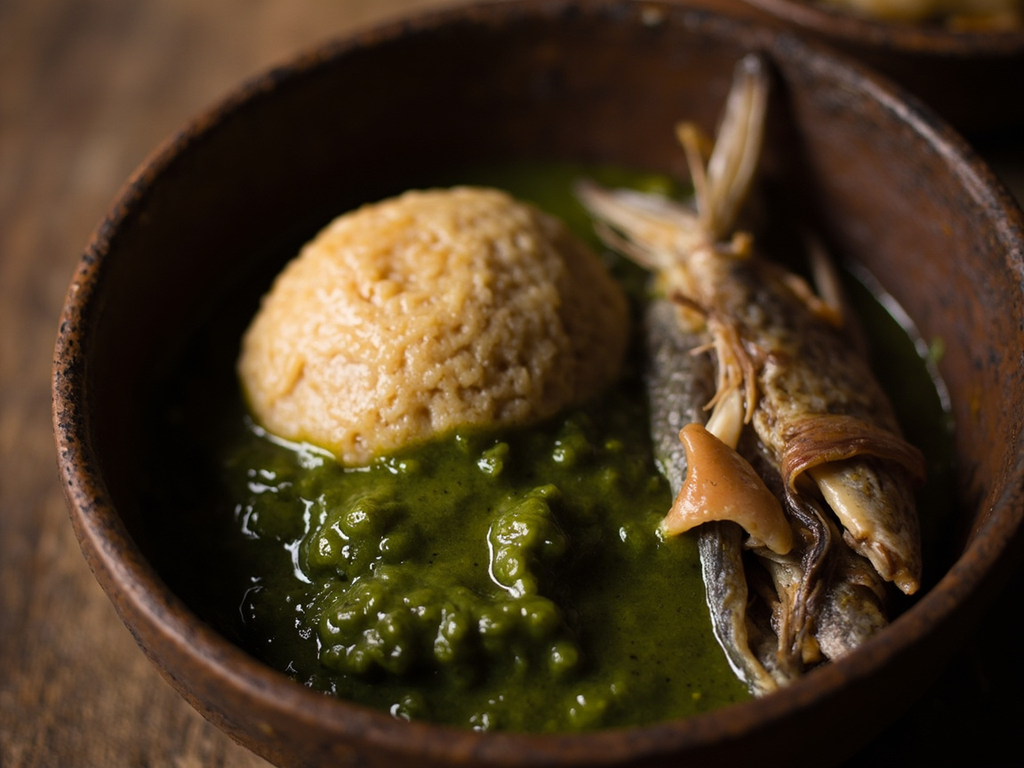
A soft, neutral millet paste, dipped by mouthfuls into a green, stringy dried okra sauce flavored with fish. The staple food of the Sahel farmer, thrifty and nourishing.
Millet is the patience of the farmer: you sow it, you wait for the rain, you thank heaven when it comes. This tô, my mother stirred it with a stick in the big pot until her arm grew warm—a smooth paste without lumps, that is an art. The okra, we cut and dry it in the sun for lean days, and the sauce strings between the fingers just right. We throw nothing away here, and a man who knows how to keep his harvest does not know hunger.
- •Millet or sorghum flour — two large ladles (base)
- •Dried and pounded okra — a handful (sauce binder)
- •Dried fish from the Niger — a few pieces (umami)
- •Potash (kanwa) or ash — a pinch (sauce texture)
- •Onion, salt, chili — to taste (seasoning)
Millet Tô with Dried Okra Sauce
A soft, neutral millet paste, dipped by mouthfuls into a green, stringy dried okra sauce flavored with fish. The staple food of the Sahel farmer, thrifty and nourishing.
Why this dish? Tô, a millet or sorghum paste, is the staple food of Sahel farmers and the Niger bend—exactly the world of Ali Farka Touré, who defined himself first as a farmer. Dried okra and dried fish made it possible to get through the off-season when the river gave less: this is the cuisine of foresight.
Millet is the patience of the farmer: you sow it, you wait for the rain, you thank heaven when it comes. This tô, my mother stirred it with a stick in the big pot until her arm grew warm—a smooth paste without lumps, that is an art. The okra, we cut and dry it in the sun for lean days, and the sauce strings between the fingers just right. We throw nothing away here, and a man who knows how to keep his harvest does not know hunger.
Ingredients (period version)
- Millet or sorghum flour — two large ladles (base)
- Dried and pounded okra — a handful (sauce binder)
- Dried fish from the Niger — a few pieces (umami)
- Potash (kanwa) or ash — a pinch (sauce texture)
- Onion, salt, chili — to taste (seasoning)
Ingredients
- Millet flour (or fine cornmeal as substitute) — 300 g (base)
- Dried okra powder (or fresh okra) — 60 g (binder)
- Smoked/dried fish, crumbled — 1 handful (umami)
- Onion — 1 (base)
- Baking soda (potash substitute) — 1 pinch (stringy texture)
- Oil, salt, chili, cube — to taste (seasoning)
Method
- Prepare the sauce: sauté the onion, add water, the smoked fish, okra powder, and a pinch of baking soda; let thicken into a stringy sauce.
- For the tô: bring water to a simmer, dilute part of the flour into a thin porridge.
- Gradually add the remaining flour, stirring vigorously with a stick or spatula to avoid lumps.
- Cook over low heat, working the paste until it is smooth and pulls away from the pot.
- Mold the tô into a dome in a bowl, unmold onto a platter, and serve with the okra sauce on the side.
How it was made : Tô was stirred by wrist strength in a large pot over a wood fire. Okra and leaves were sun-dried for the lean season; a pinch of vegetable potash (kanwa) gave the sauce its characteristic smooth, stringy texture.
The contemporary twist : Tô molded into a neat quenelle with a cutter, okra sauce arranged as a shiny green mirror—peasant cuisine in an elegant version.
Ali Farka Touré · Charactorium