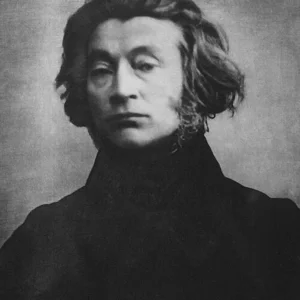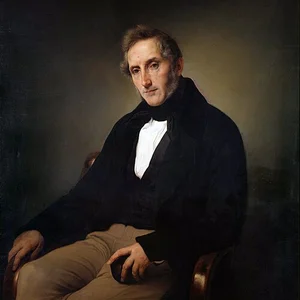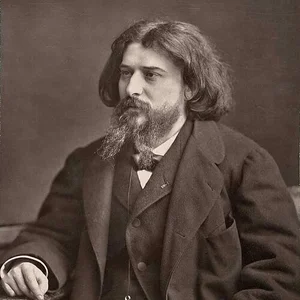

French writer (1840-1897), author of novels and short stories that paint with humor and warmth the life of Provence and Paris. He is best known for his *Letters from My Mill* and his unforgettable characters such as Tartarin of Tarascon.
Alphonse Daudet(1840 — 1897)
Alphonse Daudet
France
9 min read
Frequently asked questions
Famous Quotes
« No one pays attention to happy people.»
« Truth is on the march, and nothing will stop it.»
Key Facts
- 1840: born in Nîmes into a modest family
- 1866: publication of *Letters from My Mill*, a collection of Provençal short stories
- 1872: publication of *The Prodigious Adventures of Tartarin of Tarascon*
- 1884: publication of *Sapho*, a naturalist novel
- 1897: death in Paris, leaving a rich body of work including novels, short stories, and plays
Works & Achievements
A collection of Provençal short stories first published in *Le Figaro*. These foundational texts establish Daudet's signature tone: gentle humor, nostalgia for the South of France, and keen observation of ordinary people.
An autobiographical novel recounting young Daudet's years of hardship and resourcefulness in Lyon and then Paris. One of the first major realist coming-of-age novels in French literature.
A comic masterpiece immortalizing a boastful, cowardly southerner who sets off to hunt lions in Algeria. Tartarin has become a literary myth — a warm, humorous symbol of the South of France.
A collection of short stories inspired by the Franco-Prussian War of 1870, including the celebrated *The Last Lesson*. These texts blend patriotism, emotion, and realistic observation of the upheavals brought on by France's defeat.
A novel set in the world of business and the Parisian bourgeoisie, awarded a prize by the Académie française. It marks Daudet's turn toward the realist novel as a broad social panorama.
A satirical portrait of a southern French politician under the Third Republic — by turns charming and irresponsible. One of Daudet's most politically engaged novels.
A novel about a destructive love affair between a young man from the provinces and a woman from the Parisian demimonde. One of Daudet's most psychologically probing works, which would go on to influence Maupassant.
Anecdotes
Alphonse Daudet never actually lived in the famous mill of Fontvieille that inspired his *Letters from My Mill*. This abandoned windmill in the Alpilles, discovered during visits to Provence with friends, served him as a symbolic backdrop. Most of his Provençal stories were in fact written in Paris, far from the cicadas and sunshine he described with such nostalgia.
In the final years of his life
Daudet was struck down by progressive locomotor ataxia
which gradually paralysed him. Despite excruciating pain
he continued to write and kept a personal diary of his suffering
composed partly in Provençal
entitled *La Doulou* (
the pain
). This deeply moving text
published after his death
stands as an exceptional account of illness experienced from the inside
as told by a writer.
When *Tartarin de Tarascon* was published in 1872, the residents of the real town of Tarascon protested vigorously against this mocking portrait of a southern braggart. Some boycotted Daudet's books, offended at being so caricatured. Yet a century later, the town proudly lays claim to this literary connection and has erected a statue of Tartarin in its main square.
Daudet was a regular at the famous dinners that brought together Gustave Flaubert, Émile Zola, Ivan Turgenev, and Edmond de Goncourt each month during the 1870s. At these legendary evenings, the greatest writers of the age read their manuscripts aloud and debated literature — gatherings that helped shape the French naturalist movement. Flaubert affectionately called them the "dinners of the booed authors.
The short story *The Last Class*, published in 1873, recounts the final French lesson in an Alsatian school following the region's annexation by Germany. The text became one of the most widely read in French schools for decades and was translated throughout the world. It stands as one of the most emblematic works of French patriotism under the Third Republic — even though Daudet had not been present in Alsace during the war.
Primary Sources
My children, this is the last time I shall teach you. The order has come from Berlin to teach only German in the schools of Alsace and Lorraine... The new master arrives tomorrow.
All night long, the little white goat fought with the wolf. From time to time she looked up at the stars dancing in the clear sky, and said to herself: “If only I can hold out until dawn…” One by one, the stars went out.
Every Sunday morning he would set off hunting with his full kit: his gun, his cartridges, his game bag… but he never killed anything, because there was nothing to kill on the plain of Tarascon.
When my father had squandered his fortune, he turned his mind to settling his sons in life. The elder was sent to a wealthy uncle. As for me, the younger, Daniel Eyssette, I was packed off to the lycée in Lyon as a study monitor.
Pain moves in, makes itself at home, becomes a permanent and implacable companion. You learn to live with it — or rather, it teaches you how to die with it.
Key Places
Birthplace of Alphonse Daudet, born in 1840. He spent his childhood here before his family's financial ruin forced them to leave. The landscapes of the Gard and the Southern accent would nourish his entire southern imagination.
This abandoned windmill in the Alpilles, which Daudet visited during stays with the Marquis de Barbentane, became the symbolic setting of his *Letters from My Mill*, even though he never truly lived there.
Daudet settled permanently in Paris, where he built his literary career and moved in prominent literary circles. His Parisian apartment became a salon where the leading figures of Naturalism would gather.
Daudet's country house in the Sénart forest, where he liked to retreat to write away from the bustle of Paris. He spent many summers there and welcomed Zola, Goncourt, and other writer friends.
The town that inspired the character of Tartarin, the famous Southern hunter — boastful and cowardly. Despite the initial protests of its residents, Tarascon is today proud of this literary connection.
Liens externes & ressources
Références
Œuvres
Lettres de mon moulin
1866-1869 (volume : 1869)
Le Petit Chose
1868
Tartarin de Tarascon
1872
Contes du lundi
1873
Fromont et Risler
1874
Numa Roumestan
1881