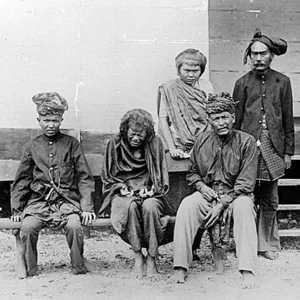

An Indonesian national heroine, Cut Nyak Dhien led armed resistance against Dutch occupation in the Aceh region (Sumatra) following the death of her husband. A symbol of Indonesian nationalism, she fought until her capture in 1905 despite serious illness.
Cut Nyak Dhien(1848 — 1908)
Tjoet Nja Dinh
Royaume des Pays-Bas, Sultanat d'Aceh
8 min read
Frequently asked questions
Key Facts
- Born around 1848 in Aceh (Sumatra, present-day Indonesia), into a local noble family
- After the death of her first husband during the Aceh War (1873–1874), she married resistance leader Teuku Umar
- Following Teuku Umar's death in 1899, she personally assumed command of the guerrilla campaign against the Dutch
- Captured by Dutch forces in 1905 despite severely deteriorating health (rheumatism, partial blindness)
- Died in exile in Sumedang (Java) in 1908; proclaimed an Indonesian national heroine in 1964 by President Sukarno
Works & Achievements
After the death of Teuku Umar, Cut Nyak Dhien took direct command of the Acehnese fighter bands in the interior forests. Despite her illness, she coordinated armed resistance for six years, significantly exhausting Dutch forces.
An Indonesian feature film dedicated to her life, selected to represent Indonesia at the Academy Awards. The film played a major role in passing her memory on to contemporary generations and in her international recognition.
Sukarno, Indonesia's first president, officially proclaimed her a Pahlawan Nasional (National Heroine) by decree. This official recognition permanently enshrined her name in Indonesian national history.
Her portrait appeared on the 10,000 Indonesian rupiah banknote, reflecting her status as a national icon. Her presence on the national currency speaks to the symbolic importance of her struggle for Indonesian identity.
Her tomb in Sumedang has become a national place of remembrance maintained by the Indonesian state, regularly visited by official delegations and pilgrims. A commemorative museum in the same city is dedicated to her.
Anecdotes
In spite of severe joint disease (rheumatism) and progressive blindness caused by an eye infection, Cut Nyak Dhien stubbornly refused to leave the jungles of Aceh. She continued to command her fighters from her makeshift shelter, guided only by her memory of the terrain and her still-steady voice.
When her second husband Teuku Umar was killed in a Dutch ambush in 1899, she ordered the camp's weapons and supplies destroyed rather than let them fall into enemy hands. She immediately reorganized the resistance, refusing any show of mourning that might weaken her fighters' morale.
In 1905, it was one of her own lieutenants, Pang Laot Ali, who revealed her hiding place to the Dutch. Unable to bear his commander's suffering any longer, he had acted against her wishes so she could receive medical care. Cut Nyak Dhien, furious at this betrayal, solemnly cursed him before being taken away.
At the time of her arrest, Dutch soldiers were struck by her absolute dignity: ill, nearly blind, and emaciated, she nonetheless refused to kneel and declared she would die on her feet. General van Daalen himself acknowledged her exceptional courage in his official reports.
Exiled to Sumedang (West Java), she quietly continued to teach the Quran to local residents and to maintain Acehnese religious practices. The Dutch never knew that until her death in 1908, she was spreading the spirit of resistance among the Javanese population.
Primary Sources
Resistance in the interior remains organized around a handful of unyielding leaders. The wife of Teuku Umar, despite her deteriorating physical condition, still holds considerable moral influence over the populations of the Pidie region.
The woman known as Tjoet Nja' Dhien, widow of the late Teuku Umar, was apprehended on November 6, 1905, in the vicinity of Beutong. She is suffering from advanced blindness and severe infirmities. Her state of health requires immediate transfer out of Aceh.
The Acehnese resistance cannot be understood without accounting for the role of women from the warrior aristocracy. They maintained the social and religious cohesion of fighting bands long after the male leaders had fallen.
She prayed five times a day without exception and taught Quranic verses to the children of the kampung. She never spoke of her defeat, only of the duty to defend her land and her faith.
Key Places
Birthplace of Cut Nyak Dhien, located in the Aceh Besar region in northern Sumatra. It was here that she grew up in an Acehnese aristocratic family and received a careful religious and cultural education.
Capital of the Aceh Sultanate, captured by the Dutch in 1874. Cut Nyak Dhien lived there before the occupation and was driven out during the fighting, marking the beginning of her life as a resistance fighter.
A mountainous, forested region where Cut Nyak Dhien took refuge with her fighters during long years of guerrilla warfare. It was in these dense forests that she was finally captured in 1905.
A coastal town in Aceh where Teuku Umar, Cut Nyak Dhien's second husband, was killed in an ambush by the Dutch in February 1899. This site marks the turning point after which she led the resistance alone.
A city in Java where Cut Nyak Dhien was exiled following her capture in 1905. She spent her final years there under Dutch surveillance and died on November 6, 1908; her tomb is today a national place of pilgrimage.
Typical Objects

A traditional Acehnese ceremonial and combat dagger with a slightly curved blade. Cut Nyak Dhien wore one at her belt as a symbol of her rank and her resolve never to surrender.

Silk fabric interwoven with gold or silver threads, worn as a sarong by women of the Acehnese aristocracy. Even while fleeing through the jungle, Cut Nyak Dhien kept this garment as a sign of dignity and cultural identity.

A finely crafted gold headdress traditionally worn by high-ranking Acehnese women during ceremonies. It symbolized Cut Nyak Dhien's status as the wife of a chief and a woman of the warrior nobility.

A carefully preserved copy of the Quran that Cut Nyak Dhien carried with her through the forest. Her Islamic faith was the foundation of her resistance, and she would recite suras to keep up the courage of her companions.

Plants gathered from the Acehnese jungle used as remedies for rheumatism and infections. Her companions prepared these handmade treatments for her — the only medicine available during years of guerrilla warfare.

A firearm seized from the enemy or obtained through resistance networks, used by Acehnese fighters under Cut Nyak Dhien's command. The shortage of ammunition forced the resistance to salvage any equipment they could from fallen Dutch soldiers.
School Curriculum
Vocabulary & Tags
Key Vocabulary
Tags
Daily Life
Morning
Cut Nyak Dhien began her day with the Fajr dawn prayer, recited in a low voice in the darkness of the forest camp. She then listened to her sentinels' reports on Dutch movements during the night, and organized the day's tasks despite her painful joints.
Afternoon
Afternoons were devoted to strategic movements from one camp to another to avoid detection. Despite her worsening blindness, she took part in command meetings, guided by her precise memory of the local geography, and dictated her instructions to her lieutenants.
Evening
At sunset, she led the communal Maghrib prayer, which gathered her fighters together and strengthened their cohesion. She then received news from outside brought by messengers and made her tactical decisions for the night, before reciting the final prayers in complete darkness.
Food
Food in the forest was sparse and subject to the hardships of guerrilla warfare: boiled rice when supplies allowed, supplemented with wild vegetables, foraged tropical fruits, and occasionally fish or game. During lean times, fighters had to make do with tubers and edible plants from the Acehnese forest.
Clothing
Cut Nyak Dhien wore the kain (sarong) and the traditional Acehnese baju kurung, adapted to the harsh jungle conditions. She always took particular care with her appearance as a mark of dignity, even though the silk fabrics befitting her rank had given way to simpler, more durable cloth.
Housing
Shelters were quickly built from bamboo and palm leaves, camouflaged within the dense vegetation. Regularly relocated to avoid Dutch patrols, these makeshift camps contained only the bare essentials: a prayer space oriented toward Mecca, a few mats, and survival provisions.
Historical Timeline
Period Vocabulary
Visual Style
Style pictural historique alliant réalisme colonial néerlandais et esthétique textile acehnaise, dans une palette de verts profonds, d'ors et de terres rouges évoquant la jungle de Sumatra.
Sound Ambience
Ambiance de jungle tropicale dense et humide d'Aceh, mêlant sons de la forêt équatoriale, prières murmurées et tension sourde de la clandestinité guerrière.
Liens externes & ressources
Références
Œuvres
Organisation de la résistance guérilla en Aceh (1899–1905)
1899–1905
Décret présidentiel de proclamation Héroïne nationale
1964
Billet de banque indonésien de 10 000 roupies
1998
Musée et mausolée de Sumedang
XXe siècle