
Coya Pacsa was an Inca queen (coya), wife of the Inca Huayna Cápac, who ruled the Tawantinsuyu at the end of the 15th and beginning of the 16th century. A figure of the highest Inca nobility, she embodies the power and political role of the great royal wives in Inca civilization on the eve of the Spanish conquest. Information about her comes primarily from Quechua oral tradition and Spanish colonial chronicles.
Coya Pacsa
Coya Pacsa
10 min read
Frequently asked questions
Key Facts
- Coya Pacsa was one of the principal wives (coya) of Huayna Cápac, the eleventh Sapa Inca, who reigned around 1493–1527 — information drawn from colonial chronicles and Quechua oral tradition.
- In Inca society, the coya held an essential ritual and political role: she oversaw the cult of the Moon (Mama Quilla), the feminine counterpart to the Inca's solar cult.
- The Inca Empire (Tawantinsuyu) reached its peak under Huayna Cápac, stretching from present-day Colombia to Chile — Coya Pacsa lived at the court of Cusco, the imperial capital.
- Upon the death of Huayna Cápac (around 1527), a civil war between his sons Huáscar and Atahualpa weakened the empire, paving the way for Francisco Pizarro's Spanish conquest (1532).
- Sources on Coya Pacsa are indirect: they come from 16th-century Spanish chroniclers (Cieza de León, Guaman Poma de Ayala) and the oral memory of Quechua peoples.
Works & Achievements
As principal coya, Coya Pacsa oversaw the Acllawasi institution, managing the hundreds of acllacuna who produced sacred textiles and ritual chicha. This role gave her genuine economic power at the very heart of Inca imperial administration.
The coya co-presided with the Sapa Inca over the major festivals of the religious calendar: Inti Raymi (Festival of the Sun), Capac Raymi, and Mama Quilla (Festival of the Moon). Her presence at these rituals legitimized the cosmic order and ensured the symbolic unity of the empire.
The coya wove and maintained a network of political alliances through marriages and affiliations among Cusco's noble families. This female network was a discreet but essential instrument of governance for stabilizing relations between the empire's great panacas (royal lineages).
Upon the death of her imperial husband, the coya played a central role in organizing the funerary rites and preserving the royal mummy. The embalmed mummy continued to symbolically "reign" from its palace, and the coya oversaw its cult.
Anecdotes
Coya Pacsa held the title of 'Coya,' meaning literally 'queen' or 'star' in Quechua. This title was reserved for the principal wife of the Sapa Inca and granted her a near-divine status: she was regarded as the earthly embodiment of Mama Quilla, the Moon goddess, while her husband represented Inti, the Sun god.
As the great royal wife of Huayna Cápac, Coya Pacsa oversaw the Acllawasi, the 'house of the chosen women.' These acllacuna, selected from childhood across the empire for their beauty and talents, wove sacred textiles and prepared the ritual chicha. Through this role, the coya wielded considerable economic and religious power.
Colonial chronicles record that the great coyas took part in the ceremonies of Capac Raymi and Inti Raymi, seated on golden litters before the assembled nobility. Coya Pacsa, like her predecessors, was carried by specially designated bearers — her feet were never to touch the ground during official processions.
At the death of Huayna Cápac around 1527, likely struck down by a smallpox epidemic introduced by the Spanish even before their direct arrival, the coya and the leading women of the Inca elite played a central role in the funeral rites. The embalmed body of the ruler had to be surrounded by his wives and servants so that he could continue to 'reign' symbolically from his huaca.
The Quechua oral tradition passed down to Spanish chroniclers emphasizes that the coyas themselves chose some of their ladies-in-waiting from the finest noble families of Cusco. This network of female alliances formed a quiet but real counterbalance to power within the court of Tawantinsuyu.
Primary Sources
And the Coya, lady and queen, was held in great veneration by all the lords of Cusco, and her words were obeyed as those of the Inca himself, because she was the image of the Moon on earth.
The principal coyas and ñustas of the Inca held great power and authority over the acllas and over the goods of the Sun and the Moon. They were respected and feared throughout the Tawantinsuyu.
The Coya, the Inca's legitimate wife, was called Mamá, meaning mother, and was revered as the universal mother of all subjects of the Empire of the Sun.
The quipucamayocs recounted that in the time of Huayna Cápac, the principal coya was responsible for the chosen women and the sacred textiles destined for the temples of the Sun throughout the kingdom.
The wives of the Inca, especially the legitimate Coya, were buried with great honors and accompanied by their servants so that they would continue to serve their mistress in the afterlife, as prescribed by the religion of the Incas.
Key Places
Sacred city regarded as the "navel of the world" (qusqu in Quechua), seat of Inca imperial power. The royal court resided here, the coya lived here, and the empire's great religious and political ceremonies took place within its walls.
The principal temple of the Inca Empire, dedicated to Inti (the Sun), but also housing a sanctuary devoted to Mama Quilla (the Moon), the deity with whom the coya was symbolically associated. Its walls were covered in gold plates, and its gardens filled with lifelike replicas of plants and animals crafted from precious metal.
A palace-convent at the heart of Cusco, under the authority of the coya, where the acllacuna (chosen women) lived. They were tasked with weaving sacred textiles and preparing ritual offerings. The coya oversaw this strategically important institution, which held considerable economic and symbolic power.
A major Inca pilgrimage site, atop which stood a huaca (sacred place) linked to the mythical origins of the Inca people. Grand royal ceremonies were held here — including initiation rites for young nobles — in the presence of the imperial family.
A large Inca city built by Huayna Cápac in the northern reaches of the empire, where the ruler spent many years in residence. The coya and part of the royal court accompanied him during his stays, making Tomebamba a de facto second capital.
Typical Objects

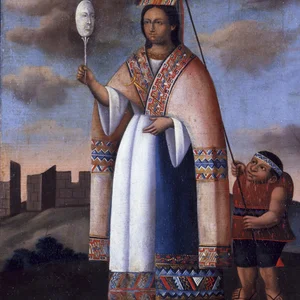
A finely woven rectangular cloth made of alpaca wool, fastened over the shoulders with a large gold or silver pin (tupu). The coya's lliclla was adorned with tocapu motifs — codified geometric symbols reserved for the nobility — and signaled her supreme rank within the imperial hierarchy.

A large ceremonial pin made of gold or tumbaga used to fasten the lliclla across the chest. The tupus worn by the great coyas were set with precious stones such as turquoise or spondylus shell, symbols of wealth and divine power associated with Mama Quilla.

A cylindrical cup made of precious wood or gold, used to drink chicha during religious and political ceremonies. The coya used qeros of precious metal when making libations offered to Mama Quilla, her tutelary deity.

A record-keeping and memory instrument made up of knotted cords of different colors and lengths. The coya had access to quipus recording the state of the empire's reserves, the population of the Acllawasi, and the textile resources under her supervision.

A fermented drink made from purple maize, prepared by the acllacuna under the coya's supervision. Chicha was essential to rituals, Inca calendar festivals, and political ceremonies, where its offering symbolized the alliance between the human world and the deities.

A palanquin covered in gold panels and adorned with exotic bird feathers, on which the coya was carried during official processions. Her feet never touched the ground in public — a sign of her divine nature and her status as the earthly embodiment of the Moon.

An exceptionally fine textile woven from the softest vicuña wool, reserved exclusively for the royal family and offerings to the gods. The coya's garments were made entirely from cumbi by the most skilled acllacuna in the empire.
School Curriculum
Vocabulary & Tags
Key Vocabulary
Tags
Lieu
Daily Life
Morning
The coya rose before dawn for the first offerings to Mama Quilla. Her ladies-in-waiting helped her don her cumbi garments and fasten her golden tupus. She then presided over a morning ceremony in the palace's lunar sanctuary, where the acllacuna burned coca leaf offerings and poured sacred chicha.
Afternoon
The afternoon was devoted to overseeing the Acllawasi and to audiences with high-ranking noblewomen who came to seek her favor or report on matters within her domain. The coya also received updates from quipucamayocs on the state of the textile and food reserves under her management.
Evening
In the evening, the coya joined the Sapa Inca for ceremonial meals, seated facing him, with tableware of gold and silver. Court entertainments — songs, recitations of epic memory, and ritual dances — marked important evenings. Nights of the full moon called for nocturnal ceremonies dedicated specifically to Mama Quilla.
Food
The coya's diet was among the most refined in the empire: boiled and roasted corn, potatoes cooked in ash, quinoa soup, roasted llama and guinea pig, dried fish from the coast, and exotic fruits such as chirimoya and lucuma. Purple corn chicha, prepared by the acllacuna, accompanied every meal.
Clothing
The coya wore exclusively cumbi, the finest Inca cloth woven from the wool of wild vicuñas. Her dress (anacu) was white or crimson, held at the waist by a wide belt (chumpi). The lliclla, fastened with solid gold tupus, was decorated with tocapu patterns reserved for royalty. Her sandals (ushutas) were braided from golden fibers.
Housing
The coya resided in the royal apartments of Huayna Cápac's palace in Cusco, made up of rooms with perfectly fitted stone walls covered in places with gold plating. The rooms were arranged around interior courtyards with fountains, gardens, and private places of worship. Dozens of attendants slept in the antechambers to be at her service day and night.
Historical Timeline
Period Vocabulary
Visual Style
Style visuel de la cour impériale inca : géométrie sacrée des motifs tocapu, tonalités d'or, de cramoisi et de terracotta andine sur fond d'architecture de pierre cyclopéenne et de ciel montagnard intense.
Sound Ambience
Atmosphère sonore de la cour royale inca à Cusco : percussions rituelles, flûtes andines et chants cérémoniels des prêtresses se mêlent au murmure des fontaines de pierre et au tintement des ornements en or.
Liens externes & ressources
Références
Œuvres
Supervision de l'Acllawasi de Cusco
vers 1493–1527
Participation aux cérémonies du calendrier inca
vers 1493–1527
Gestion du réseau d'alliances nobiliaires féminines
vers 1493–1527
Rites funéraires de Huayna Cápac
vers 1527