 flip
flipCaballa en escabeche
Caballa en escabeche
Why this dish? Escabeche is the quintessential Spanish preserving technique: fish cooked then marinated in vinegar and oil, which keeps for days and improves with time. For a researcher with an unpredictable schedule, it's the dish of foresight: prepared on Sunday, it waits in the fridge until a seminar that runs late finally leaves time for dinner.
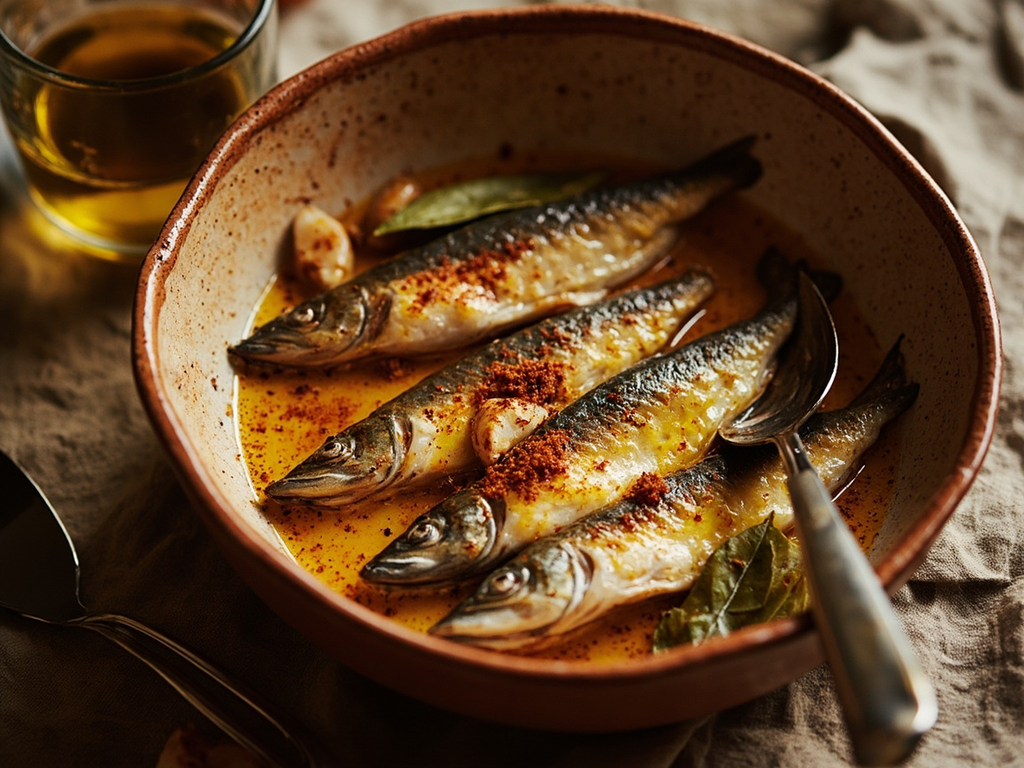
Mackerel fillets browned then bathed in a warm marinade of vinegar, olive oil, garlic, bay leaf, and *pimentón*. They are left to marinate at least overnight: they keep and gain in flavour.
My grandmother used to say that *escabeche* is the memory of the pantry before refrigerators — and I use it as an edible archive! I brown my *caballa* fillets, then drown them in warm vinegar with garlic, bay leaf, and a touch of *pimentón*, and I forget them in the fridge overnight. The next day, when a seminar runs over and I come home starving at ten in the evening, my dinner is waiting, better than the day before. Patience and vinegar: two virtues of a researcher.
- •Fresh mackerel (caballa) — a few, filleted (base)
- •Wine vinegar — a good splash (preservation and acidity)
- •Olive oil — generous amounts (marinade)
- •Garlic — a few cloves (aroma)
- •Bay leaves — 2 or 3 (aroma)
- •Pimentón de la Vera — a spoonful (colour and smokiness)
- •Black peppercorns — a few (spice)
- •Salt — to taste (seasoning)
Caballa en escabeche
Mackerel fillets browned then bathed in a warm marinade of vinegar, olive oil, garlic, bay leaf, and *pimentón*. They are left to marinate at least overnight: they keep and gain in flavour.
Why this dish? Escabeche is the quintessential Spanish preserving technique: fish cooked then marinated in vinegar and oil, which keeps for days and improves with time. For a researcher with an unpredictable schedule, it's the dish of foresight: prepared on Sunday, it waits in the fridge until a seminar that runs late finally leaves time for dinner.
My grandmother used to say that *escabeche* is the memory of the pantry before refrigerators — and I use it as an edible archive! I brown my *caballa* fillets, then drown them in warm vinegar with garlic, bay leaf, and a touch of *pimentón*, and I forget them in the fridge overnight. The next day, when a seminar runs over and I come home starving at ten in the evening, my dinner is waiting, better than the day before. Patience and vinegar: two virtues of a researcher.
Ingredients (period version)
- Fresh mackerel (caballa) — a few, filleted (base)
- Wine vinegar — a good splash (preservation and acidity)
- Olive oil — generous amounts (marinade)
- Garlic — a few cloves (aroma)
- Bay leaves — 2 or 3 (aroma)
- Pimentón de la Vera — a spoonful (colour and smokiness)
- Black peppercorns — a few (spice)
- Salt — to taste (seasoning)
Ingredients
- Mackerel fillets — 4 (approx. 500 g) (base)
- White wine vinegar — 100 ml (preservation and acidity)
- Extra virgin olive oil — 150 ml (marinade)
- Garlic — 4 cloves (aroma)
- Bay leaves — 2 (aroma)
- Pimentón de la Vera — 1 tsp (colour and smokiness)
- Black peppercorns — 8 (spice)
- Salt — 1 tsp (seasoning)
Method
- Lightly salt the mackerel fillets; optionally dust with flour. Sear them for 1 minute per side in a little olive oil. Set aside in a shallow dish.
- In the same oil, fry the crushed garlic cloves with the bay leaves and peppercorns until golden.
- Off the heat, add the *pimentón* (which burns quickly), then the vinegar and remaining oil; warm the mixture for a minute.
- Pour this warm marinade over the fillets, making sure they are covered.
- Let cool, cover, and refrigerate for at least 12 hours. Keeps for 3 to 4 days and is best served cool, with bread.
How it was made : *Escabeche*, of Arabo-Persian origin (from the word *sikbāj*), spread throughout the Iberian Peninsula in the Middle Ages. Before refrigeration, vinegar and oil allowed fish and game to be preserved for several days — a vital technique in a country with long distances and scorching summers.
The contemporary twist : Serve cold on a slice of toasted bread as a welcome pincho at a post-conference aperitif.
Sources : Simone Ortega, 1080 recetas de cocina, Alianza Editorial · Claudia Roden, The Food of Spain, Penguin
Ana García · Charactorium